.svg)


.svg)
.svg)
.svg)
.svg)
.webp?width=1220&height=1090&name=Osano-guarantee-seal%20(1).webp)

Imagine you order an entree at a restaurant. What do you expect from your dining experience?
You expect your meal to be delivered promptly, for it to be filling and hopefully tasty as well. You expect to be able to finish it by yourself in a sitting, or perhaps two if you take half of it away in a box. You expect it to cost what it says on the menu (plus tip, depending on the country you’re dining in).
You wouldn’t expect it to be delivered hours later in piecemeal components you need to assemble yourself into a single meal, or for it to actually be a party platter intended for a dozen-plus diners. And when the waiter brings the bill, you’d be shocked if the price was five, ten, or twenty times larger than what you were originally told it would cost.
In that circumstance, you’d be well within your rights to leave that restaurant and dine elsewhere. This standard of service isn’t acceptable in dining–why do we tolerate it in software?
OneTrust: Problematic for Mid-Market and SMB Buyers
Discover why a legal team left their legacy privacy vendor in our case study.
OneTrust maintains a substantial footprint in the data privacy market. For large enterprises with well-resourced legal and/or compliance departments managing the spectrum of governance, risk, and compliance (GRC), this platform is a good fit. They’re that party of a dozen-plus diners looking to build a custom meal that perfectly fits their appetite.
But those organizations represent a small portion of OneTrust users. Many have found they require faster deployment, easier workflows, and a data privacy-specific feature set. That’s prompted many mid-market and small businesses–and even some enterprises–to look for OneTrust alternatives in 2026. They’re hungry for the discrete entree that most diners expect when ordering at a restaurant.
Compounding the challenges that OneTrust presents for these organizations, the company is also undergoing significant changes. Earlier this year, they brought in a new CEO to focus on artificial intelligence concerns and high-end enterprise governance tools. Meanwhile, with 23 data privacy laws in the US (as of this writing), the complexity of managing data privacy compliance is increasing, and OneTrust seems more interested in expanding to all GRC use cases rather than focus on data privacy specifically.
For mid-market companies evaluating their long-term contracts, the new leadership and broad GRC focus adds a layer of uncertainty as to the future of OneTrust’s data privacy capabilities. These challenges can be handled by the twenty-person teams OneTrust was designed for, but teams of one to five professionals find them to be a source of daily friction.
What Makes OneTrust Too Expensive for Most Organizations
We don't want surprises in the pricing models. So, we're looking for other alternatives that could meet same needs, but at the same time can maintain some kind of projected budget.
–Enterprise Manufacturer
One of the most-frequently cited reasons why businesses leave OneTrust in favor of alternatives is its cost.
Typically, this friction isn’t due to the initial software license fee itself. A lack of price clarity and budgeting consistency makes OneTrust contracts costlier than originally anticipated.
In 2026, this budget friction has grown increasingly intense. OneTrust's decision to sunset its standalone CookiePro product and transition legacy accounts onto its primary platform has removed a popular, simple entryway, pushing mid-market companies straight into full-scale enterprise software renewals.
A fair share of users migrating away from OneTrust speak to Osano as part of their evaluation for alternative data privacy solutions. Across hundreds of such evaluations, we consistently hear the same OneTrust pricing complaint: huge swings in pricing when contracts are due for renewal.
Often, these increases run between 15% and 50%, but there are uncommon (but not rare) reports of 10- to 30-fold increases. During their evaluation of Osano, a small software firm with fewer than 500 employees disclosed they saw their pricing scaled from $1,000 a year to $16,500 upon renewal, with no change in services provided. Customers frequently report being drawn into contracts at low initial entry points, only to encounter steep cost climbs with short notice periods once their workflows are fully tied to the vendor’s infrastructure. OneTrust’s bet is that once they’ve gone through implementation, customers will feel that migrating is too difficult. Fortunately, that isn’t necessarily true.
Faced with these budgeting hurdles, businesses looking for a reliable OneTrust competitor are considering platforms with a reputation for more consistent, predictable pricing practices with any changes communicated clearly and in advance.
The Cost of Complexity
I barely understand how it works. I have a law degree, not a technology degree. Ultimately, I'm responsible for managing it. And so that's where I think the challenge for me is.
–Mid-Market Furniture-as-a-Service Provider
For a large corporation, an extensively configurable software solution is highly useful. When that extensive configurability requires extensive maintenance, they can throw headcount, consultants, and dollars at the problem. For mid-market firms and smaller organizations, however, endless configurability becomes an operational burden.
These organizations rarely have multiple people whose sole job is to manage a single piece of software. Under these circumstances, a highly configurable tool can work against the people trying to manage it. The fact that a tool can do everything becomes the very obstacle that stops it from doing anything.
The cost of complexity shows up across everyday workflows:
- Simple Adjustments Become Projects: Routine updates that should be quick, like updating consent banner functionality, can turn into time-consuming work that demands specialized training. Lean teams find themselves clicking through deep menus or opening help tickets for basic tweaks.
- Slow Deployment Timelines: Former OneTrust customers report that getting the platform configured and fully operational routinely stretches into an eight-month ordeal. Internal engineering groups find themselves buried in intricate website code and tracking script rules to ensure items load in the correct sequence, or else risk a broken site or non-compliant, broken tracking opt-outs. This extra implementation work wastes internal engineering and IT hours that could be devoted elsewhere.
- The Hidden Cost of Outside Consultants: Because OneTrust implementations are so intricate, many companies find they cannot manage it alone. Businesses often have to pay external consultants to deploy the platform and keep it running smoothly, creating an ongoing, unbudgeted expense.
- The Need for Large Privacy Teams: Multiple former OneTrust customers who spoke to Osano team members during their evaluations estimated they’d need a team of 20-40 compliance professionals to manage OneTrust effectively.
- Friction with Growth and Marketing Teams: In a fast-moving business, privacy operations cannot live in a vacuum. When data management tools are overly intricate, a minor misstep in a setup option can break core website layouts, block critical user analytics, or lower digital conversion rates. Any changes requested by the marketing team can take far longer to review, encouraging them to make website changes without consulting compliance teams.
When a platform offers too many settings that you didn’t know existed and never needed to use, the risk of human error rises. For a small- to medium-sized team, a successful compliance program requires straightforward tools that deliver reliable outcomes and are focused on essential privacy tasks, rather than an intricate system that demands constant manual oversight.
Support for Big Spenders Only
We've heard from other people that OneTrust is just becoming this loaded company and they just don't care. They just don't care about their clients, which is evident in the way we've been treated.
–Mid-Market Financial Firm
When a software provider serves the world’s largest enterprises, its support model naturally prioritizes those high-paying accounts. While global companies with premium tiers receive dedicated attention, mid-market buyers navigate a different customer service reality. Smaller shops run into several structural support hurdles.
- No Continuity for Tickets: A common complaint among non-enterprise accounts is having to work with a new person on every single ticket. Instead of working with an advisor who understands their service history, privacy managers start from scratch with each technical issue, which wastes time. This broken communication creates an exhausting loop where organizations spend days waiting in an enterprise support queue to resolve basic issues, paralyzing their workflows in the meantime.
- High Costs for Personal Service: Dedicated customer success managers at OneTrust are typically reserved for larger accounts spending over $50,000 a year. For businesses operating below that baseline, the vendor often bills directly for individual support hours, turning basic technical troubleshooting into an expensive addition to the annual contract.
- Relationship Gaps: Multiple former customers report sales reorganizations introduce friction into their relationship with OneTrust. Often, these reorganizations result in long periods of silence and account neglect, and when points of contact are re-established, the focus of their conversations center on upsells rather than service.
This difference is easy to see in user reviews. Independent ratings on sites like G2 show that smaller buyers consistently give OneTrust alternatives higher scores for support quality and responsiveness. When a privacy department has only a few people (or when no one person truly owns privacy compliance), having a responsive, reliable partner is the best way to keep the program moving forward.
Three Trends Data Privacy Software Buyers Are Moving Toward
Three distinct trends are shaping how mid-market companies choose privacy software. Buyers want:
- Transparent, predictable pricing
- Faster time-to-value
- Compliance support (not just tooling)
With 23 comprehensive state laws enacted or active across the US as of 2026, the scale, complexity, and urgency around data privacy compliance has never been higher. Lean teams cannot afford to spend most of a fiscal year stuck in a software implementation whose cost keeps climbing while their compliance posture remains unacceptably risky.
The market wants software that delivers solid outcomes out of the box, not an empty toolkit. When a vendor platform is too complex, they drop the responsibility for correct configuration entirely on the customer.
Recent California Consumer Privacy Act (CCPA) enforcement actions against household brands like Honda and Ford show how easily this heavy setup burden can backfire. Both companies deployed OneTrust with a non-compliant configuration that required consumers to complete identity or email verification before submitting basic marketing opt-out requests. Under California law, adding that extra friction to an opt-out workflow is a direct compliance violation. The California Privacy Protection Agency fined Honda $632,500 and Ford $375,703 for their respective violations.

This setup challenge points to a much larger, ongoing risk: the burden of long-term software maintenance. In a rapidly evolving legislative landscape, states constantly pass amendments, introduce new administrative regulations, and tighten statutory definitions long after the original law goes into effect. With an intricate, multi-layered framework, every update to an opt-out rule requires an organization to manually re-engineer its back-end settings, reword user-facing disclosures, and test the deployment again.
Regulatory changes are one thing; simple website changes are another. Even if the laws were stable, websites are constantly evolving, and privacy compliance software needs to be adjusted to account for new trackers and functionality. Whether it’s accounting for a changing legal standard or website setup, smaller teams don’t have time to act as part-time software engineers.
Who Should Stay on OneTrust
Despite these clear mid-market shifts, staying on OneTrust is the right decision for some organizations. The platform continues to be a reasonable fit for large enterprises with more than 5,000 employees and dedicated internal privacy departments of ten or more people. These massive organizations have the scale, budget, and administrative hours required to maintain an extensive platform.
Companies should remain on the platform if they have this level of resourcing and their data protection scope goes beyond basic data privacy. If your organization needs unified software to manage governance, risk, and compliance (GRC); environmental, social, and governance (ESG); and broader IT security policies within a single interface, then a multifaceted system is the right choice.
If your department has already invested heavily in months of custom implementation, deep back-end code integrations, and extensive staff training, you may be inclined to avoid the operational costs of migration. In some cases, this may be true, but be sure to account for the sunk-cost fallacy and the cost of on-going maintenance in your consideration as well.
When to Evaluate Alternatives
For most teams, the decision to look for an alternative provider builds up over time through an accumulation of friction points rather than a single breaking moment. If your business has a small compliance function, a program focused on data privacy rather than broader business risk, and the need to self-manage its operations without hiring a fleet of outside consultants, it is time to consider other options.
This realization is why more than 40% of Osano customers migrated from legacy providers.
Osano’s automated consent management, subject rights management, data mapping, privacy assessments, and AI-powered privacy workflows ensures teams can achieve real compliance outcomes in days rather than quarters. We also offer a $500k “No Fines, No Penalties” Guarantee; if you receive a fine as a result of your use of Osano and have configured the platform according to our documented best practices, we’ll pay up to $500k.
The financial protection is nice, but the real value of this guarantee is that it puts us on the same side of the table as you. We want our customers to become actually compliant—because we have skin in the game. Selling you tools and wishing you good luck isn’t a strategy the Osano team is interested in.
If you are tired of budgeting surprises and operational headaches, it might be time to compare your options:
- Take a look at our OneTrust vs. alternatives comparison page to see how OneTrust compares to other privacy vendors, including Osano.
- Learn about the migration process to see how easily your team can make the switch.
- Book a live demo with our compliance team today.
Frequently Asked Questions
Is Osano a full replacement for OneTrust?
For data privacy requirements, yes. Osano completely replaces the core privacy features you use, including consent management, data mapping, vendor risk assessments, and consumer rights processing. However, because Osano focuses entirely on streamlined privacy management, it intentionally omits non-privacy enterprise features such as supply chain auditing, corporate risk governance, and ESG tracking.
How much cheaper is Osano?
The exact savings depend on your existing contract, and while Osano is typically less expensive than OneTrust, evaluating the total cost of ownership means looking beyond the software license. Osano eliminates the hidden fees that drive up costs, such as separate payments for basic support hours or the ongoing need for expensive outside configuration consultants. Osano protects your long-term budget by providing stable pricing and ample notice before any adjustments.
What does migration look like?
Migrating from a legacy vendor to Osano typically takes from two to four weeks. Because Osano deploys using a single line of JavaScript, the technical change is exceptionally clean. Osano also provides dedicated migration support to help transition your historical configurations smoothly.
What does the “No Fines, No Penalties” Guarantee cover?
The guarantee provides up to $500,000 toward regulatory penalties if your business receives a fine resulting from your use of Osano. To qualify for coverage, your organization must implement and run the software according to Osano’s documented compliance best practices.
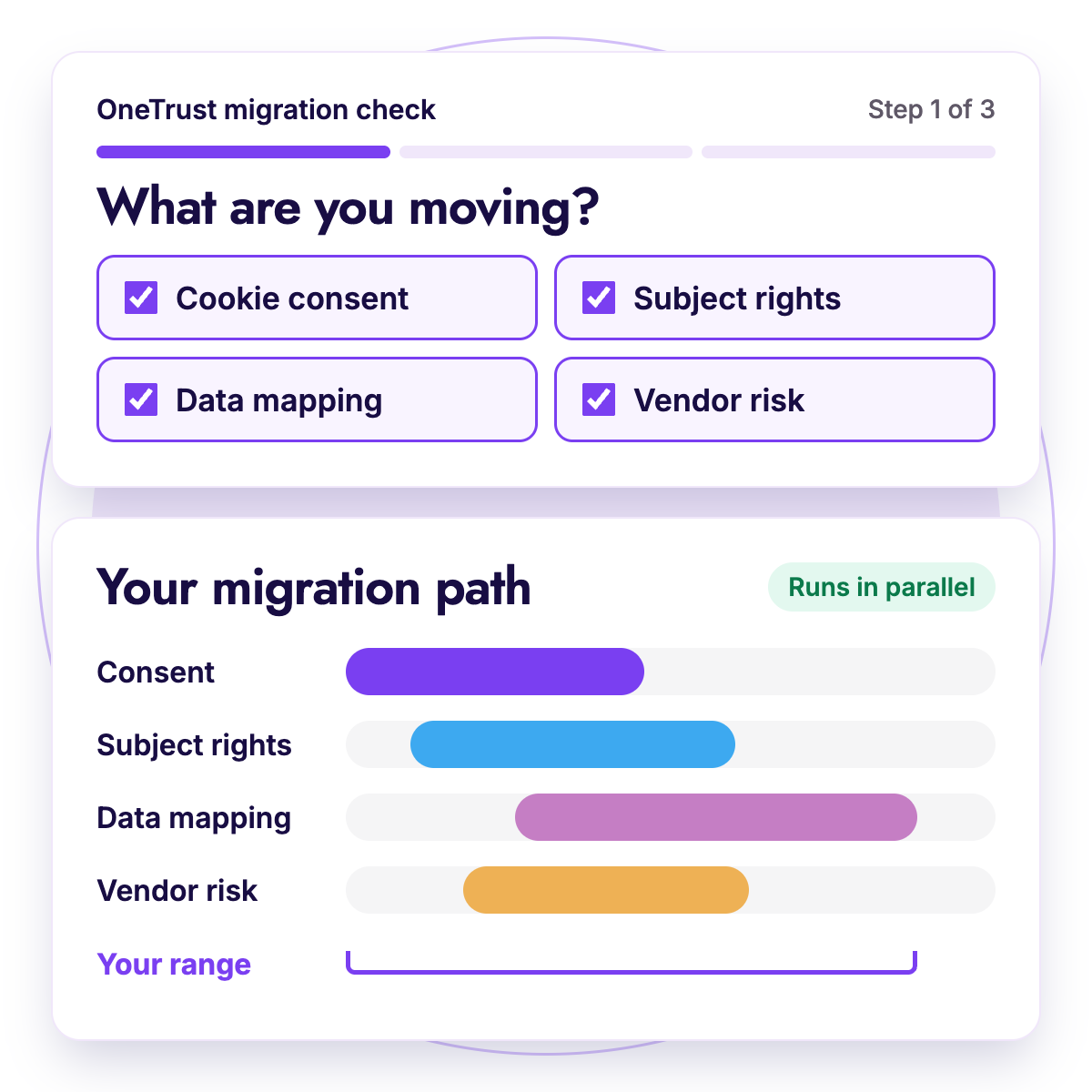
Calculate Your OneTrust → Osano Migration Timeline
Contemplating a switch from OneTrust to Osano, but concerned about migration challenges? Forty percent of Osano customers came to us from OneTrust; see what typical migration timelines look like based on which capabilities you'd like to transition.
Calculate your migration timeline