.svg)


.svg)
.svg)
.svg)
.svg)
.webp?width=1220&height=1090&name=Osano-guarantee-seal%20(1).webp)
Hello all, and happy Thursday!
Do you provide video content on your website? You may be about to get some good (or not so good) news. The Supreme Court is officially weighing in on when the Video Privacy Protection Act’s (VPPA’s) applies.
The VPPA prevents “video tape service providers” from disclosing personally identifiable information about consumers without their consent. In recent years, this decades-old law has been applied to websites (classifying them as “video tape service providers”) that provide video content and track viewers of said content, particularly through the use of the Meta Pixel.
But! The law only protects its definition of a “consumer,” which it defines as “any renter, purchaser, or subscriber of goods or services from a video tape service provider.” The question at the core of the Supreme Court’s case: Does the VPPA kick in even when the consumer subscribes to non-video content, like a newsletter?
It may seem like the issue at hand is fairly narrow, but it could have a major impact on many websites. If any kind of subscription makes a website visitor a “consumer” under the VPPA, then websites with video content and tracking pixels will be exposed to litigation risk unless they ask for explicit, opt-in consent to share viewing behavior first.
Gotta love legalese.
Best,
Arlo
New From Osano
Blog: Q&A From Our 2026 Privacy Laws Webinar
Whether you were in attendance at our recent webinar, Untangling 2026 Privacy, and didn’t get a chance to hear your question’s answer, or you weren’t able to make it, here’s your chance to learn more. We collected the questions asked by our audience and answered them here in this blog. Learn what there is to know about wiretap lawsuits, assessment workflows, enforcement priorities, and more.
Events
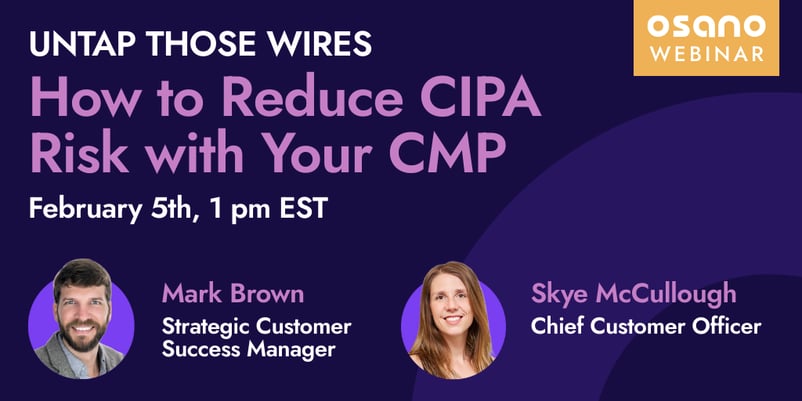
Webinar: Untap Those Wires: How to Reduce CIPA Risk with Your CMP
The Cold War may be over, but wiretap laws are alive, well, and–if you’re a member of the plaintiff’s bar–very lucrative. Thousands of lawsuits have been filed under decades-old wiretap laws in recent years, with the California Invasion of Privacy Act (CIPA) chief among them. How can you protect your business against opportunistic CIPA lawsuits? Join Osano’s Chief Customer Officer Skye McCullough and Strategic Customer Success Manager Mark Brown on February 5th to discover the answer.
Save your seat | February 5th, 1 pm EST
Top Privacy Stories of the Week
US Supreme Court to Decide When VPPA May Apply to Internet Users
The Supreme Court has agreed to hear a case that asks whether the 1988 Video Privacy Protection Act (VPPA) applies to users who sign up for newsletters from websites that use tracking technology. The statute prohibits “video tape service providers” from disclosing “personally identifiable information” about “consumers” who rent, purchase, or subscribe to their services. In recent years, this law has been applied to companies whose websites track consumers’ viewing habits through technologies such as the Meta Pixel.
Adult Website Provider to Pull Services from UK to Avoid Age Verification
Aylo, the parent company to some of the most popular adult sites like Pornhub, announced that it will restrict access to its platforms in the United Kingdom, effective February 2nd. Aylo has chosen to block access to UK users over its Online Safe Act (OSA), which mandated—among other provisions—that websites with pornographic content verify the ages of visitors before showing them content that is inappropriate for minors.
Brazil, EU Finalize Adequacy Agreement
The European Commission is adding Brazil to its list of adequacy partners after finalizing a decision on the 27th of January. The decision recognizes Brazil's data protection framework, the General Data Protection Law, as having equivalent or adequate protections compared to the EU General Data Protection Regulation, allowing data to flow freely between jurisdictions.
French MPs Vote in Favor of Bill to Ban Social Media for Under-15s
France's National Assembly has backed a bill that would ban social media access for under-15s, a proposal supported by President Emmanuel Macron. Lawmakers in the lower house voted 116-23 in its favor. Next, the bill will go to the upper house, the Senate, for approval. If it passed, young teenagers would not be able to use networks such as Snapchat, Instagram, and TikTok, and France will need to agree on a mechanism for age verification.
Trump Administration Lawsuit Seeking California Voter Data Is Dismissed
California scored a key victory against the Trump administration over access to the names and personal information of the state’s 23 million voters, persuading a federal judge to dismiss a Justice Department lawsuit filed last year demanding the data. The ruling appears to thwart the federal government’s efforts to challenge voters’ eligibility by collecting sensitive information, such as driver’s license numbers and partial Social Security numbers.
Like what you see in the Privacy Insider newsletter?
There's more to explore:
🎙️The Privacy Insider Podcast
We go deeper into additional privacy topics with incredible guests monthly. Available on Spotify or Apple.
📱 The Osano Subreddit
Join our official subreddit to stay up to date on the latest news, analysis, guidance, and content from Osano!
📖 The Privacy Insider: How to Embrace Data Privacy and Join the Next Wave of Trusted Brands
The book inspired by this newsletter: Osano CEO, Arlo Gilbert, covers the history of data privacy and how companies can start building a privacy program from the ground up. More details here.
If you’re interested in working at Osano, check out our Careers page!