


.svg)


.svg)
.svg)
.svg)
.svg)
.webp?width=1220&height=1090&name=Osano-guarantee-seal%20(1).webp)
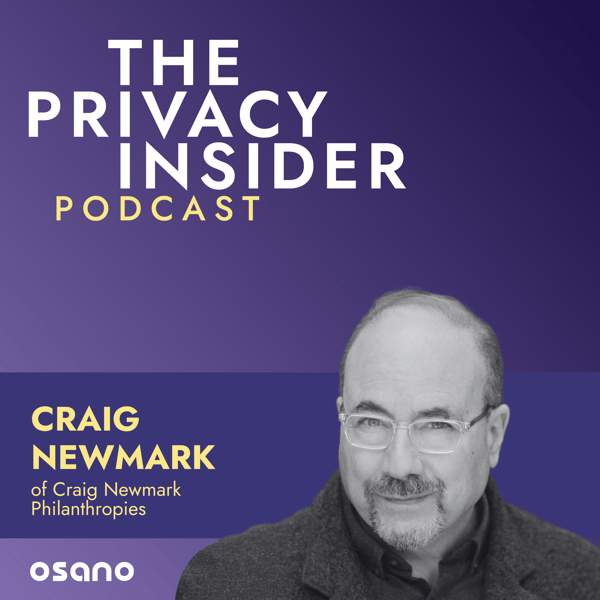
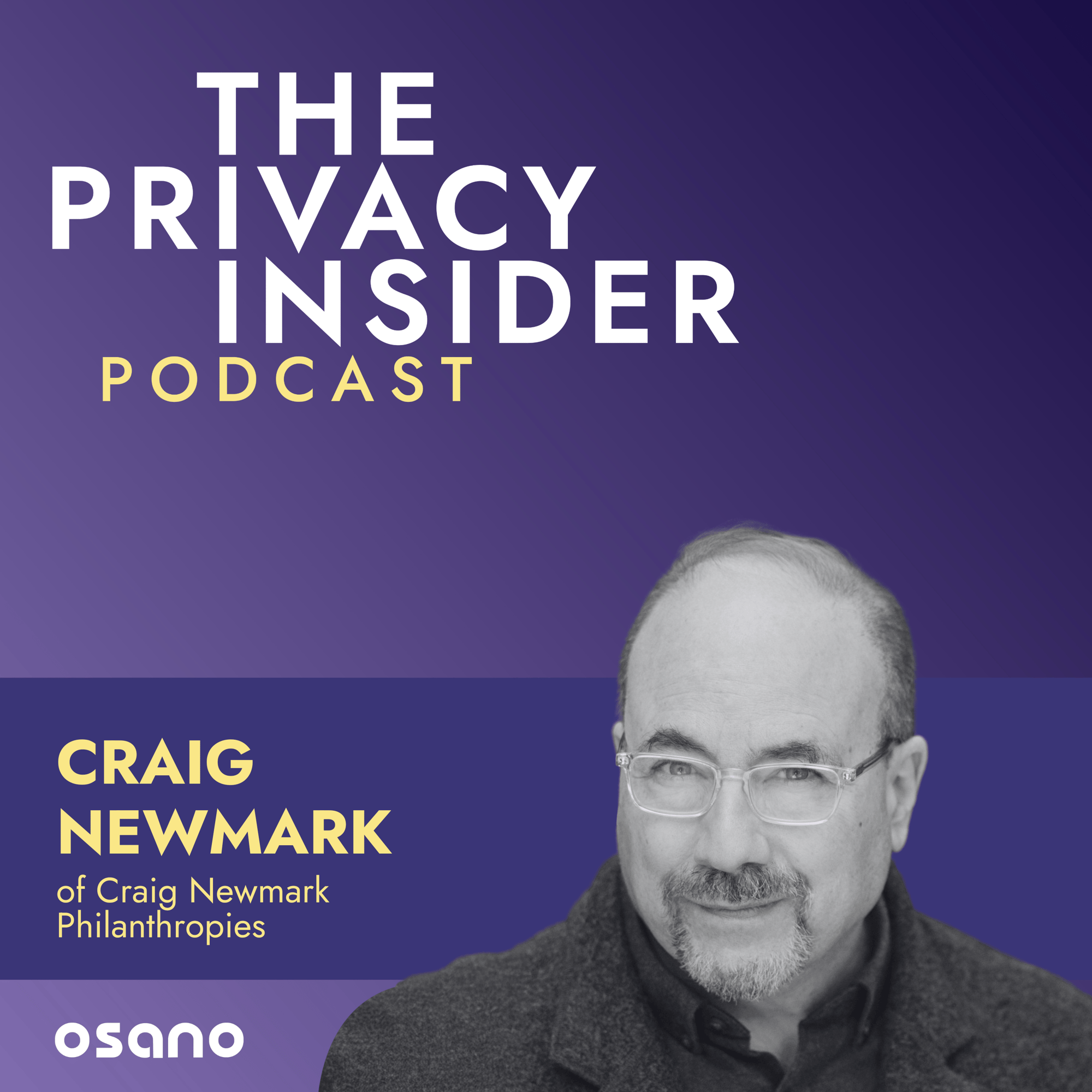
The Privacy Insider Podcast
From Craigslist to Philanthropy, It’s All About the Golden Rule with Craig Newmark


Craig Newmark, Founder and CSR of Craig Newmark Philanthropies, has long championed privacy, trustworthy technology, and public service. At a time when AI, online scams, and cyber threats are reshaping daily life, his voice is especially relevant. Guided by early lessons in ethics and civics, Craig has spent decades applying a simple principle: treat people the way you want to be treated. From building one of the internet’s most enduring platforms to funding initiatives in journalism, cybersecurity, and veteran support, his perspective offers a grounding in values and a roadmap for addressing today’s urgent challenges.
Episode Highlights:
- 00:00 Introduction.
- 02:29 The early influences that shaped Craig’s values.
- 04:14 Building trust while navigating law enforcement and online safety.
- 09:58 Balancing anonymity and accountability in online communities.
- 15:58 Supporting veterans and military families through long-term commitments.
- 21:50 Lessons learned from early experiences in programming and technology.
- 28:56 Expanding philanthropic focus to address modern cybersecurity threats.
- 40:25 Perspectives on privacy, inclusivity, and digital responsibility.
Episode Resources:
Craig: [00:00:00] We have to be able to tell people what practices and what tools. People should use to keep themselves and their families safe. that includes fighting scams and we have to figure out how to tell everyone how to help keep their companies safe and the country safe. Hello, my name is Arlo Gilbert. I'm the founder of Osano, a leading data privacy company, but today I'm your host on the Privacy Insider. My guest today needs no last name like Madonna, prince, or Cher. He's simply Craig. You probably know him as the guy who made it [00:01:00] possible to find your first apartment, your vintage lava lamp, and maybe even your soulmate.
Arlo: Yes, I'm talking about the founder of Craigslist, but Craig Newmark isn't just a pioneer of online classifieds. He's also a passionate philanthropist, championing journalism, veterans, and trustworthy technology. He's quirky, kind, and quietly changing the world for the better for all of us. Craig, welcome to the Privacy Insider.
Craig: Hey, I'm really glad to be here.
Arlo: It's nice to have you. I first, I just have to say thank you for all the couches that you helped me to buy as a college student many, many years ago. Uh, without Craigslist. I'm certain my apartments would've been barren at the time.
Craig: Hey, I really appreciate it. Please, uh, keep using the site.
Arlo: Well, so today we're here to talk to you about, both some of the interesting things that you've done in the past, some of the interesting things you're doing right now. But also we would love to talk to you about privacy because many people might not know [00:02:00] that you're a pretty staunch privacy advocate and have been for many, many years.
And so. you may be best known for founding Craigslist, which is a very user friendly, kind of no frills platform, did this interest in privacy come from? Because at the time that you started Craig's List, people were largely trying to figure out how to monetize user data and, and Craigslist kind of went the other direction and it paid off pretty well.
Craig: I guess it goes back to Sunday school. Uh, Mr. And Mrs. Levin who are Holocaust survivors, they were pretty good at, teaching stuff like you should really know when enough is enough. That set my basic moral compass regarding kind of everything treat people like you wanna be treated. Then around 1970, I had a really good high school, history and civics class, and there the teacher, a guy named Anton Schulsky, he was really good at [00:03:00] making sure he understood the bill of Rights.
Constitutional rights, and I just absorbed the attitude there. while the Constitution doesn't spell out privacy, really, it does have a definite uh, vibe regarding privacy, and I just absorbed that. Then 1993, uh, this was the World's Science Fishing convention in San Francisco. Days after I moved there, the Electronic Frontier Foundation had a panel, it seemed like the exact right thing, and I signed up kind of, uh, immediately. Their attitude was like with Mr. Schick's attitude, you do want to, uh, help out the cops. But you do wanna respect the rights of the accused, um, innocent until proven guilty due process, which is the whole constitutional rights thing. So simultaneously, I have the attitude like the EFF, [00:04:00] that I should both wanna help the cops out and yet respect everyone's privacy.
That became a real thing when I was first contacted by cops about 25 years ago.
Arlo: Wait, why, why, why were you contacted by the cops? Now you, you opened that bag of worms and I've gotta know
Craig: around then I got a call from the, uh, local FBI office. They asked me if I knew there was an A for plutonium on the site. Now, back then, I didn't know what the law was at all. but I figured this was a prank. I asked the agent if it was okay if I asked the poster, probably a kid to turn themselves in, and, uh, they said, sure.
The kid turned themselves in. Probably got grounded permanently. But that was the first time that began. That began what became a really good relationship with actual law enforcement.
Arlo: That is fascinating. [00:05:00] And so, you know, when you, when you, and I assume then the plutonium was a joke, and the kid did not actually have any plutonium,
Craig: It was a joke, but I think the kid's geography was near the, uh, Berkeley, uh, Lawrence Livermore Labs, so that made us all slightly nervous
Arlo: Yeah. Yeah. He needs to pick his audience a little better next time, hopefully. And, and I'm curious, you talked about
science fiction conventions. when you first got to San Francisco, were you a treche? Were you a Star Wars fan? what kind of, uh, sci-fi, uh, were you into?
Craig: I was an am, a nerd. Uh, the whole real deal with marginal social skills, although I can fake 'em. Um, and the literature of my people, the nerds is science fiction. So I've been reading it well over 60 years. So my interests are pretty broad in science fiction. Um, I read kind of, uh, everything. I kind of prefer star, Trek over [00:06:00] star Wars, because the vision is positive and hopeful in a way that I like.
and so that's kind of my, uh, preference
Arlo: star, Trek is, a little more sci-fi. I, I think of Star Wars as being a little more kind of space battles and, you know, a lot more, uh, violence and war. do you have any, do you have any, oh, sorry, go ahead.
Craig: I don't make those distinctions, but uh, star Wars does have more of a, uh, mystical, uh, quality to it, which is fun to watch. But, since I'm lacking in mystical experiences myself, I do prefer a hard science stuff.
Arlo: I love that Now, uh, I, I also am a big sci-fi fan, and I, I've been reading ov for, you know, most of my adult life and wonder, do you have any recommendations for folks who are, uh, I should sa call them SCI curious, and, uh, who would like to get into science fiction but aren't quite sure where to start?
Craig: I read so much of it. [00:07:00] It's, uh, difficult to keep it sorted in my head, at least for books. TV in a way is easier. Like you can, I'd recommend The Expanse, which I think is in Amazon now. Both the, uh, TV and the books. there's, uh, as of foundation, there's a great series, uh, now on about that. Recommend the TV and the books, which are different stories, both really good.
There's also for all mankind on Apple, and for that matter, my wife and I are now catching up on a slightly older series called The Lazarus Project, which is turning out to be unexpectedly good. Good. But there's a lot of other good stuff. Oh, on tv there's also a severance.
Arlo: severance.
That was, dark and creepy. and, and kind of hit home for a lot of people.
Craig: I have lived the office experience. I spent 17 years at IBM, although at IBM, my [00:08:00] problems. Were pretty much all caused by myself. back then, I lacked the ability to fake social skills and occasionally I would be a jerk which I mean, occasionally I would be a real asshole.
Hopefully I've gotten better.
Arlo: you certainly strike me as a mild mannered, soft spoken person. So for what it's worth, if you're faking it, it's working really well.
Craig: I appreciate it. Doing customer service pretty heavy at Craigslist. In, in philanthropy, that's 30 years and that's a long time to wear off the rough edges.
Arlo: Yes, that is, that is true. And, and time is, is amazing as well Uh, and, and helping to, to do all of that. I know I'm certainly softer now than I was 20 years ago. so let's, I'd love to talk a little bit about, uh, about your time with the e you know, your time and your experience, with the EFF early on.
You know, you briefly touched on, you went and, and met them and thought they were. Kind of cool and [00:09:00] inspiring in many ways, but it sounded like you took away more than just a little bit of inspiration because Craigslist was pretty innovative in, in the sense of privacy. you know, for those of you who, who haven't used Craigslist lately, you know, they've always had this capability that allowed, people to sell things and buy things in a fairly anonymous manner.
I didn't need to know your email. You didn't need to know my email, and I was curious what inspired that direction for the
the commerce.
Craig: Well, the uh, vibe is that of respecting, uh, a person's rights. guided by, in high school, a history and civics guided by the Constitution and reinforced in really good ways by the EFF 'cause I've been working with him, chatting with him for over 30 years and that set the vibe and the feel of everything I kind of intuited.[00:10:00]
That there was a, uh, balance that no one had figured out between accountability and anonymity on the internet, and that's the initial direction I set for Craigslist in the first five years. Don't give me too much credit for that. About five years in, I realized that as a manager, I suck. I hire this guy Jim Buckmaster.
Who's been CEO since I made him CEOI became a full-time customer service rep, not a manager, a rep. And Jim has maintained that tradition of, privacy.
Arlo: Wait, I love this. I'm, I'm a
founder and I think that lots of us who start companies, we love building, we love creating, but we quickly discover that that's not what you spend most of your time doing. When you run a company that's growing, you spend most of your time talking to board members and working on [00:11:00] management and keeping track of metrics.
And so I I'm very inspired by that. Customer support rep, that's an unusual direction for a founder to go. What, what made you wanna do that versus building or, uh, or doing something different with your time?
Craig: I remember Mr. And Mrs. Levin, my study school teachers, treat people like you wanna be treated. I figure I should provide, uh, to the best of my ability, the customer service I would like to receive. And I did that at Craigslist as best we could on a site, which is almost all free.
Now, I do kind of the same thing for philanthropy, although a lot of that has to do with, helping people with certain grant proposals, reminding people that they need to sign them, which there's all sorts of legal stuff involved, and I take a customer service attitude about that. I just wish I was better at persuading, uh, other [00:12:00] companies to take customer service seriously.
Arlo: Yes. Well, in, in today's modern era of ai, we're seeing even, even more, uh, separation between the human being and the customer side and
customer, right? More and more layers of automation and technology, which we often call, we often reach out, and all we're hoping for is just I want to talk to a human being.
That's all I
want.
Craig: I know what you mean. Hard to scale humans and hard to afford a team of people in customer service who can do a good job of answering questions. calls to call center approach doesn't look like it's viable. sometimes I'm optimistic about AI and figure that if the company is genuinely committed to good customer service, then they could build a chat system, which honestly does the job.
So far, the only hope I have is from two [00:13:00] projects, uh, frankly, on funding. One is at moms first supporting paid leave in New York and elsewhere. Moms First is about, childcare for everyone and good customer service for it.
And then I'm supporting customer service projects at Consumer Reports, which is in the very center, the biggest player in let's say pro-consumer, everything.
Arlo: that's so fun. I, You know, we, we've partnered with, consumer reports on, uh, uh, several different projects at, at our company here. I.
did not know that you were part of that organization.
Craig: I am heavily funding, uh, consumer reports for customer service ai, but even in a bigger way, I think they're gonna play a big role in cybersecurity for regular people. We have to be able to tell people what practices and what tools. People should [00:14:00] use to keep themselves and their families safe. Uh, that includes fighting scams and we have to figure out how to tell everyone how to help keep their companies safe and the country safe.
That's, uh, a work in progress. We've only been started in earnest, let's say a year, and uh, that's the biggest single thing I spend my time on.
Arlo: Well, that's fascinating. I, I'm sure there's many, many things that we can talk about. And I, I hope we get a chance to speak offline because, uh, I do have a, a soft spot for my, uh, in my heart for Consumer reports. My mom, growing up always had a paper subscription to Consumer Reports, and it served both as a, an awesome guide but also.
It was like the equivalent of the Sears catalog. You know, you get it and you open it up, you're like, oh, I hadn't been thinking about buying a washer, but now that I know what the best one is, I'm really curious.
So you, you do a lot of philanthropy and I think that, for many people. Although, although you may be best known [00:15:00] for Craigslist because of the, the shared name, the work that you've done in philanthropy has been really impactful.
I personally donated because of some of the work that you had done, with getting teachers, funded and, and you know, you had been on, I think it might have been Twitter, was the social media platform you're posting on, and you really got a lot of people excited and rallied to go and start contributing money to teachers on.
Whatever the platforms were that they were using, but. It was going directly to the classrooms, you know, right around school time. We need more crayons. We don't have a chalkboard that works. You know, I, I need a laptop to teach my students. And, you know, you were out there donating much larger sums than I was, but you inspired me.
And, and I started doing the same thing every year, for quite a few years after that, started donating directly to classrooms to do the same thing. And so, you know, thank you for the inspiration. that note, I would love to talk more about your philanthropy, and the
move you, post Craigslist,
Craig: well the deal, [00:16:00] I've been thinking about it for years. And we need to work together to help protect the country, and we need to get a break for the people who have sacrificed a lot to protect the country. So a lot of that has to do with supporting vets and supporting military families. The deal is all Americans owe vets and military families and active service members a lot.
So I've committed, uh, $200 million to support 'em. I've already, uh, paid up over half of that. And in these areas what I've done is I found one group called Bob Woodrow Foundation. They've built a Skyer six network of nonprofits that actually are good at helping vets across the country. I'm working with Blue Star families and they're building a network of chapters.
Outposts across the country who are really good at helping [00:17:00] military families, particularly after they've been moved because the, uh, DOD moves military families around the country and the world around, they say 600,000 times a year. And if you're suddenly moved to a new area and you.
don't know anyone, you're kind of screwed.
And so Blue Star will come up with chapters or outposts who can help a new family, find childcare, can help the spouse get a job, that kind of thing. That illustrates my deal with philanthropy. I find people who are smarter than me, who are really good at something. I give them funding and whatever influence I have, and then they do the job.
It's a lot harder when it comes to cybersecurity. There are multiple big areas in there, and I am, I've delegated some things like workforce [00:18:00] development to the Aspen Institute when it comes to tools to recommend for regular people. That's me. Plus Consumer Reports, plus the Aspen Institute and a few other groups.
Arlo: That is incredible. Now, I, I, I get the sense, and, and you know, I'm kind of leading the witness here, but you know, you've mentioned supporting America, supporting the country, supporting veterans as being a big priority. and maybe this is a good time to, to talk a little bit about your life. Prior to Craigslist in San Francisco because it, my recollection is you have a military connection.
and I'd love to learn a little bit about the Craig of, of yesteryear and kind of the things that inspired you and brought you to have a belief in, uh, military families.
Craig: Well, the deal is that my, uh, father, never really talked about his service in the army in the Pacific, and it may not have been that distinguished. [00:19:00] I finally got hold of partial, uh, records from a hospital stay in the, uh, mid forties. And as far as I could tell, he fought in the Pacific behind a desk with the Army engineers and served in places like uh, the Philippines.
And as far as I could tell, he did paperwork. Well. That's just how I'm protecting the country firsthand behind a desk doing cyber stuff, which is kind of the internet equivalent of paperwork. My mom, I know, learned bookkeeping. So the company bookkeeper, I guess he, uh, picked up a rifle and went overseas to fight.
But I never thought about that much as a kid, and I only got those records several years ago. Someone as a favor to someone else found those hospital records because there was a big Veterans Affairs warehouse that burned in [00:20:00] 73, I think, and a lot of World War II records were held there. Also, I grew up in a town called Morristown, New Jersey.
that's where Washington and the Continental Army 250 years ago, spent a couple really hard winners, and there were reminders of that all over town. In my teenage years, I more or less lived across the street from Washington's headquarters and growing up. We went to see, uh, Fort Nonsense, Jackie Hollow, uh, that kind of thing.
So I grew up knowing that stuff. I grew up in the summers as a kid going past the big statue of Thomas Payne every day. And I've passed it again just a couple months ago visiting, uh, the home. so. This is what reminds me of stuff. And then in [00:21:00] high school, during the Vietnam War, I, uh, would see, vets returning home being treated badly, and I was very naive.
I didn't understand anything about the war except that you shouldn't treat returning. That's badly. It's not fair.
Arlo: Absolutely. I, I, uh, you know, I lived in New Jersey as a child as well, and, I remember lots of class field trips to the Liberty Bell.
get a lot more exposure. To the history of the country over on the East coast, just because that's where so much of it happened, you know, in the early days.
That's really fascinating, Craig. Thanks for sharing that story. I'm really curious because, uh, you know, how did you get into computers? I haven't heard anything
the history yet that leads me to believe that you're, you would become a technical person.
Craig: In, uh, high school in Morristown, uh, when I became a junior, I was allowed to use a computer that IBM [00:22:00] had, uh, just given to school. It's an old IBM 1620 about the size and appearance of a regular upright piano. Use punch cards to, uh, program it. And I taught myself Fortran two. I was good at it, and I just kept doing that.
Uh, 19 69, 19 70, 71. Unfortunately, I I, I used a computer at the expense of any social skills, and so when I went to college, intending to be like a quantum physicist. Well, after realizing that I wasn't smart enough to do that, I remembered, oh, I'm good with computers. I'll go into computer sciences, and this AI stuff looks great.
And I started learning about things like neural networks, which are the basis of generative ai. But then I realized I would like a job someday, so I went into more [00:23:00] conventional software work.
Arlo: I love that. That was very early in the concept of AI and I mean, punch card programming. You had to take those punch cards and then go walk over to another machine and put them in for it to read them. Right. And you would have, were these, these were reams of these punch cards, right?
That you'd
to have.
Craig: that's, uh, quite accurate. It started in a small way in high school, became a really big thing for me through my college years, because that was only when CRTs were being introduced as computer terminals .
Arlo: And when you started Craigslist, I mean there weren't, a lot of frameworks for developing applications out there. You know, a lot of this stuff you just had to go figure out. I'm curious, just for my own personal satisfaction, what did you program Craigslist did in the early days?
Craig: good catch. And in 95, 96. One point I remembered, [00:24:00] or I'm running a mailing list, emails are in a predictable standard format and I can write some code in Pearl to turn emails into HTML pages. So I had web publishing for free since I wrote the code myself, there were no frameworks for me to use. Uh, there were some good network libraries.
Back then also I got lucky and I attended an EFF meeting with the people who had just created and published the Java programming language. And I learned Java. I wrote some code for Craigslist, but the network libraries, well, especially running under the Java web server, which came around about then the Java web server and the network libraries weren't stable.
They would fail. So I gave up on Java for Craigslist, but at the same time, I did write a stress tester for Bank of [00:25:00] America home banking. I was doing my first contract gig. I wrote the stress tester in Java. It worked. It broke, uh, home banking a couple times and they were able to find, uh, bottlenecks.
And to my knowledge, this was the first commercial use of Java anywhere.
Arlo: Wow, you've got a lot of firsts in your life. you seem like you're somebody who, who likes to chart your own course in the world and, and pursue the things that are interesting to you. And it sounds like that's really worked out very well for you, both financially, but also also from the influence and, and the positive impacts you've been able to have.
So, I'd love to shift gears a little bit and, and talk about some of the philanthropies. So you, you mentioned the, uh, the childcare one. Uh, you mentioned the military veterans, and, you know, when we talked prior to the show, you had one, one philanthropy that stood out to me as particularly unusual. and this was around [00:26:00] birds, can you share with our audience the, this, this other philanthropy.
Craig: I love birds. And I don't understand why, but during this interview, I have the shade shut in part because otherwise I overlook a bird feeder. And we have a lot of birds, a lot of finches, hummingbirds, gold finches for that matter, and even doves. And if I didn't have the shades, clothes, I would be very distracted.
I'm in San Francisco now. Where I live in New York, the dominant birds are, uh, pigeons, doves and sparrows. And again, for reasons unknown, I love to see them. and I actually fund in very small ways, pigeon rescue. not hard to find, on the net pictures of me doing photo ops with pigeons, and in particular, I recommend.
Cy in the Bay [00:27:00] Area and in New York there's the Wild Bird Fund.
Arlo: And well, I, I, I have to, now I know very little about pigeons. so I just have to ask what do they need rescuing from?
Craig: typically not much, but sometimes there'll be an accident and say lose a wing. sometimes people, uh, release them. They buy white pigeons thinking that, they need to be rescued. And a white pigeon, uh, in places like New York or San Francisco, they're basically food for hawks. And so the pigeon rescue groups have to rescue, uh, pigeons, which were attacked by hawks and not killed and you never know. Sometimes people do what they think are clever things, but are bad ideas like dying, pigeons, different colors, things like that?
Arlo: Get out of here.
Craig: Yeah. Uh, yeah. So like the Wild Bird Fund, which I [00:28:00] visited, kind of always has, I don't know, 20, 30 pigeons, which they're taken care of. And while bird Fund and pal diplomacy need people to adopt, uh, pigeons, and I've
always been
tempted, but, uh, Mrs.
Newmark usually, uh, vetoes that.
Arlo: yeah, having birds in the house can get, loud,
Craig: uh, it can get, messy. And, uh, during my first photo op via Cy, I learned the hard way that you wanna put the pigeon pants on the pigeon before they spend time on your shoulder. pigeon pants, which are a real thing , are diapers.
Arlo: I'm learning so much today. Pigeon pants. I had no idea. Well, this is, this is really interesting. Uh, and so, so are there any other, uh, philanthropies that you're particularly passionate about that we haven't discussed?
Craig: pretty much the great focus for me personally in my time is [00:29:00] cybersecurity. And again, there, there's a number of nonprofits I help, like there's something called Shadow Server. Which scans the entire internet looking for, uh, problematic sites. And they will help, law enforcement put away, uh, malware gangs.
that's one of them. There's a global cyber alliance and there's a lot of groups doing really great work. There's the, uh, consortium of cyber clinics. Cyber clinics help people in specific towns. take care of cybersecurity, for example, if they're at nonprofits or something like that. There's the Cyber Resilience Corps, which helps protect our utilities against cyber attacks by a foreign military, because right now it's pretty much in the news that the Chinese military has already compromised.
Water supplies, [00:30:00] small water supplies across the country. Although most water providers across the country are small, uh, the cyber resilience core is helping protect electrical utilities. We're together working with how do you protect utilities everywhere from the country. That includes transportation, hospitals, it includes food providers.
Because the reality is our enemies are al, have already compromised a lot of utilities. They set them up so that they can get back into the utilities in the case of a war,
Arlo: Got it now, and what's what's surprising to me is hearing that this is being done through philanthropic efforts rather than as a concerted government approach,
- is. Do you have any sense as to why?
Craig: Oh, both are happening. The deal is, the military has cybercom. There's the NSA and so on. They're [00:31:00] doing good work. Protect the coun, protecting the country, but regular people. We need to protect ourselves and our families, and we need to know enough to be good partners where we work to help protect companies.
Because if a, if a cyber attack like ransomware takes out your, the company where you work, you're screwed. if, uh, foreign military takes out, uh, your water supplies, you're kind of screwed also. And the reality is that. If everyone did cybersecurity basics, everyone would be a lot safer, including the entire country.
We're working on that. If you look at pause, take nine.org, you'll see our current recommendations. We're working on more and we're starting to work on what are recommendations for regular people to protect themselves against scams, and how do we help people. Figure [00:32:00] out how to stop scams altogether. For example, it would be great if your email provider stop scams from reaching you.
It would be great if you.
are a messaging provider. Stop scams. So we've just started in the last month to figure out how to do that. The challenge again, how do we balance accountability and anonymity? The EFF is a real part of that. And I asked for them advice about that, particularly considering that we have to help the cops and other services stop bad stuff while respecting the rights, the accused, uh, respecting the principal and is sent until proven guilty.
This is not easy, but I got a really good start from my Sunday school teachers. From my history, civic feature from the EFF and [00:33:00] others.
Arlo: Do you find, you know, by, by the way, just as an aside, you know, I, I really connect with some of the things you're talking about there. I, I.
had the privilege of, of starting and running a phone company for about 10 years, a voiceover IP provider and. Inevitably, many, many people thought that they could use those tools completely anonymously.
uh, as anybody who's ever been in the telecom space will tell you, you quickly develop a relationship with the Secret Service and the NSA because they have to be able to go and stop some really bad things, and they often have hours to go and, and stop these things. And so, kind of leads me to my, my question, which is that.
You know, there's an entire generation of, people who have grown up in a country where we are, number one. are really don't have any significant risk of, people attacking us, at least not within the boundaries of the [00:34:00] United States. It hasn't been since, we had nine 11, but prior to nine 11, the, the last major attack would've been what?
Pearl Harbor. So it's so infrequent. And I'm curious, do you think that there's a challenge, around getting awareness of the issue of protecting the homeland?
Craig: there's a lot of problems communicating that, the cause Take nine thing that we're doing is about alerting the entire country that we all have a role to play. At least we have to protect ourselves and our families. It's kind of like World War II except that the enemy is already here and I figure I take it personally and it's time to start the right kind of, uh, communications campaign to alert everyone.
It has to be like World War II or kind of I've inspired by, uh, Don Draper. starting the whole by the world of Koch campaign, and I know he [00:35:00] didn't do it in real life, but that's the, we need a campaign that effective, that's successful because everyone really does need to play a part. Um, there's basics that everyone can do provided they're remotely comfortable with their phones and their computers.
and in some cases they're gonna help have to help other people with that. for example, uh, Myan laws. but that's the, that's the big challenge. The technology is kind of easy in comparison to getting the word out in a convincing way.
Arlo: Yes, I can. I can see that. so, we are a privacy podcast and so I would be remiss if I didn't talk a little bit about privacy with you. we've touched on some of the early things with the EFF and how those inspired some of your work on Craigslist. it seems like, you know, you have a good sense of walking the line between extreme anonymity but [00:36:00] also.
Sometimes we have to do things to take care of our country. I'm curious how you think about the state of privacy now. We have a pretty significantly changing tech landscape with the advent of large language models. we have a generation of people who have grown up on TikTok, where privacy is a, an afterthought.
I'm kind of curious, you know, what do you think about privacy these days?
Craig: I'm trying to figure out how to express what I want in light of what actually exists now or soon. Uh, with technology I figure that. Whenever we do anything on the net, typically we wanna be sure we're talking to the people that, uh, they say they are like a company or organization and they should be able to expect that I could prove myself in terms of I am who I say I am.
some transactions are low risk, some are very high risk, and you wanna be able to tune that So for low risk [00:37:00] transactions, I wanna be able to go to a site and say, maybe here's my driver's license. You can see who issued it. Uh, here's a credit card. You can see who issued it. You can decide to trust me based on your trust on who's vouching.
For me. If it's a high risk transaction, maybe you might request a driver's license and a uh, credit card. The deal is that most everyone has those in our country. Most everyone in our country, I think 90% has a phone which could, uh, have a wallet with credit cards and a driver's license. So maybe that's the beginning of the solution.
That's just me guessing right now. I need help from people who study this every day. The challenges are things like, well, if you're running a website, let's say with user generated [00:38:00] content, I wanna be able to go to some sites and maybe saying, sure, somebody could post with a pseudonym, which makes it somewhat anonymous, but if I misbehave on that site, I should be held accountable so that the site operator can see my credentials and act accordingly.
So again, this is the beginning of thinking, but because I wanna follow the golden rule, treating people like I wanna be treated, I realize that there are Americans who might not have credentials, who might not have a, a mobile phone. So we have to figure out how to include everyone so that we can be fair.
' cause that's what I learned in Sunday school.
Arlo: That is true. I mean, there are many people who are unhoused who have a challenge with, you know, securing mobile devices or identity or a credit card. I mean, maybe out of reach for many people. There are many [00:39:00] people who are unbanked entirely. you know, and we do tend to talk about, technology and privacy with the assumption that everybody is right in the middle.
and ignoring all those outliers, not, not, not even outliers who rep represent a, you know, a significant, you know, single digit percentage of people who don't have a checking account. you know, and those people still have a right to be Americans and participate in our economy. And as it becomes more and more digital, I've gotta imagine that gets harder and harder for those people.
Craig: Yeah, the deal is to, uh, not make things, uh, worse, but to figure out, again, the ba, the balance between accountability. And, uh, anonymity and I guess, uh, affordability. and I have a feeling we have the beginning of a solution. and it may be a really good start because it might cover most Americans, but, uh, I have to respect what I, uh, learned in Sunday School and to make a good faith effort to include [00:40:00] everyone.
Arlo: Well, you know, Craig, this has been a very fascinating discussion and you know, as I, I think I told you one of the things we always love to find out from our guests is, you know, we all have things that we recommend that other people do. but that we sometimes, you know, we tell, we say do as I say, not as I do.
and I'm curious. You know, you, you just sound like such an amazing person, uh, with such an altruistic bent. is there anything that you, that you, uh, that you do in your own personal life that you wouldn't recommend that other people do as it relates to technology or privacy?
Craig: frankly, when it comes to technology, privacy, security, I, uh, play it safe. I'm a very soft target and I've taken, uh, some stands, Which, uh, I know, uh, there are people who don't like my ethnicity. given my, uh, Sunday school background taught by Holocaust survivors, that has exposed me [00:41:00] in other ways.
I need to, uh, figure out the right balance between safety and, uh, living a, uh, reasonable life. my problem is that since I've turned down the billions of dollars, you don't see me doing anything like, hiring bodyguards. There's no privates yet. And, uh, so I.
uh, have to, uh, use some common sense. But the bottom line still is that I'm a really soft target.
Arlo: Well, Craig, this has been a really fascinating interview and I, I appreciate so much that you've taken the time out of your day to come and join us. Given how many things you're involved in, I know that our audience would love to know more about some of these, particular, uh, charities and philanthropies you're involved in.
And I know that one of them is Pause take nine. And that's pause. Like take a pause. so pause, take nine. Dot. And can you tell us just a little bit [00:42:00] about why it's called Pause take nine.
Craig: typically you can keep yourself out of, uh, some trouble on the net by pausing when you are about to hit by. Think about it for a little bit, stereotypically nine seconds, and then make a decision then.
Arlo: I love it. Pause and take nine. Except for when it comes to listening to the Privacy Insider. Don't pause at all when you're planning to listen to our show. Craig, this has been amazing. Thank you for joining. I hope we get to have you on again another day, and thanks for your time.
Craig: And remember all this is because, uh, a nerd's gotta do what a nerd's gotta do.
Arlo: I love it. [00:43:00]
Meet the host
Arlo Gilbert is the host of The Privacy Insider Podcast, CIO and cofounder of Osano, and author of The Privacy Insider Book. A native of Austin, Texas, he has been building software companies for more than twenty-five years in categories including telecom, payments, procurement, and compliance.

/White%20Castle%20logo%20grey%20400.svg)
/Sprinklr%20logo%20grey%20400.svg)
/Sierra%20Nevada%20logo%20gray%20400.svg)
/Sesame%20workshop%20logo%20grey%20400.svg)
/Rodd%20and%20Gunn%20logo%20grey%20400.svg)
/Ping%20logo%20gray%20400.svg)
/Newegg%20logo%20gray%20400.svg)
/New%20Relic%20logo%20gray%20400.svg)
/Loves%20logo%20grey%20400.svg)
/linux%20foundation%20logo%20gray%20400.svg)
/JD%20Supra%20logo%20gray%20400.svg)
/BuzzRX%20logo%20grey%20400.svg)
/Broadridge%20logo%20gray%20400.svg)
/Boston%20Medical%20logo%20grey%20400.svg)
/AMC%20Theatres%20logo%20gray%20400.svg)