.svg)


.svg)
.svg)
.svg)
.svg)
.webp?width=1220&height=1090&name=Osano-guarantee-seal%20(1).webp)
When can compliance professionals and business stakeholders expect data privacy to stop evolving year after year?
Our guesstimate is sometime between the turn of the 22nd century and the heat death of the universe. In any case, it certainly won’t be in 2026.
Here at Osano, we’re lucky enough to interact with a great many privacy professionals, businesses, and thought leaders from different industries and regions. As a result, we have a unique vantage point over the privacy landscape. But you don’t need to have any special perspective to tell that a lot is happening this year in the privacy space.
Here are the major privacy trends we predict businesses will need to contend with in 2026.
1. Children’s Privacy & Safety Becomes a Primary Focus
Children’s privacy and safety has always garnered a lot of attention, but 2026 is shaping up to be an especially active year for this aspect of data privacy.
In 2025, multiple countries implemented age assurance requirements in digital regulations. In 2026, we’ll see the ramifications of those decisions.
In the UK, the Online Safety Act’s controversial provisions around age verification came into effect in the summer of 2025. Australia implemented a blanket social media ban for under-16-year-olds in the winter of 2025, forcing these platforms to verify users’ ages to comply with the ban.
CCPA amendments that went into effect at the start of the year now classify under-16-year-olds’ data as sensitive personal information (PI). This classification interacts with the Digital Age Assurance Act, a California law going into effect in 2027 that asks OS and app store developers to request users’ ages upon profile creation. The act then requires app developers to treat that age information as “actual knowledge” of the users’ age. Suddenly, businesses that never wanted to know their users’ ages will have no choice but to, increasing their compliance burden under the CCPA.
A Recipe for Data Breaches?
Protecting children online is all well and good, but it requires businesses to know who is a child and who isn’t–that requires the collection of additional information (often sensitive information like biometric data). This violates the principle of data minimization and increases the risk of data privacy incidents.
Age verification approaches that occur at the app store level, like California’s approach, reduce the proliferation of personal data transfers and rely on self-reporting rather than uploading IDs or estimating age based on biometrics.
But in the UK and Australia, the burden of age verification falls on individual service providers, virtually ensuring that someone will overcollect sensitive data and undersecure it. Watch for data breaches involving children’s data in 2026 as a result.
Data Protection Commissioner Brent Homan shares his view on the right way to teach children about digital safety and privacy on a recent episode of the Privacy Insider Podcast.
2. Consent Fatigue Boosts Adoption of Browser-/Device-Level Privacy Preference Signals
Sick of clicking on a million different banners every time you visit a website? So is everyone else.
Consumers, advocacy groups, regulators, and even some businesses are pushing for the adoption of universal opt-out mechanisms rather than website-level preference signals. Sometimes called opt-out preference signals (whimsically abbreviated as OOPS), these enable users to set their privacy preferences in their browsers, rather than on every individual website they visit. Then, the user’s browser propagates those signals to your website. If your website is compliant, it will honor the user’s choice to be or not be tracked accordingly.
In California, the Opt Me Out Act goes into effect January 1, 2027. It requires all browsers to natively support a universal opt-out mechanism. In the US, the Global Privacy Control (GPC) is the most common of these mechanisms.
As part of the CCPA amendments that went into effect this year, businesses must now display an icon that demonstrates consent preferences have been received and processed. If you set a browser-level preference, then you’d have no way of knowing if a business has actually acted on that preference without a signal of this kind.
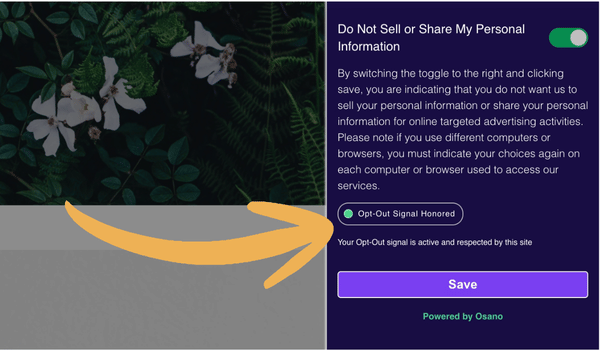
Osano supports universal opt-out mechanisms like the GPC and displays when such signals have been processed, in compliance with the CCPA.
Of the 19 state comprehensive privacy laws in the US, only six states do not require businesses to honor universal opt-out signals:
Some or all of these laws may be amended to include that requirement should universal browser-level opt-outs become the norm.
Similarly, the EU is considering a browser-level consent preference setting as well. Since the GDPR takes an opt-in approach to data collection, banners on individual websites are even more onerous to navigate. The Digital Omnibus package proposes to amend a number of European digital regulations, including the GDPR, and would require websites to accept and honor universal preference signals.
Does this mean consent management platforms (CMPs) will be a thing of the past? Probably not.
Banners that comply with the users’ governing privacy law will still be needed for individuals that do not set a browser-level preference for data tracking, and you’ll still need an automated way to fire or block trackers according to the preferences users set in their browsers.
3. Enforcers Zero in on Technical Truth in Consent Management
For a while, businesses could skate by so long as they had some form of consent management on their website. In 2026, that’s no longer the case.
Regulators now expect businesses to have seamless consent management. Enforcement actions increasingly focus on exceptions, edge cases, and “privacy theater.” Does your organization honor universal opt-out signals? Are all (not just most) data trackers firing or being blocked according to user preference? Have you fully disclosed what you’re tracking and why? These are the questions regulatory bodies will be asking.
An Example Consent-Centric Enforcement: Tractor Supply
A California enforcement action in late 2025 serves as a good example of this new focus.
Among other violations, Tractor Supply received a $1.35 million CCPA fine for providing users with a non-functional webform to opt-out of the sale/sharing of their personal information. Here’s what the California Privacy Protection Agency’s (CPPA) complaint said:
Although Tractor Supply’s webform purported to allow consumers to opt-out of the sale of their personal information, completion of the webform did not opt out consumers from the third-party tracking technologies that Tractor Supply used for advertising purposes. [...] Tractor Supply’s webform had no effect upon how the company shared consumers’ personal information through third-party tracking technologies used for advertising purposes, leaving consumers with the false impression that Tractor Supply had stopped selling and sharing their personal information.
It’s unclear whether the webform had some partial effect but failed to function appropriately for third-party tracking technologies, or if it was completely non-functional. If we were to speculate, it seems likely Tractor Supply believed the webform functioned and opted consumers out of tracking technologies, but failed to effectively test that assumption. Ultimately, only Tractor Supply and the CPPA knows exactly how this enforcement unfolded.
Businesses interested in staying compliant in 2026 should take note of the importance of technical truth in consent. Emphasize vendor governance to ensure you’re aware of which vendors receive what data from your organization, and audit your consent management platform to ensure it’s configured to manage consent across the spectrum of data processing activities at your organization.
4. The Regulatory Seesaw Bends Toward Compliance Practicality
Data privacy regulations are no longer new concepts in the world. 2026 will mark the ten-year anniversary of the GDPR’s publication in the Official Journal of the European Union. Now that the world has had time to reckon with these regulations, legislators are looking to reduce the administrative burden of compliance without compromising protections.
The Digital Omnibus proposal is one such example. This massive regulatory package seeks to simplify a number of regulations in the EU, including the GDPR. Over the course of 2026, we’ll see that package advance through the EU legislative process, receive adjustments and refinements, and maybe even pass into law.

Portions of the UK’s Data Use and Access Act will also begin entering into force over the course of 2026. Passed in June 2025, the act updates a number of regulations, including the UK GDPR.
Among other changes, some of its most significant updates include creating a new lawful basis for processing data in specific contexts, allowing for the use of data in both commercial and non-commercial scientific research, fewer consent requirements for analytics or service improvement cookies, and relaxed subject rights request requirements.
Watch out for updates to these legislative proposals and guidance from EU and UK authorities on these changes. The UK’s Information Commissioner’s Office (ICO) and the European Commission are good sources of information, as well as Osano’s newsletter, the Privacy Insider.
5. US Consumers Increasingly Use (and Complain About) Their Rights
Slowly but surely, US consumers are waking up to the reality that they have rights over their data.
In the EU, residents have been submitting subject rights requests (SRRs) in high volumes for years now. When US states began passing their own privacy laws, it was unclear whether US consumers would match EU SRR rates, especially since US laws placed less of an emphasis on individual rights.
In 2026, it’s clear that there is indeed a rising awareness and usage of privacy rights in the US, though many consumers still don’t understand privacy laws or businesses’ data practices.
There’s no database tracking all SRRs issued under US state privacy laws, but a few states release regular reports on privacy complaint metrics. By looking at the number of complaints tied to SRRs, we can gain a sense of how consumers are starting to use their subject rights.
In late 2025, for example, the California Privacy Protection Agency (CPPA) released its enforcement update. Of the over 8,000 complaints the agency received by that point, 51% and 39% of complaints were associated with SRRs to delete and limit the use of sensitive PI, respectively. In California and other states in the union, we can only expect consumers to grow more aware of their rights, more interested in exercising them, and more willing to complain to regulators when their SRRs aren’t being honored.
There are a few important insights to take away from this trend. Yes, honoring SRRs effectively and efficiently will be important. But equally important (and easily overlooked) is the need to effectively document the SRRs you processed and/or rejected.
SRRs are one of the major ways in which your privacy program interfaces with the public at large. If things go wrong, they’ll complain about you to regulators (as over 8,000 Californians did in late 2025). That draws regulators’ attention, and if they ask you to prove your compliance, you’ll need to show them the receipts. Fortunately, data privacy software can help you both process SRRs efficiently and create a record trail.
How to Prepare for These Changes
If there’s a common theme among these trends, it’s consent management.
Users are increasingly frustrated with the barrage of consent banners thrown in their faces; businesses are going to need to be able to honor universal opt-out signals as both legislative pressure and consumer preferences increase their adoption.
At the same time, enforcers will be taking a close look under the hood to ensure you’re honoring consent at a granular, technical level. And if any new legislative requirements force you to verify users’ ages? You’ll want to double down on ensuring you have accurate, verifiable consent for any data trackers on your systems.
Collectively, these trends balloon the risk of a homegrown approach to consent management or adopting a budget consent management platform (CMP) to untenable proportions.
In the US, subject rights management is likely to reach the stage that consent management was a few years ago: users and enforcers expect there to be some process in place at the very least. Ensuring you have accurate records of when you received a request, what you did in response, and why will be key–especially if you want to be prepared for 2027.
Osano Can Help You Stay Compliant in 2026
Whether you’re hoping to plug all the gaps in your consent management process or take your subject rights workflow to the next level (even if that level is level one), Osano can help. Developed and maintained by privacy experts according to current best practices and regulatory requirements, Osano gives you a means of automating consent and subject rights management.
The platform honors and accepts universal opt-out signals like the GPC, provisions compliant banners for the user’s jurisdiction, and can be implemented with a single line of code. Common subject rights requests, like summaries and deletions, can be automated within the platform, and workflow automation ensures data owners know what to do and when to meet request timelines. And Osano does it all with detailed, automated record-keeping.
If worse comes to worst and you do receive a notice from a regulator, Osano’s Audit Defense service guides you through the response process so you can respond to inquiries and investigations with confidence. Furthermore, the industry’s only “No Fines, No Penalties,” Guarantee means that up to $500K of any fine resulting from your use of the Osano platform is covered.
2026 might be the toughest year yet for privacy compliance, but that doesn’t mean you’re not up for the challenge. Schedule a demo today.
On-Demand Webinar: Untangling 2026 Privacy
Watch our free and ungated webinar to learn all there is to know about 2026's US privacy laws.
Watch Now