.svg)


.svg)
.svg)
.svg)
.svg)
.webp?width=1220&height=1090&name=Osano-guarantee-seal%20(1).webp)
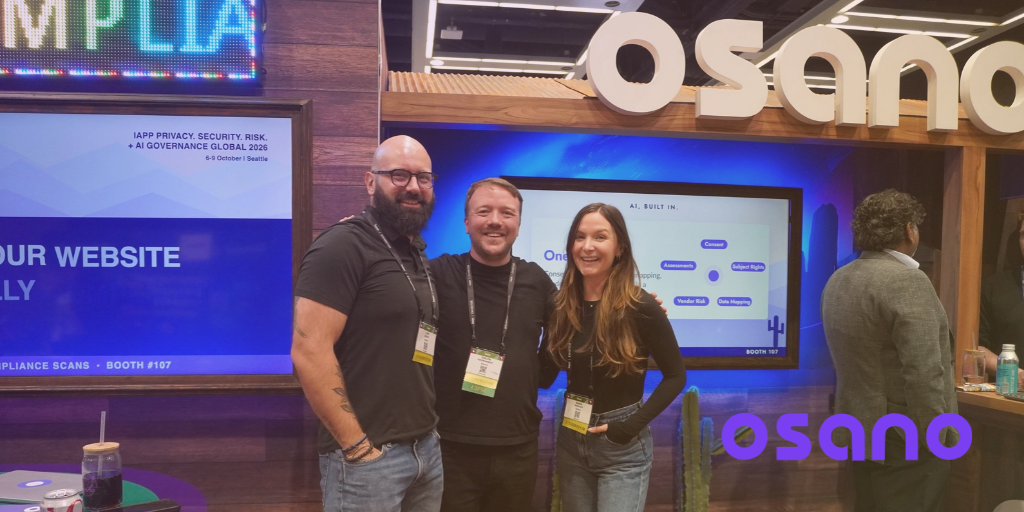
IAPP’s Privacy. Security. Risk. + AI Governance Global 2026 (PSR) took over Seattle from October 6 to 9. Our team spent the week at the Osano booth, in sessions, and on the conference floor.
As always, the privacy professionals in attendance and presenting had a lot of insights to share. Attendees voiced their questions and concerns at the booth. Over the course of the event, the Osano team picked up on some recurring themes.
Seven topics stood out. For each one, we’ve included what it means for your privacy program and one thing you can do about it.
1. Agentic AI Is the Governance Problem Everyone’s Racing to Solve
Agentic AI was one of the clearest threads at PSR this year. Unlike a chatbot that answers questions, an agent takes actions on its own, like sending emails, moving data, or making decisions inside HR and other workflows.
The sessions came at it from several angles. One made the case that even companies with solid AI governance aren’t ready for agents. Agents carry a different, higher risk profile, and regulators and courts are going to assign the responsibility for AI agents’ actions to the companies that deployed them.
A session led by Salesforce’s AI legal team pushed privacy pros to step up. They argued that consumer-grade LLMs, shadow AI, and ungoverned agents are already inside most companies. If privacy teams don’t offer a responsible path, employees will find their own.
People clearly wanted hands-on help, too. The agentic AI workshop for privacy professionals sold out. Attendees built an agent themselves while working through questions like which data sources it can use, where a human reviews its work, and who’s liable when it gets something wrong.
The common thread across these sessions was the need for proactive risk management. Privacy teams can’t wait for agents to land in a review queue, because their colleagues are already deploying them.
What to do: Find the agents you already have. Agents rarely show up in a formal review, so look where they hide:
- Ask team leads which tools now take actions on their own, like sending emails, updating records, or approving requests.
- Check the admin settings and release notes of the SaaS tools you already pay for. Many have added agent features that may be switched on by default.
- Ask IT or security which apps have been granted access through SSO, API keys, or service accounts. That’s often where agents connect to your data.
If your AI policy doesn’t cover agents, ask three questions (the same ones the PSR workshop had attendees work through): what data can each agent use, which actions need a human to sign off, and who owns each agent and its logs.
If you don’t have an AI policy yet, set a simple interim rule while you build one: no agent touches personal data or takes an action you can’t undo without human approval.
2. ‘Configured’ Doesn’t Mean ‘Compliant’ When It Comes to Consent
A cookie banner can look perfectly set up while tags and pixels still fire before anyone clicks “accept.” Or someone opts out of advertising on a signed-in account on your website, and that choice never reaches your app.
That gap between what your consent tool says and what your site actually does came up again and again at PSR. Sessions covered cross-channel opt-outs, pixels sending data they shouldn’t, and the difference between a consent setup that’s merely configured and one that’s compliant. One spotlight talk was simply called The Shocking Things I Found Scanning Fortune 500 Websites.
Osano’s Community Engagement Lead Caroline Hall heard the same worry from the people she talked to:
I kept hearing the same thing at PSR: ‘We feel like we’re compliant, but we can’t prove it.’ Their tools are complex, their teams are stretched thin, and nobody’s sure whether trackers are still firing after consent.
Caroline Hall, Community Engagement Lead, Osano
What to do: The most useful consent tools go past the banner and show you what’s happening on your site after someone makes a choice. Test what your site actually sends before and after a user opts out.
3. Tracking Tech Is a Growing Litigation Risk
Lawsuits under the California Invasion of Privacy Act (CIPA) and similar state wiretapping laws are going after pixels, chat widgets, and session replay tools. Plaintiffs’ firms are scanning websites for easy claims and sending demand letters, so the threat goes well past regulators.
Even teams that feel confident about their tracking setup may be more exposed than they think. Amar Ramakrishnan, our SVP of Product, co-presented Take a CIPA This: What It Takes to Really Reduce Your CIPA Risk with Anokhy Desai of Husch Blackwell. The response in the room surprised him:
I went in thinking this was old hat and everybody already gets it. But so many people told us they were grateful we broke it down and helped them understand their actual risk. Teams think they understand CIPA, but the demand letters are coming. My biggest takeaway was: let’s not take the basics for granted.
Amar Ramakrishnan, SVP of Product, Osano
What to do: Inventory every third-party script on your site. For each one, ask whether you could explain and defend what it does. Look for cookie consent tools with reliable cookie and script discovery and AI classification recommendations.
4. California Is Moving from Rules to Audits
California’s recent CCPA regulations add cybersecurity audits and risk assessments for covered businesses. That changes the question from “Do you have a policy?” to “Can you prove your program works?”
PSR made it clear this is on people’s minds. Sessions walked through how to prepare for this new kind of audit and what California’s cybersecurity audit and risk assessment rules ask of companies.
The California Privacy Protection Agency also had a big presence on the speaker list, including its chief auditor and leaders from its enforcement team. When the people doing the auditing show up to talk about it, that’s a good signal of where their attention is going.
What to do: Start documenting your program now as if an auditor will ask to see it. Eventually, one might. A few places to begin:
- Check whether you’re covered. The cybersecurity audit requirement applies if your organization earns 50% of its annual revenue from selling or sharing PI, or earned over $26,625,000 in gross revenue last year and either processed the PI of more than 250,000 consumers or the sensitive PI of more than 50,000. If you’re just under those thresholds, it’s still worth preparing in case you grow into them.
- Know your dates. Audit certifications are due by April 1, 2028, for businesses making over $100 million, with later deadlines in 2029 and 2030 for smaller ones. Activities that took place before January 1, 2026, must be risk-assessed before December 31, 2027, and automated decision-making requirements begin January 1, 2027.
- Run one practice risk assessment now. Pick a single high-risk activity, like selling or sharing PI or using automated decision-making, and treat it as a learning exercise. It doesn’t need to be perfect on your first try; the goal is to understand the gaps in your current process.
5. Vendor Risk Includes Your Vendors’ AI
Plenty of the SaaS tools you already use have added AI features. That means your vendors may now be handling your data in ways your last risk review never looked at.
And when a vendor gets breached, the incident still lands on your desk. PSR had a whole cluster of sessions on this, from updating risk reviews for AI-enabled SaaS to hands-on exercises built around a supplier’s breach. Throughout, the theme was that third-party risk now has to cover the new questions AI raises on top of privacy and security.
That’s a lot to track by hand. Vendor risk tools can help by keeping reviews current as your vendors change, so a review isn’t a one-time event you revisit years later.
What to do: Add AI-specific questions to your vendor assessments. Then revisit reviews for any tools that have shipped AI features since you last checked.
6. Good AI Governance Starts with Good Data Governance
Many organizations find far more AI systems than they expected once they start looking. One spotlight talk was even titled You Found 300 AI Systems. What Do You Do Monday Morning? And the data feeding those systems is often poorly documented.
Ungoverned data turns into AI liability. That can mean biased outputs, privacy violations, or training on data you never had the right to use. Governance has to start with knowing what you have.
The privacy-by-design discussions at PSR pushed the same idea. With AI moving this fast, privacy has to be part of how systems get built from the start, instead of something added at the end.
Retrofitting is the expensive path. Adding privacy to a system that’s already built means auditing existing processes, redesigning components, and retesting everything to make sure the fixes didn’t break anything else. Building privacy in early also means defaulting to less: collecting only the data you need for a specific purpose, and not holding on to it once that purpose has been served.
Aruna Ravi, our Principal Product Manager, saw the gap firsthand in a session on building trust in an era of AI and infinite data:
In the trust session, almost everyone in the room had an AI policy, but only a few people could say it was actually being enforced. It made me think about how much value there is in privacy controls that are built into the systems themselves.
Aruna Ravi, Principal Product Manager, Osano
What to do: Build or update your AI inventory and map the data sources each system uses. A few things make that inventory hold up:
- Don’t trust it just because it looks complete. An inventory can appear comprehensive while missing processing activities you don’t know exist, so you won’t know to investigate them.
- Use more than one method. Combine automated discovery with questionnaires or interviews with the people who know the systems and business needs.
- Make reporting part of the routine. Train colleagues to self-report new processing, especially when onboarding new vendors or changing systems. That’s how new AI tools end up on your list instead of slipping past it.
- Give it an owner. Decide who maintains the records and set a regular review cadence.
7. Lean Privacy Teams Are Rethinking How They Get Work Done
Privacy and AI governance teams are being asked to do more with the same number of people, or fewer. A PSR panel on whether to build, buy, or code for compliance framed the shift well: teams have stopped asking whether technology can help and started asking which approach fits.
Every path has tradeoffs in cost, control, and upkeep. Buying a platform gets you running faster, while building internally gives you control but needs people to maintain it. AI-powered automation can take repetitive work off your plate, but it still needs someone watching it.
More tools don’t automatically mean less work, though. Plenty of teams have bought platforms packed with features and still aren’t sure what “compliant” looks like. The software hands them the controls but not the guidance to use them. It’s the same thing Caroline heard at the booth: complex tools, stretched teams, and no confidence it’s all working.
The right tool should cut down the work and the guesswork. It shouldn’t become one more system to manage.
What to do: Before adding another tool, list your team’s most repetitive tasks. Then ask whether a new platform would take them off your plate or just give you more to configure.
The Common Thread
Across the board, privacy programs are being asked to prove they work, which is a higher bar than proving they exist. That’s true for consent, tracking, vendors, and AI alike.
PSR puts privacy alongside security, risk, and AI governance, but privacy starts with people rather than policies or tools. As Amar put it:
Privacy fundamentally is about people. With the way AI is going, somebody has to keep putting people first.
Amar Ramakrishnan, SVP of Product, Osano
That’s the job privacy teams are taking on, and it isn’t getting any simpler.
U.S. Data Privacy Checklist
Stay up to date with U.S. data privacy laws and requirements.
Download Your Copy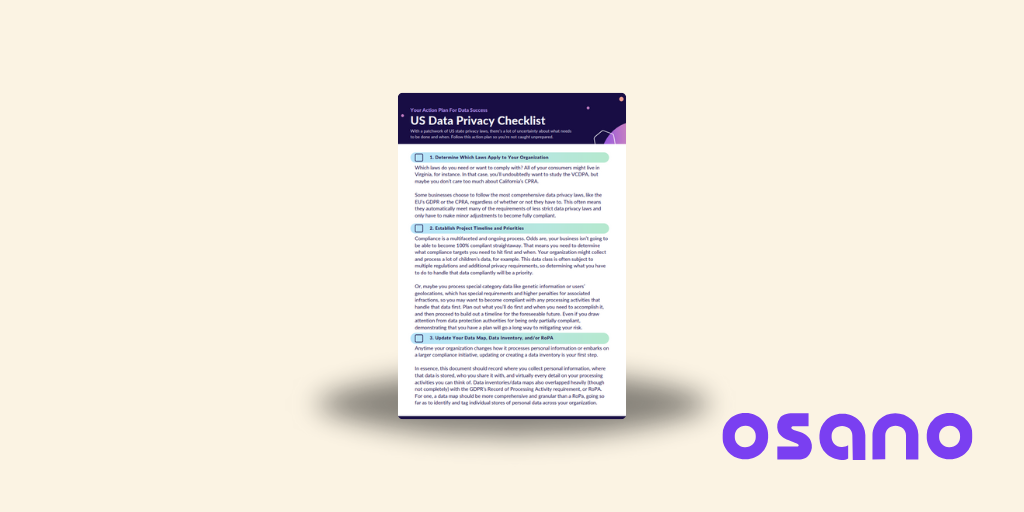

Chris Stephens
Chris Stephens
As Osano's Content Marketing & Design Specialist, Chris works closely with subject matter experts to turn complex technical systems into clear, compelling content that moves people and grows brands. Outside of work, Chris DJs house music, loves dancing and catching DJ sets around Chicago, and enjoys the occasional horror novel.