.svg)


.svg)
.svg)
.svg)
.svg)
.webp?width=1220&height=1090&name=Osano-guarantee-seal%20(1).webp)
Data privacy compliance can be overwhelming. It’s a complex matter for growing businesses, who need to know exactly which laws they need to comply with and what they require. And that’s all before working out how to manage these obligations.
A consent management platform (CMP) can help make compliance simple. These solutions help you ask for, collect, operationalize, and record consent for data processing in compliance with the dozens of data privacy laws across the globe.
What does this mean for you? No more uphill scrambling to manually stay on top of ever-growing regulatory demands. With the right CMP, you can make compliance feasible and protect customer trust, all while reserving more time for high-impact activities.
However, it’s important you choose the right platform for your organization. To help you find the best fit, we’ll walk through six of the best consent management platforms and their pros and cons. First, though, we’ll cover the basics of CMPs and what key features to look for when evaluating solutions. If you just want to see our comparison of CMPs, scroll down to the bottom of this article.
What Is a Consent Management Platform?
For most, a consent management platform is a means of managing the cookie consent aspect of privacy compliance, simplifying how this is handled. Cookie consent is the biggest use case for CMPs, but they can also help you manage consent for non-cookie-based data collection. Essentially, it’s software that helps websites collect and manage the user consent required to process consumers’ personal data, making this easier and more transparent.
Note that data privacy laws regulate the collection of personal data–not the use of cookies per se. In most cases, you’ll need to secure consent for any data collection and processing you engage in. Commonly, data collection and processing includes:
- Advertising,
- Personalizing user experiences,
- Measuring website performance,
- Understanding website visitor behavior,
- Combining information to profile consumers,
- Selling or sharing consumer data with other organizations,
- And pretty much anything you want to do with others’ data.
CMPs are essential to ensuring compliance with privacy regulations like the GDPR or CCPA/CPRA, which often state that users must be able to make informed choices about their data collection. They allow you to track individuals’ preferences and keep records of their decisions around consent, so you can adjust your activities around these choices, honor consumers’ requests, and remain accountable to regulators. If you don’t have a record of consumer consents, regulators will treat it as though you never collected consent in the first place!
What Does a CMP Do?
The main features of a CMP are:
- Consent collection: This is the main function of a consent management platform. It coordinates the collection of valid user consent in compliance with regulations, ensuring consent is as granular as required by local law and can be revoked. Every jurisdiction with a privacy law has different requirements around consent collection (not to mention different languages to ask for consent in), so outsourcing the research and development of consent banners is in itself a huge timesaver and risk reduction.
- Consent and preference management: After you secure consent from a user, what happens if they change their mind? Or if they’re willing to consent to certain uses of their data only? What if they want to adjust privacy-adjacent aspects of their experience, like how and how often you communicate with them? CMPs let you manage individual users’ consent and communication preferences to give them the control they deserve and are due by law.
- Consent signals: Emerging tools allow consumers to indicate their consent preferences in their browser, rather than on each individual website they visit. Your CMP needs to be able to accept these signals, like the Global Privacy Control (GPC), and block or permit data trackers on your site accordingly.
- Proof of consent: To allow you to actively demonstrate compliance, a CMP stores every consent once it’s collected so it can be used as proof of compliance during regulatory audits.
Why Do You Need a Consent Management Platform?
A consent management platform helps you stay compliant as it’s often mandated that businesses get consent before collecting and using personal data. Here’s how some of the world’s most prominent data privacy regulations treat consent management:
- The GDPR (General Data Protection Regulation; the EU): Businesses must obtain freely given, specific, informed, and unambiguous consent before processing a user’s personal data. Individuals also have the right to withdraw their consent at any time, and businesses are required to maintain clear records proving consent was given.
- The CCPA/CPRA (California Consumer Privacy Act/California Privacy Rights Act; California): Consumers must be informed about what personal data is being collected and for what purpose, though businesses are free to collect personal data prior to asking for consent unlike the GDPR. However, consumers must also be given the option to opt out of the sale or sharing of their data, and companies must provide a clear and accessible way to exercise these rights.
- The LGPD (Lei Geral de Proteção de Dados; Brazil): Closely mirroring the GDPR’s principles, the LGPD requires businesses to obtain explicit consent before collecting or processing personal data. It also grants individuals the right to access, correct, and delete their information, among the data subject rights.
- PIPEDA (Personal Information Protection and Electronic Documents Act; Canada): Organizations have to obtain meaningful consent for the collection, use, or disclosure of personal information. This can be opt-in or opt-out consent, depending on the sensitivity of the information and the reasonable expectations of the individual providing consent.
The Benefits of Using a Consent Management Solution
What happens if you fail to comply with these laws? Non-compliance can have serious consequences, such as substantial fines and legal action, depending on the severity of the violation. The GDPR, for example, issues fees of up to 4% of annual global revenue or 20 million euros, whichever is greater.
But beyond the financial damage, non-compliance can have devastating effects on your company’s reputation, eroding the trust of your clients and even driving potential new customers away.
Furthermore, cyberinsurers, M&A partners, and other partners are making privacy compliance part of their due diligence process. If you want to engage with other organizations in a significant way, achieving compliance is a necessary step to prove you’re worth their time.
The Benefits of Using a CMP
An effective enterprise consent management platform helps to avoid these risks, and is therefore a necessity for businesses. It ensures the process of collecting and managing user permissions is fully transparent so consumers can have full confidence that their data is being respected. At the same time, it provides accountability with clear audit trails and records–a practice that is not only good governance, but also meets requirements under data privacy law.
Ultimately, by implementing a CMP, businesses not only make it far easier to stay compliant (thereby protecting themselves from penalties) but also build stronger relationships with their audience through trust and loyalty.
Key Features to Look for In a Consent Management Software
All consent management solutions are different, so it’s important to carefully consider which option best complements your business. Having said that, there are some features that should be non-negotiable when selecting the right tool, no matter how you work.
Regulatory Coverage
CMPs are designed to help you maintain compliance, so it’s non-negotiable that they do this comprehensively. Does the platform support all privacy laws that your business is subject to? It should adhere to certain standards, including the requirements set out by the GDPR, CCPA/CPRA, and any other international or regional regulations that apply or may someday apply to your organization.
Easy Implementation
You don’t want to have to spend hours taking up developer time to tweak code and make your CMP fit your existing systems. Even if a solution can integrate with every niche system under the sun, if it’s a complicated slog to implement, you won’t be able to enjoy the benefits of those integrations. A big part of evaluating the ease of solution’s implementation is evaluating the vendor’s onboarding team and process. See if you can get a sense of what the process will look like, how much assistance you’ll have, and what other customers’ experiences have been.
Customization
Can you adapt your cookie banner to fit your brand style? You should be able to customize the look and feel of the pop-up to reflect your company’s design. And, it should have responsive design that enables it to work perfectly on any device. However, total customizability isn’t necessarily a good thing in this case–some privacy laws have very specific requirements about banner design, down to the colors you can apply to the buttons. You’ll want to ensure your solution lets you present an on-brand banner without making it easy to customize your way into non-compliance.
Automatic Cookie Scanning
To ask for consent in line with privacy laws, consumers must be made aware of any cookies and other scripts being used to track data on your site so they can make a fully informed decision. But do you know all the cookies and scripts you’re currently deploying?
A good CMP will be able to detect tracking technologies used on your site. It should then categorize them based on their purpose (e.g., marketing, analytics, personalization, essential) so you can give a detailed description to users when asking for their consent. Many privacy laws, like the GDPR, require you to give users the option of consenting or not consenting to specific categories of data trackers.
Consent Reporting
It’s not enough to simply ask for consent, you must also be able to prove this to demonstrate compliance. To support this, a CMP should thoroughly document every permission given and store consent records to create a trail for regulators to follow during an audit. This should include a timestamp of when consent was given, what the status was (whether they accepted or not), and which cookie categories they agreed to.
Scalability
Whether you’re an SMB or a large enterprise, your CMP must be able to handle the volume of data and consent requests that your business receives. Not only this, but as your business grows you’re likely to have increasing levels of traffic, possibly across different digital properties, and your CMP must be able to accommodate this. Is it scalable enough to fulfil your needs far into the future?
Ongoing Updates
Privacy laws are ever-changing, and it can be hard to keep up with current requirements. Manually checking laws and updating policies is highly ineffective. Your cookie consent management platform should make it easy to remain up to date by automatically aligning with the latest regulations and best practices. You’ll want to ensure privacy and legal professionals on your vendor’s team are evaluating developments in the privacy world and working with the vendor’s developers to translate these developments into the CMP’s design.
6 of the Best Consent Management Platforms to Ensure Compliance
With so many consent management platforms available, how can you choose the best option for you? While they may appear similar at first glance, each has different features, strengths, and weaknesses that should be taken into account when assessing the right fit.
We’ve evaluated six of the most prominent options to help you select your ideal platform.
Osano
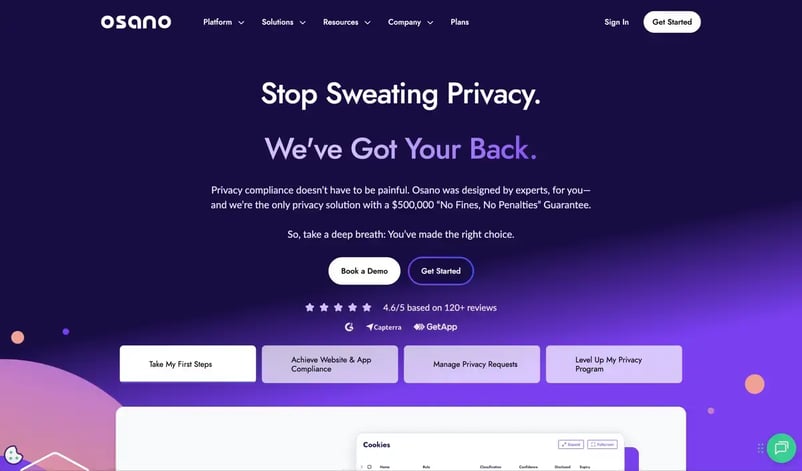
Best for: A wide range of businesses interested in managing user consent with a simple implementation, baked-in compliance guidance, and excellent support.
Osano offers a fully comprehensive, compliance-first CMP that ticks all the boxes and more. Together, its Cookie Consent and Unified Consent & Preference Hub give privacy professionals and other consent owners a one-stop global privacy platform for total visibility and control across their business. Read how Osano compares with DataGrail
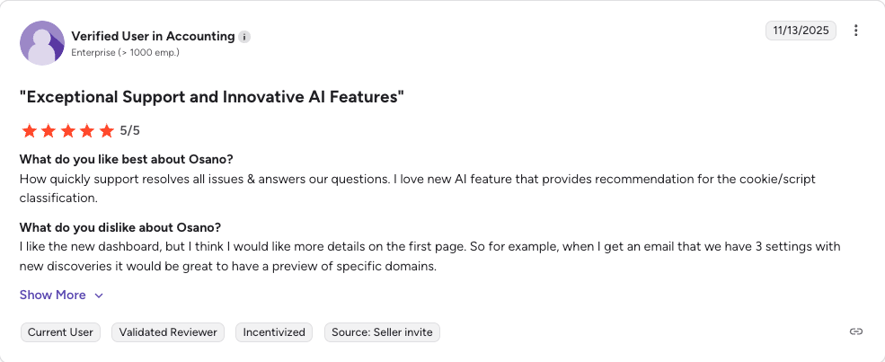
Compliance is baked into the platform, and advanced AI enforces this with highly accurate cookie identification and classification, which a recent G2 reviewer higlighted, "I love new AI feature that provides recommendation for the cookie/script classification."
And, as a Google CMP partner, Osano integrates seamlessly with Google Consent Mode. It also accepts universal opt-out signals like the GPC.
Lastly, Osano is the only CMP to provide a compliance guarantee. If you use the platform according to best practices and still get fined, Osano will pay up to $500,000 off your penalty.
Key capabilities:
- Fast implementation: Implement cookie consent management in minutes with one line of code, supported directly by dedicated implementation and migration experts who specialize in consent choices.
- AI-powered automation: Identify and classify cookies and streamline consent tasks using AI for optimal accuracy–note that Osano’s AI does not process personal information.
- Unified consent management: Track and manage all consents (from cookie consent banners to do-not-sell/-share requests) across your entire business from a single source of truth.
- Built-in compliance and risk mitigation: Stay up to date with global privacy regulations with continual updates, prevent dark patterns with built-in templates and guardrails, maintain detailed auditable consent logs, and integrate with GRC tools to embed consent into your broader risk strategy.
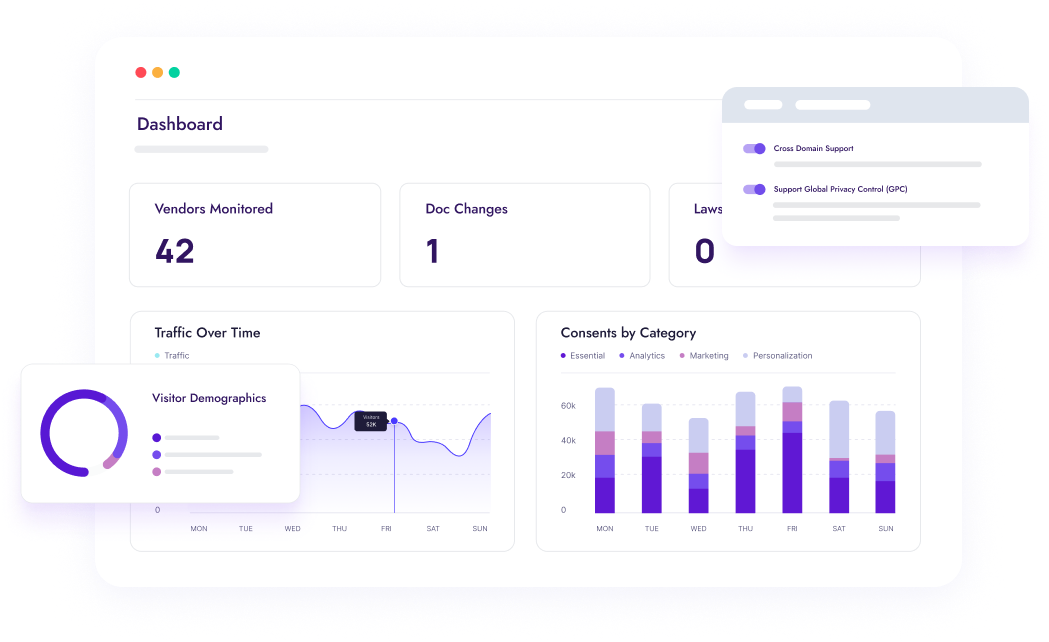
- Insightful reporting & analytics: Gain visibility into consent metrics, trends, and opt-out rates with intuitive dashboards that help you identify risks and make informed decisions.
- “No Fines, No Penalties” Guarantee: Osano stands behind its platform. If consent is managed according to best practices and you still receive a fine, Osano covers it, giving you confidence and peace of mind.
- Audit defense: If you receive an audit, notice of inquiry, cure letter, or other regulatory notice, the Osano team will guide you through the response process, providing guidance in what can be a very stressful time.

CookieBot
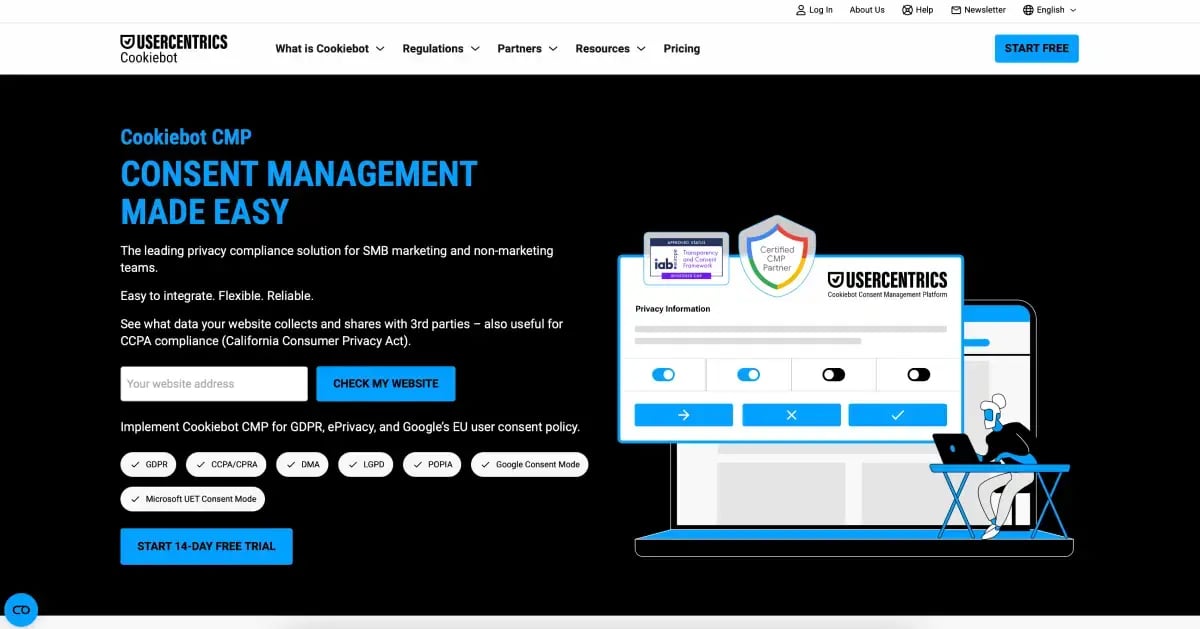
Best for: Midsize businesses prioritizing automation in consent management
CookieBot is best known for its automated cookie scanning and CMP partner certification from Google. It also provides consent banners in a wide range of languages, making it a strong option for businesses with international audiences, and is specialized for WordPress users.
This solution is suited particularly well to websites that need quick, simple cookie consent compliance. However, its more basic setup makes it less compatible for growing organizations that therefore need scalable, comprehensive compliance support. In addition, CookieBot has been found to have an outsized impact on site speed due to its use of an externally hosted script.
Key capabilities:
- Automated cookie scanning: Detect cookies and trackers on your site with CookieBot’s patented scanning technology. Schedule on-demand updates and receive a monthly scan report via email.
- Customizable consent banner: Fully customize the design, content, and placement of the banner to increase opt-in rates and user trust. Geotarget consent banners in real-time and auto-translate your consent banner in 47+ available languages.
- Easy integration with CMS platforms: Integrate with Google Tag Manager and a wide range of CMS platforms, including Shopify, Magento, Drupal, and many more.
OneTrust
Best for: Large organizations that need tools extending beyond consent and privacy management
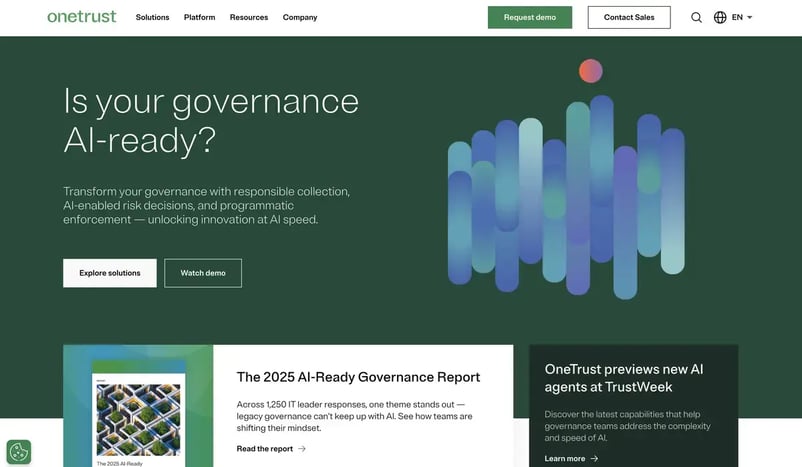
OneTrust is one of the first CMPs to have emerged on the market and is a key player in this area. Its platform offers a full suite of tools not only in consent management but also vendor risk, data governance, security, and compliance automation.
As a result, it’s a valuable solution for companies in heavily regulated industries. It’s also aimed mainly towards large enterprises, so may exceed the needs and budgets of smaller teams. Its scope and flexibility also make it very complex to implement and use, and users often report a lack of support. As a result, an ecosystem of OneTrust consultants exists that can help OneTrust users configure the platform.
Key capabilities:
- Enterprise-grade consent management: Manage consent granularly across multiple devices with full Google CMP and IAB compliance, tailored for large-scale organizations.
- Privacy and data governance: Do more than just consent management with integrated tools for mapping and auditing data, managing vendor risk, and ESG reporting.
- AI-powered automation: Speed up workflows and increase accuracy with AI tools that automate consent updates and compliance reporting to reduce manual effort.
- Centralized compliance and record-keeping: Maintain one single archive of user preferences, opt-outs, and audit logs, making it easy to demonstrate compliance with over 50 global privacy laws.
- Large-scale integration: Connect with CRMs, IT systems, GRC platforms, and more for truly personalized workflows. Setup may require additional implementation time due to its depth and scale.
Learn more about OneTrust alternatives here
Usercentrics
Best for: Enterprise-level businesses needing a highly customizable CMP solution
Designed for scale, Usercentrics is a gold-tier certified CMP in Google’s partner program with customers in over 180 countries. It’s a very customizable CMP platform that helps large organizations manage fine-tuned consent preferences across multiple channels. It also integrates well with complex internal systems, making it a good choice for growing and large companies.
In 2021, Usercentrics acquired Cookiebot. Its automation was therefore enhanced, but its primary focus remains on consent management.
Key capabilities:
- Optimization and performance insights: Measure banner performance and improve consent rates over time with A/B testing and analytics tools. Note that excessive consent optimization can lead to dark patterns, which violate privacy laws.
- Developer-friendly flexibility: Seamlessly integrate with internal systems, apps, and third-party tools using robust API and SDK support.
- Scalable, session-based pricing: Adapt pricing with a flexible model that scales with website traffic, which is ideal for growing companies and digital agencies managing fluctuating visitor volumes.
- Customizable compliance: Automatically customize compliance banners to match brand identity, and adapt them to regional privacy laws with geolocation-based rules, ensuring accurate compliance across 150+ countries.
- Automated compliance enforcement: Automatically block non-essential cookies and third-party services until consent is granted using Usercentrics’ extensive repository.
Didomi
Best for: Global businesses requiring a multi-regulation CMP across multiple devices
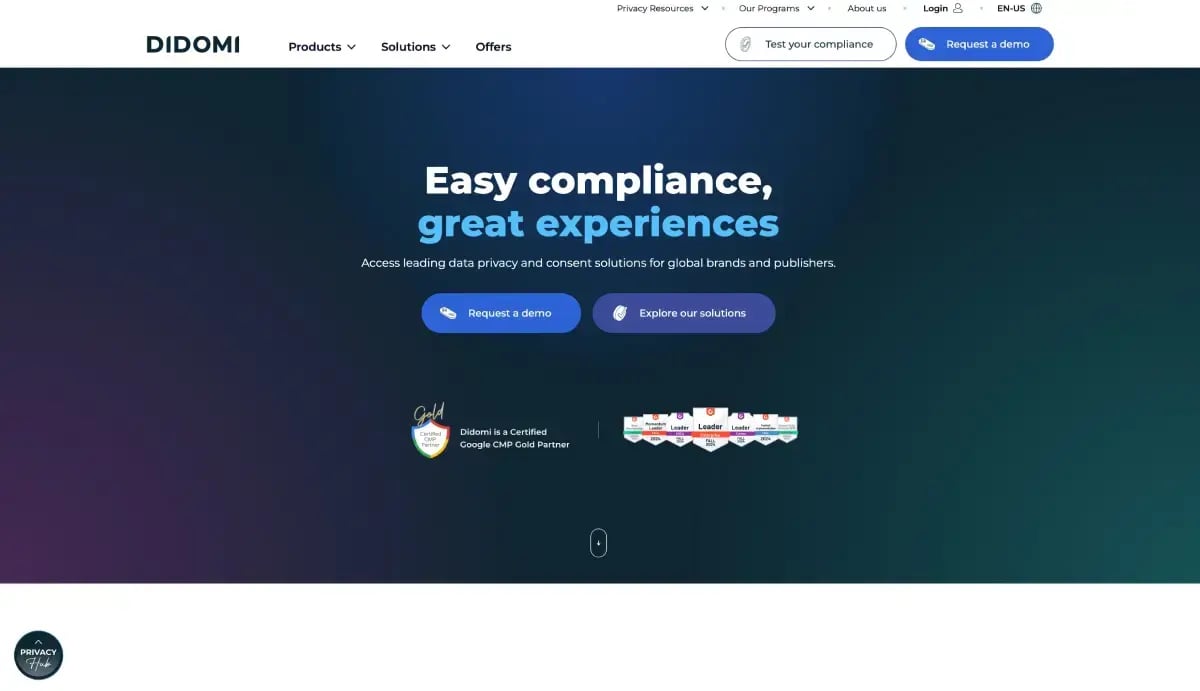
Specializing in multi-regulatory consent management, Didomi addresses all laws, including GDPR, CCPA/CPRA, LGPD, PDPD, and PIPA. Every consent banner is automatically geotargeted. They also have a large focus on usability, highlighting their intuitive UI-based tools that can be easily adopted by “anyone with basic internet skills.”
Didomi is also Google-certified and is adaptable to businesses of all sizes, making it an effective consent management tool. It is a slightly more premium solution, however, so may be unsuitable for organizations who only need a simple consent banner. It also has been found to impact site speeds and doesn’t allow for scanning more than 25 domains, which can be a dealbreaker for agencies or other organizations that manage multiple domains.
Key capabilities:
- Multi-regulation compliance and geotargeting: Manage locations and regulations from Didomi’s admin console, with geotargeting so that the right consent banner or privacy notice is always displayed based on user location. Choose from over 45 languages available.
- Branded and personalized experiences: Customize your banners to fit your brand aesthetics and regulatory needs to achieve higher opt-in rates. This can also lead to dark patterns, however.
- Integration-friendly: Integrate easily with your existing stack, from popular CRMs to analytics platforms and marketing tools, as well as major frameworks like Google Consent Mode, Microsoft UET Consent Mode, and the IAB Transparency and Consent Framework (TCF)
- Privacy support: Get assistance for your most complex challenges from Didomi’s team of privacy professionals along with insights, such as a yearly consent benchmark.
- Multi-device support: Reduce consent fatigue for customers with a cross-device feature that respects consent across different devices and environments, so users only need to provide their consent once.
CookieYes
Best for: Smaller businesses who need a simple, budget-friendly CMP that’s easy to implement.
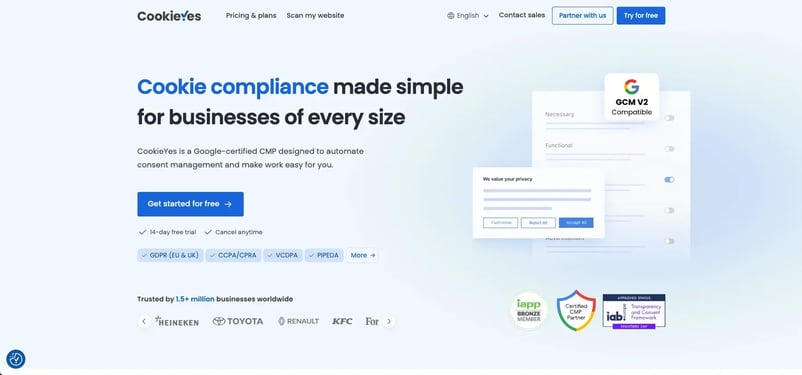
CookieYes combines a simple-to-use platform with essential tools and attractive pricing, making it an ideal option for small businesses wanting a fast setup. It supports GDPR, CCPA, and UK GDPR requirements while offering one-click deployment and multilingual support, but lacks more advanced capabilities like deep automation and adaptability. As a result, it may not be the best option if you anticipate growth or have changing legal needs.
One of CookieYes’s most attractive features is its free plan, though the capabilities in this option are understandably limited, with features like language and multi-domain support only being available in paid tiers.
Key capabilities:
- Custom cookie banner display: Add customized layout, design, and text to your consent banner, personalizing it with CSS and your branding. Display the banner in one of over 30 languages.
- Granular cookie control: Set cookies as per user preferences and collect consent for specific cookie categories, with a full overview of opt-ins readily available.
- Automated website scanning: Detect and auto-categorize all cookies with the option to schedule monthly cookie scanning and generate a detailed audit report.
- Comprehensive consent management: Deliver effective compliance with geo-targeted banners, consent logging for audit trails, Google Consent Mode integration, and a cookie widget that lets users easily review or withdraw consent.
- Instant policy generation: Create customized privacy and cookie policies in minutes using free generators, quick questionnaires, and pre-built templates, and then copy and embed them directly on your website.
Want to see Osano action? Start your free trial to explore how Osano approaches consent management differently.
See Osano in Action
Ready to start evaluating CMPs? Start here. Schedule a demo to see how Osano can help simplify your privacy program.
Book a Demo