.svg)


.svg)
.svg)
.svg)
.svg)
.webp?width=1220&height=1090&name=Osano-guarantee-seal%20(1).webp)
Nobody wants to run afoul of regulation and ignore people’s right to privacy. It’s just much harder to be compliant than it is to be non-compliant!
Once you’ve understood the basics of your governing privacy law, you’ll learn there’s another regulation to comply with, new rulemaking, or recent amendments. You’ll find out it’s tough to get everyone to adhere to your policies, help fulfill subject rights requests, or carry out privacy assessments. Your cookie banner needs to work a certain way, you need to offer certain controls to users, you need to notify them of this, that, or the other–the list goes on.
It’s not easy. Fortunately, privacy compliance software can help make doing the right thing a little easier.
Different organizations have different needs, so they aren’t a one-size-fits all software category. You’ll need to understand what makes one privacy compliance software a better fit for you compared to others, what features to look out for, and what pitfalls to avoid.
What Is Data Privacy Compliance?
Data privacy compliance is non-negotiable in any organization that handles consumers’ data. In order to protect consumers’ right to privacy–including protecting their data, asking them for permission to use it, explaining what you intend to do with it, and giving consumers control over what happens to their data–you’ll need to comply with data privacy laws.
The most prevalent of these laws include the GDPR and the CCPA.
These rules safeguard consumer data, known as personal information (PI). They establish standardized rules for companies to follow, making privacy largely consistent across businesses and industries.
So, data privacy compliance consists of the policies and practices taken to collect, process, and store data in a way that is in line with all applicable privacy regulations.
What Is Privacy Compliance and Management Software?
Data privacy compliance (or data privacy management) software helps organizations meet regulatory standards. They’re digital tools that manage and automate data privacy protection, focusing on tasks such as:
- Mapping data
- Managing consent
- Conducting assessments, such as privacy impact assessments (PIAs) and records of processing activities (RoPAs)
- Responding to data subject access requests (DSARs; often referred to as subject rights requests or SRRs)
- Managing third-party risk
- Maintaining audit trails
Centralizing all of these processes in a single platform reduces human error and also frees up time for teams to focus on risk mitigation, revenue generation, or other business priorities.An often underlooked benefit of these solutions is the peace of mind gained from increased visibility, knowing that you’re fulfilling your compliance obligations, and being able to prove it should the need arise.
Why Is Data Privacy Software Important?
Privacy laws are becoming increasingly common and increasingly enforced, making a compliance software solution increasingly necessary to have in your arsenal.
Here are some examples of some of the most prevalent privacy laws worldwide:
- GDPR (General Data Protection Regulation–EU & UK)
- CCPA/CPRA (California Consumer Privacy Act & California Privacy Rights Act–USA)
- LGPD (Lei Geral de Proteção de Dados–Brazil)
- PIPEDA (Personal Information Protection and Electronic Documents Act–Canada)
Fail to adhere to these regulations, and you may face damaging financial penalties. For example, non-compliance with the GDPR can result in fines of up to €20 million or 4% of global annual turnover (whichever is higher). Our Enforcement Tracker can give you a sense of the pace and scale of privacy enforcement globally.
However, fines and penalties aren’t the only reason to comply. The penalties that make the headlines are just the tip of the iceberg; for each violation that yields a fine, regulators conduct thousands of investigations and audits that disrupt the flow of business.
Non-compliance can also have devastating effects on your company’s reputation, eroding the trust of your clients and even driving potential new customers away.
Finally, data privacy compliance is increasingly seen as table stakes for businesses. Cyber insurers may charge you more or refuse to cover your business. Partners may be wary of entering into a relationship with your organization. And potential M&A deals may sour or become less attractive if privacy risk is high at your organization.
Key Functions of Data Privacy Compliance Software
Consent and Preference Management
A key aspect of privacy laws is user consent. Before companies are able to collect or use consumers’ personal data, they must either secure their consent or provide them a means of opting out of data collection. These two methods of collecting consent are known as explicit and implicit consent, or opt-in and opt-out consent, respectively.
In either case, businesses must:
-
Inform users about how their personal data will be collected and used.
-
Inform them of their rights, including their right to opt-out.
-
Document their consent preferences to prove compliance later on.
Privacy compliance software tracks and manages consent for data collection and processing, including by providing granular preference settings for those that want to opt in to some forms of data processing but not others. Additionally, your privacy solution should create an audit trail of the choices made
Subject Rights Management
Data privacy laws give consumers certain rights, known as data subject rights. Sometimes, you’ll see these referred to as data subject access rights (DSARs) or subject rights requests (SRRs).
The rights you’ll need to honor will differ from law to law, but generally, they include the:
- Right to know/access, in which you’ll provide a summary or all of the data you’ve collected on a data subject
- Right to correct inaccurate data
- Right to request the deletion of data
- Right to opt out of the sale or sharing of data
- Right for the data subject to receive their information in a portable format
Privacy compliance software should help you orchestrate the end-to-end process of fulfilling these requests. That includes secure intake, communication, notifying internal teams, fulfilling requests within mandated timeframes (usually 30 or 45 days), discovering data, and performing the requested operation on it.
Tracking Privacy Regulations
Privacy regulations evolve all the time, whether through amendments, the passage of new laws, or rulemaking. Furthermore, privacy regulations apply extraterritorially; that is, they apply based on whether you process the data of local consumers, not based on where your organization is located. Thus, you might be subject to complex requirements the world over. Parsing what you need to do and where can be a full-time job.
But privacy compliance software can help. The right software solution will be maintained by privacy and legal experts such that your privacy management differs depending on the given consumer’s jurisdiction and their governing law. That could involve changing how consent banners function, adjusting applicable subject rights offerings, and more.
Automated Data Discovery and Classification
Data privacy management software should enable you to automatically find and classify personal data across your entire organization. This can be a hard task to do without dedicated software as this information is usually spread out across disparate systems or can even be contained in shadow IT systems.
PI discovery and classification is often referred to as data mapping or building a data map. Most (but not all) privacy regulations don’t require you to map your data, but doing so makes it much easier to maintain compliance. If you don’t know where your data lives, you can’t effectively respond to DSARs. If you don’t know where your data comes from, you can’t know if you’ve notified consumers and asked for their consent to collect it. If you don’t know where your data is going, you can’t know whether you’re transferring it to third parties. Understanding where your data comes from, where it lives, and where it’s going is fundamental to achieving compliance with any privacy regulation.
Vendor and Third-Party Risk Control
Every business depends on products and services from a variety of third-party vendors. But these vendors often ask for the PI you control in order to provide their product or service–and they don’t always treat that PI compliantly. The more vendors you rely on, the greater your exposure to data privacy risks. Imagine one of your vendors suffers a breach; your data would be compromised too. Or, they might have poor privacy practices and unwittingly transfer your data on to a vendor of their own. Or they could simply re-use your consumers’ data for a purpose they never agreed to.
To reduce this risk, the best privacy compliance platforms should include vendor assessment tools to evaluate whether a given third party has robust privacy protections in place and to monitor their on-going compliance..
Incident Response
Even the most diligent organization can be subject to a data breach. Your compliance management software should monitor your organizations for data breaches and enable you to mitigate breaches in your own organization. Data mapping capabilities, for example, can help you understand the scope of the breach. Customizable assessments can help you document post-breach responses. Some privacy compliance providers even offer audit defense services to help you navigate any follow-on investigations.
Detailed Reporting
It’s not enough to merely maintain compliance, you must also demonstrate it with concrete evidence. A key advantage of using privacy compliance software is its ability to automatically document compliance activities that can be easily reviewed by regulators and auditors.
A good set of reporting features should allow you to:
- Document consent history and DSARs
- Identify areas of non-compliance with visual dashboards
- Tailor reports to different regulatory frameworks
- Inventory/map your data
- Conduct and store assessments
- Maintain all of these records for required timeframes, and then delete them when they’re no longer needed and may be a source of unnecessary risk
Benefits of Using a Compliance Solution to Simplify Data Privacy
Of course, the greatest advantage of using compliance software is avoiding the consequences of non-compliance. But there are also many other benefits above and beyond avoiding fines.
Increased Efficiency
Using compliance software to automate your data privacy workflows reduces the manual labor that goes into regulatory adherence. In turn, this decreases errors and ensures you’re spending the least amount of time non-compliant as possible. With this work now taking less time and effort, employees are freed up to focus on other strategic or revenue-generating business activities.
Cost Savings
Compliance software reduces risks, which also minimizes costs by extension. For one, it helps you avoid the hefty fines that come from non-compliance. It reduces the odds of a breach occurring as well as the scope of any breaches that do occur. As a result, you’ll spend less on remediation.
More Customer Trust
Using compliance software tells your customers that you take privacy seriously. When you provide clear information on what data you collect and how as well as granular consent options, consumers will recognize that you’re worthy of their trust.
A unified platform also helps you stay consistent with compliance, so customers know exactly what to expect from you. Plus, with fewer breaches there are fewer negative experiences that can erode confidence in your brand.
Today, businesses understand that respecting consumer privacy is more than just a regulatory check box; it’s a brand value. Apple went so far as to center an entire ad campaign around the iPhone’s privacy advantages.
Data-Driven Decision-Making
Many privacy compliance tools include multiple dashboards and analytics that provide at-a-glance details about your data and patterns within it. You could discover that consumers are making certain subject rights requests at a higher rate in one jurisdiction compared to others, potentially highlighting a privacy-sensitive cohort in your market. You might realize that certain digital properties are yielding more opt-outs than others, necessitating a review of its data collection mechanisms. Maybe rights requests associated with specific data stores always take longer to fulfill.
With these insights, you can make more informed decisions around your privacy, go-to-market, and governance strategy. You’ll not only achieve compliance, but you’ll also improve top-level business processes along the way.
Regulatory Agility
Keeping up with compliance can be a cause of stress and uncertainty if you don’t have the right software to help. Privacy laws change regularly and often, which can make staying up to date a hard task–especially if you’re trying to do so manually. Furthermore, understanding the regulatory landscape is one thing; operationalizing those requirements is another. Compliance solutions can be maintained by legal and privacy experts on the vendors’ side, freeing you up from needing to research the latest requirements and how to put those requirements into practice. With this foundation in place, you’ll have lowered your risk in jurisdictions with evolving privacy standards, and you’ll be ready to move into new markets globally without being slowed down by needing to spin up a compliance program first.
The 6 Best Privacy Compliance Management Tools
There are many privacy compliance management software solutions to choose from, and some will be a better fit for your business than others.
We’ve evaluated six of the most prominent options to help you select the ideal choice for you.
Osano: The Ultimate Privacy Compliance Solution
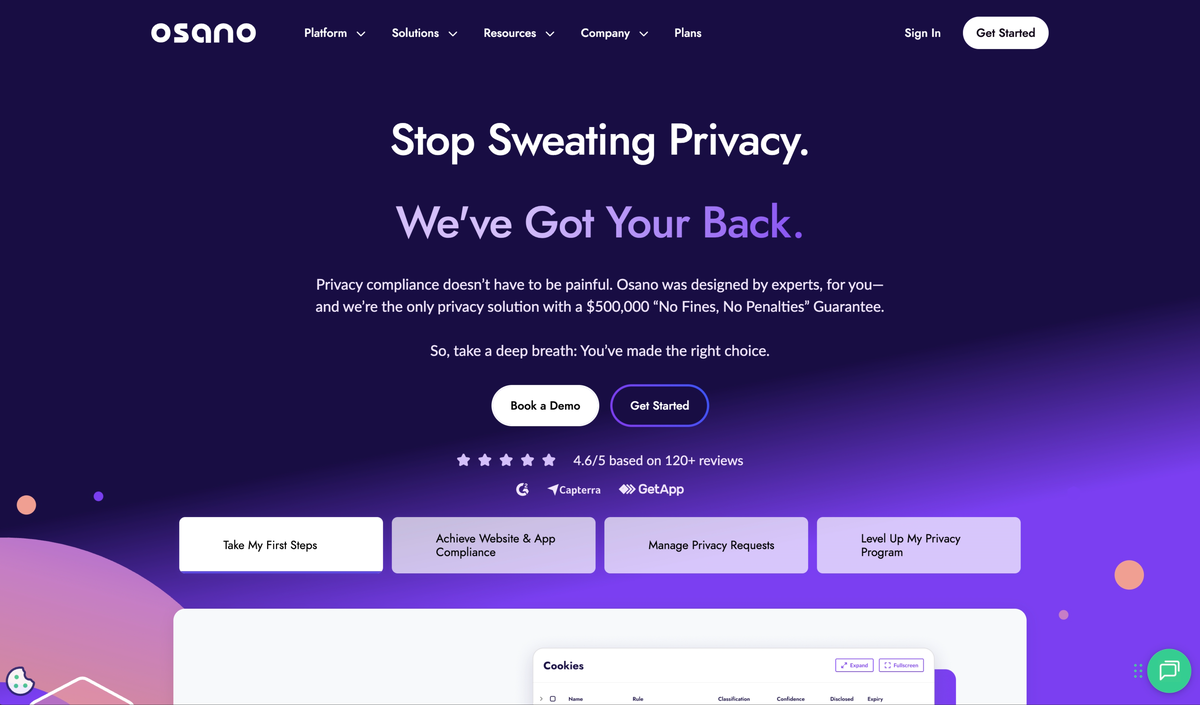
Best for: Businesses who want complete privacy compliance management and peace of mind knowing that they’re seamlessly adhering to all relevant regulations
Osano leaves no box unticked when it comes to fully comprehensive data privacy management software. It takes care of the tedious and time-consuming aspects of privacy program management so you can turn your full attention to the pressing tasks that only you can solve.
The privacy platform delivers effortless compliance in 50+ countries, but also delivers wider benefits, such as reducing risk through its “No Fines, No Penalties” Guarantee and Audit Defense service, regaining time, delivering customer outcomes, and increasing operations efficiency and cost savings.
Osano integrates with tag managers, CRMs, vendor systems, and assessment platforms, syncing consent across analytics, marketing, and legal tools to streamline privacy operations.
Key capabilities:
- Full vendor ecosystem risk management: Access vendor privacy scores, policy-change alerts, breach monitoring, and subprocessor discovery. This continuous oversight helps reduce third-party risk across a global vendor network.
- Accurate data mapping: Osano’s Data Mapping tool uses automated discovery and classification to generate records of processing activities (RoPA), making data inventories faster, more accurate, and scalable without requiring manual spreadsheets.
- Automated DSAR workflows: Integrate with 100+ common data store vendors and automate common request types to easily manage DSAR workflows from end to end.
- Unified consent management: Track and manage all consents (from cookies to do-not-sell/share requests) across your entire business from a single source of truth.
- AI-powered data classification: Use AI to automatically classify cookies and scripts, reducing manual touches and research for what each cookie/script does and how it should be classified to meet compliance requirements. Osano’s AI capabilities also automatically classify data discovered in your data map into more than 60 categories of personal, personally identifiable (PII), and sensitive data based on hundreds of data types.
- “No Fines, No Penalties” Guarantee: Osano stands behind its platform. If consent is managed according to best practices and a fine occurs, Osano covers it, giving you confidence and peace of mind. And if you receive a notice from a regulator, you can trigger Osano’s Audit Defense service. The Osano team will guide you through the response process and review your configuration to reduce the risk of being penalized for a violation.
Enzuzo
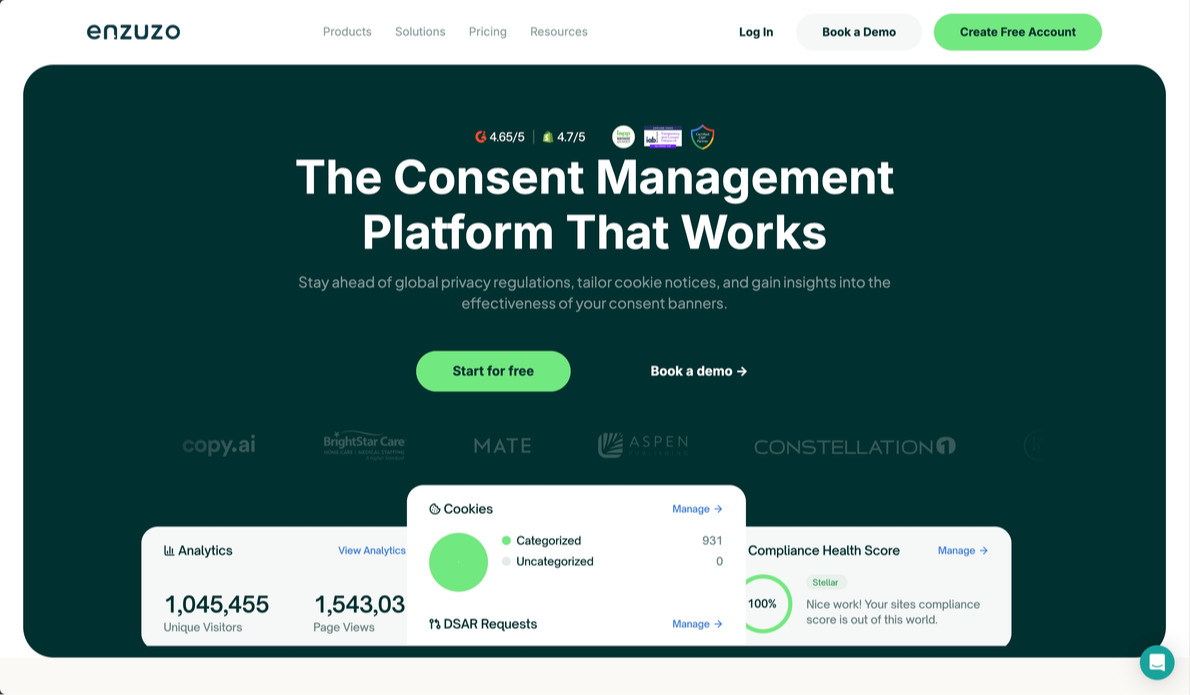
Best for: Small-to-midsize businesses who want simplicity with easy setup and affordable pricing tiers
Enzuzo has fewer advanced features than some of the more enterprise-focused options on this list, but it does cover the essentials of privacy compliance. For example, it can generate legally compliant privacy policies, manage cookie consent, and automate DSARs.
While limited in customization, Enzuzo does offer a free plan that includes a basic privacy policy and cookie banner. It’s therefore a good option for companies on a budget who just need bare-bones compliance automation.
Key capabilities:
- Privacy policy and terms of service generator: Easily adapt your policies to your business location and sector, and personalize content to your customer with over 25 languages supported.
- Built-in consent management tools: Allow users to accept, decline, or modify their preferences. Get actionable insights into banner performance with analytics that help compare metrics to tools like Google Analytics.
- DSAR automation: Track and store all requests end to end, and efficiently process and manage them. All requests can be integrated with your existing CMS.
- Human-staffed customer support: Get help from your dedicated success manager when needed on enterprise plans. Receive human-led onboarding and support with migration from previous tools, with the option of Slack integration for always-on advice.
- Integrations with website builders and ecommerce platforms: Access install guides for leading web platforms and apps such as Wix and Wordpress. Enzuzo also collaborates closely with web design and SEO agencies to ensure seamless integration without slowing down site performance.
Ketch
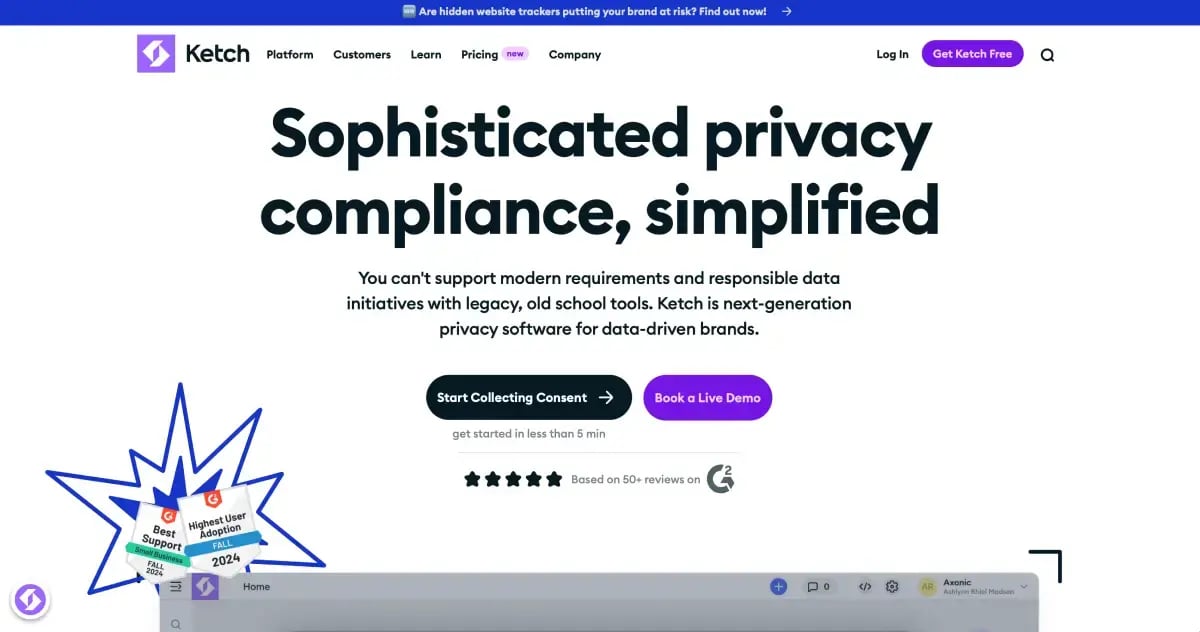
Best for: Larger enterprises looking for rapid deployment without needing specialist knowledge
Ketch is a light-code, cloud-based platform that offers a comprehensive list of privacy-focused features, from consent management and data mapping to risk assessments and more. It also has pre-built compliance templates for key regulations including the GDPR and CCPA/CPRA, among others.
One of Ketch’s stand-out features is its AI capabilities. These power its data mapping to offer real-time data discovery as well as a consent agent that restricts data sharing and access.
The downside is that Ketch has a more cumbersome onboarding process, and only a single domain can be added to the platform at a time. Therefore, its setup may involve a learning curve and require ongoing adjustments to stay up to date with changing regulations.
Key capabilities:
- Light-code setup: Automate privacy experiences and data orchestration without requiring technical expertise.
- Drag-and-drop DSAR automation: Handle DSAR request from intake to fulfillment with built-in tracking and response and a drag-and-drop workflow builder that allows you to customize the process without code.
- Comprehensive reporting and audit trails: Automatically generate compliance reports for regulators and auditors. Real-time dashboards help you easily visualize overall compliance posture.
- Automated data discovery and mapping: Identify and classify personal data across your organization using AI. Ketch connects to your existing tech stack to accurately find all relevant data.
- Pre-built integrations with popular tools: Connect Ketch to leading platforms, such as Google Analytics, HubSpot, Mailchimp, and Salesforce. With over 1,000 pre-built connectors and flexible APIs, ensure your consent and compliance signals flow seamlessly across all your business systems.
See how Ketch and Osano compare side by side: Osano vs. Ketch.
OneTrust
Best for: Enterprise budgets and teams focused on data governance in the cloud
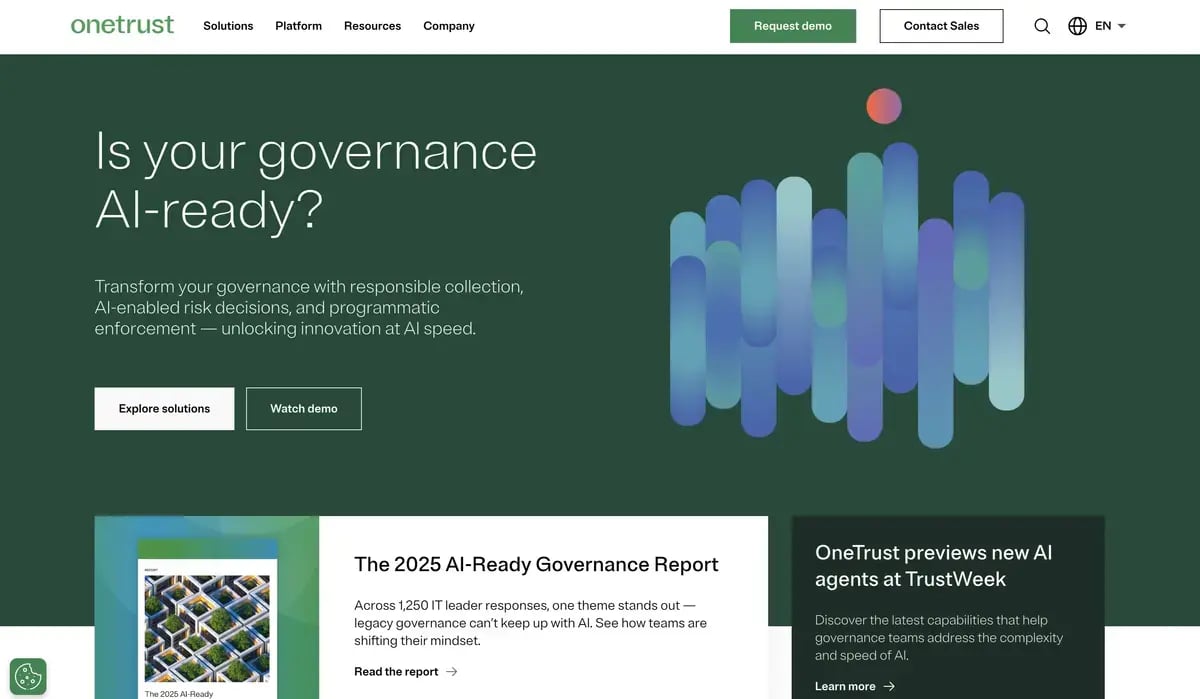
As the most widely adopted privacy management software for enterprises, OneTrust has a strong reputation. It focuses on governance but offers a full suite of tools geared towards helping highly regulated industries comply with global laws, including the GDPR, CCPA, LGPD, and more. They also go beyond selling their platform, providing a range of services from consulting to training, which help further optimize compliance.
The software is highly scalable and customizable to meet the needs of various growing businesses. The downside? It’s expensive,has a complex implementation and setup process, and doesn’t always have the latest features and updates in a timely fashion. As a result, many users consider it to be a legacy solution that requires dedicated staff to manage effectively. It may be unsuitable for smaller teams.
Key capabilities:
- Strong data mapping and AI-driven classification: Use advanced, AI-driven data classification techniques on both structured and unstructured data sources to capture data context. This allows machine-enforceable data policies.
- Easy risk assessment management: Automate privacy impact, vendor, and AI risk assessments (PIA, DPIA, TIA, etc.) and manage risk mitigation workflows.
- Automated DSAR fulfillment: Fulfill data subject requests with OneTrust’s DSR Automation, which combines regulatory-aware workflow automation with data integration.
- Customizable consent interfaces: Set up consent interfaces based on location, regulation, and industry, and customize user experiences and options from pre-built templates and configurations. Continuously update your deployment based on regulatory changes.
- Detailed third-party risk management: Automate and streamline third-party risk management with AI-driven assessments, tiered workflows, and collaborative tracking to ensure compliance and accountability across your vendor ecosystem.
Securiti
Best for: Businesses who need a wealth of features with AI capabilities at a reasonable price point
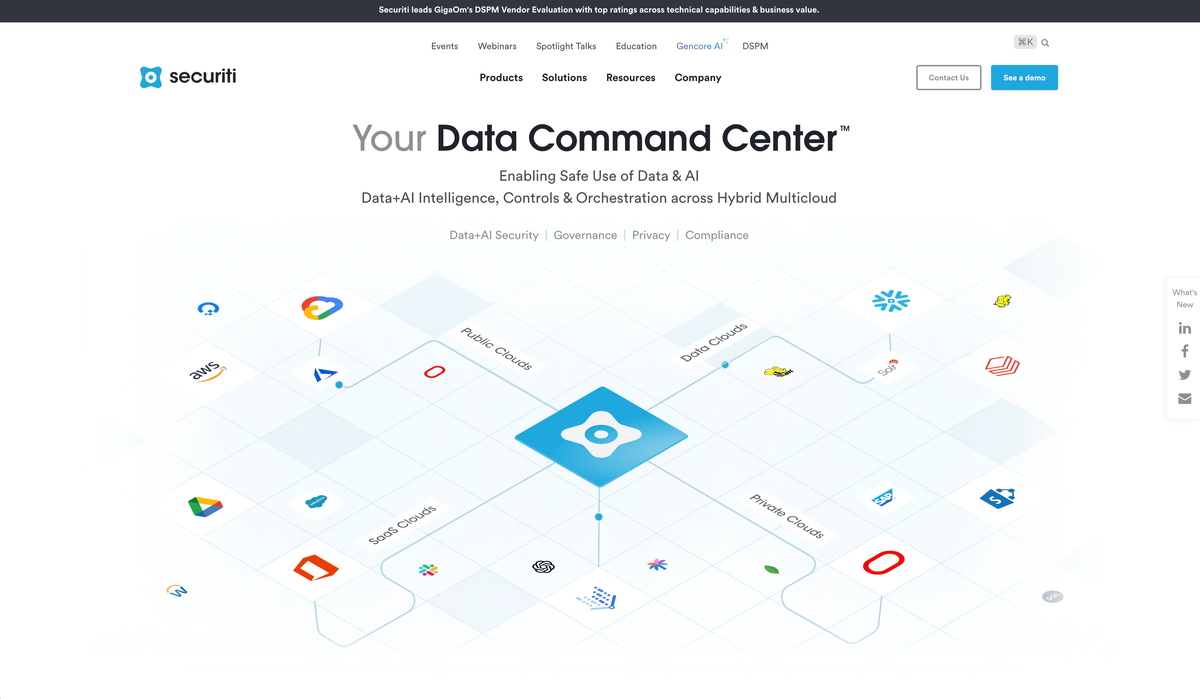
Securiti is an AI powered platform that covers security, governance, and compliance across on-premise, hybrid, and multi-cloud environments. Due to its long list of features, it’s a very large platform that is divided into separate modules to make it simpler to manage. Its main focus is on automating various aspects of data privacy at a slightly lower price point than some of the other solutions in this list.
It’s important to note that, despite having dashboards and visualization tools, Securiti lacks some of the analytics features other platforms provide. Also, navigating the platform can be more of a challenge due to its depth.
Key capabilities:
- All-in-one platform: Manage all aspects of privacy compliance, as well as security and governance, through a single pane of glass.
- Strong AI capabilities: Automate data discovery, classification, and risk assessment with help from advanced AI tools.
- Automated multi-framework testing: Reduce manual work and increase reliability using predefined tests. Or, create custom ones to verify compliance across multiple standards simultaneously.
- Advanced data discovery and privacy governance: Discover and classify sensitive data across on-prem, hybrid, and cloud environments and implement privacy impact analyses. Monitor access intelligence and enforce controls to reduce risk.
- Data Consent Automation: Use Securiti’s Data Consent Automation unit to manage cookie consent and vendor consent issues and streamline DSAR reporting to enhance trust and ensure compliance.
BigID
Best for: Enterprise organizations with complex data landscapes handling large quantities of sensitive information
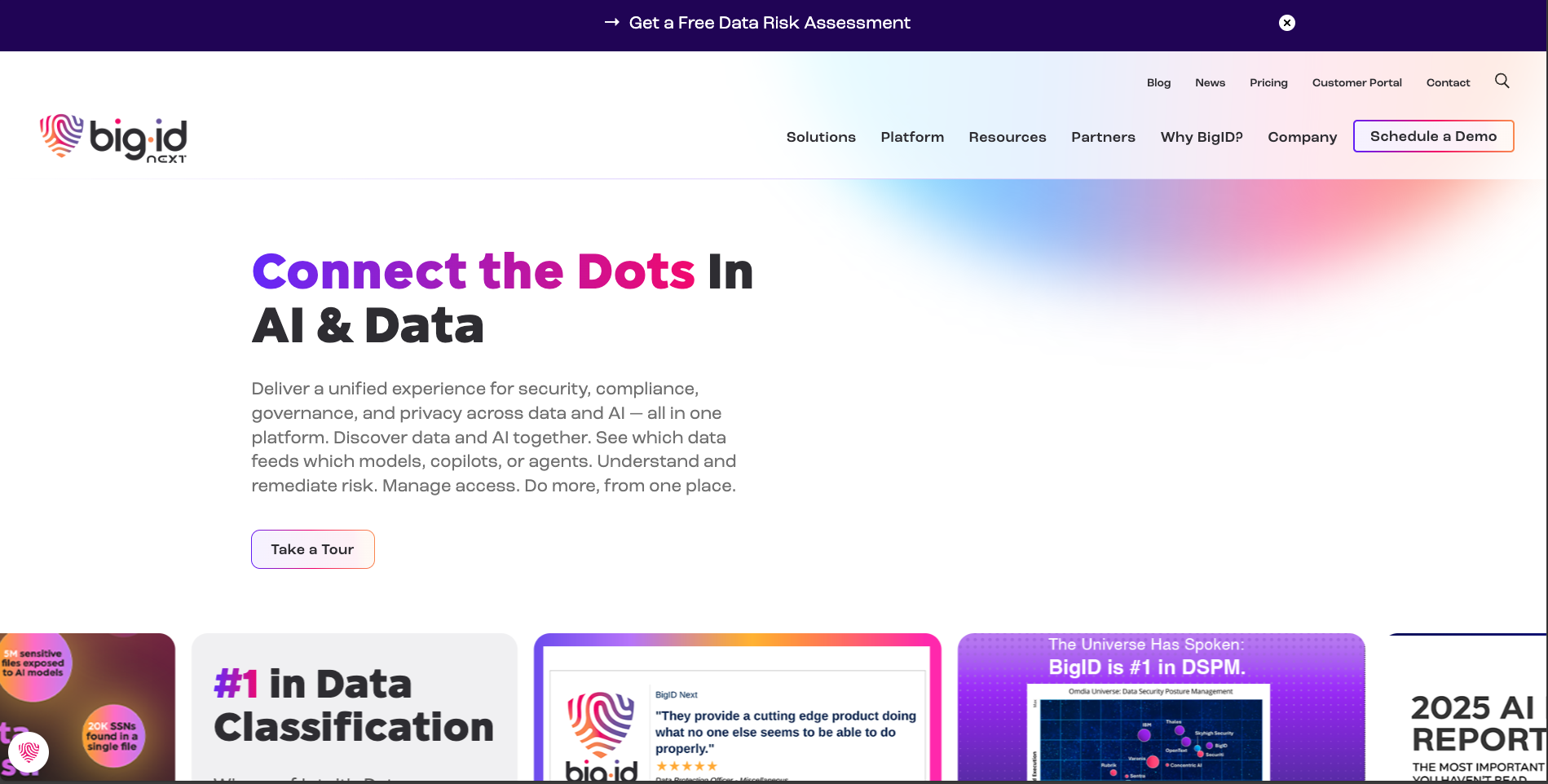
Specializing in data discovery and intelligence, BigID mainly helps businesses find, classify, and manage data across their entire landscape. In the meantime, it supports compliance with privacy regulations such as GDPR, HIPAA, and CCPA.
Offering both out-of-the-box and configurable tools, BigID’s Data Privacy Management unit is the main area for ensuring privacy compliance. It offers privacy impact assessments and data quality management, generating automatic workflows to help enhance productivity.
And, with a responsive technical and customer support team, BigID is always on hand to resolve any issues.
Key capabilities:
- Machine learning-powered discovery and classification: Find and classify all structured, unstructured, and AI data wherever it lives, and precisely classify sensitive, personal, regulated and toxic information, with an advanced discovery platform.
- Data rights automation: Fulfil data subject requests automatically, including access, deletion, and correction requests.
- Automated policy application: Automatically apply policies for GDPR, CPRA, HIPAA, PCI, NIST CSF, and emerging AI regulations to identify and act on regulated data with little effort.
- Comprehensive consent management: Centralize and enforce user consent across systems and automate cookie compliance globally with a self-service privacy portal to manage preferences in real time.
- Data retention: Define and enforce data retention policies to minimize storage costs and reduce compliance risks.
Want to see Osano in action? Start your free trial to explore how Osano approaches privacy compliance differently.
Consent Management Platform Scorecard
Worried about consent management primarily? Use our scorecard to guide your evaluation process. Discover suggested questions to ask, evaluation categories, and more.
Download Your Copy