.svg)


.svg)
.svg)
.svg)
.svg)
.webp?width=1220&height=1090&name=Osano-guarantee-seal%20(1).webp)
If your business is subject to the CCPA, you're probably aware that compliance is non-negotiable, but are you automating it yet? Many organizations are still relying on manual tracking and complex spreadsheets, which are slow and error-prone. Don't be one of them.
CCPA compliance software automates the operational work the law requires: consent and opt-out management, consumer rights requests, data mapping, and vendor oversight. This guide compares Osano, OneTrust, TrustArc, Usercentrics, and Securiti on fit, capabilities, and trade-offs so you can match a platform to your program.
With the California Privacy Protection Agency (CPPA) becoming more active in its enforcement, the need for efficient, accurate CCPA compliance work has never been more important. And the stakes have never been higher; fines are larger and more frequent than ever.
This doesn't have to be overwhelming, however. Businesses like yours can make compliance more manageable with reliable, automated software solutions built to handle privacy practices.
There are many such tools on the market, but which is right for you? Explore and compare several of the best CCPA compliance software options below, or see our broader privacy compliance software guide.
What Is the California Consumer Privacy Act (CCPA)?
The California Consumer Privacy Act (CCPA) is a data privacy law that offers consumer protections and privacy rights for residents of California. Since coming into effect on January 1, 2020, the CCPA has granted residents the following rights:
-
The right to know: Customers are entitled to information about the personal data that a company gathers about them
-
Right to delete: Consumers have the option to request that companies erase their personal data
- Right to correct: Consumers can request businesses correct inaccurate personal information
- Right to limit use of sensitive personal information: Consumers can ask businesses to limit the use of their sensitive personal information only to what is strictly necessary to provide the requested goods or services
- Right to opt out of sales and sharing: Consumers can instruct businesses not to sell or share their personal information
-
Right to non-discrimination: Companies are not allowed to treat customers unfairly if they exercise their CCPA rights
The CCPA applies to for-profit businesses that operate in California and meet any of the following:
- Have a gross annual revenue over a set threshold. The original figure was $25 million; it now adjusts periodically for inflation and stood at $26.625 million as of January 1, 2025. Adjustments are biennial, so that figure holds until January 1, 2027.
- Buy, sell, or share the personal information of 100,000 or more California residents or households
- Derive 50% or more of their annual revenue from selling or sharing California residents' personal information
What happens if you fail to comply? Your business could face financial penalties of up to $2,500 for unintentional violations and $7,500 for intentional ones, along with consumer lawsuits and reputational damage.
Why Use a CCPA Compliance Tool?
Faster Compliance Readiness
A compliance tool automates much of the manual coordination usually involved in adhering to the rules, helping you meet CCPA requirements more quickly.
Reduced Risk of Errors
Automating these processes reduces the chances of mistakes such as missed obligations or incorrect handling of consumer rights.
Meaningful Resource Savings
By freeing your internal teams from repetitive compliance tasks, automation software allows them to focus on higher-impact initiatives.
Stronger Operational Consistency
A tool helps standardize compliance practices across your business.
Increased Trust and Brand Credibility
Using a reputable CCPA compliance solution demonstrates a clear commitment to data privacy and consumer rights.
Essential Features of a Good CCPA Compliance Software Solution
Data Discovery and Mapping
Your CCPA compliance solution should discover and map your data automatically to identify sensitive information, and provide a clear view so it can be managed in line with consumer rights.
Consent and Preference Management Automation
Effective privacy compliance software needs to monitor and handle consent for all the data you've gathered or worked with, with detailed preference settings and reports for auditing.
Consumer Rights Request Management
A reliable CCPA compliance software solution helps you fulfill consumer requests efficiently and within the required deadlines with clear workflows and detailed records for auditing.
Automated Compliance Workflows
A good CCPA compliance software solution automatically creates audit trails and reports to capture actions taken such as data access, deletion, consent updates, and request fulfillment.
Vendor Risk Management
Your chosen CCPA compliance tool should provide ways to manage vendor risk, like tracking which vendors have access to personal data and assessing their compliance posture.
Top CCPA Compliance Solutions 2026: Detailed Overview
Osano
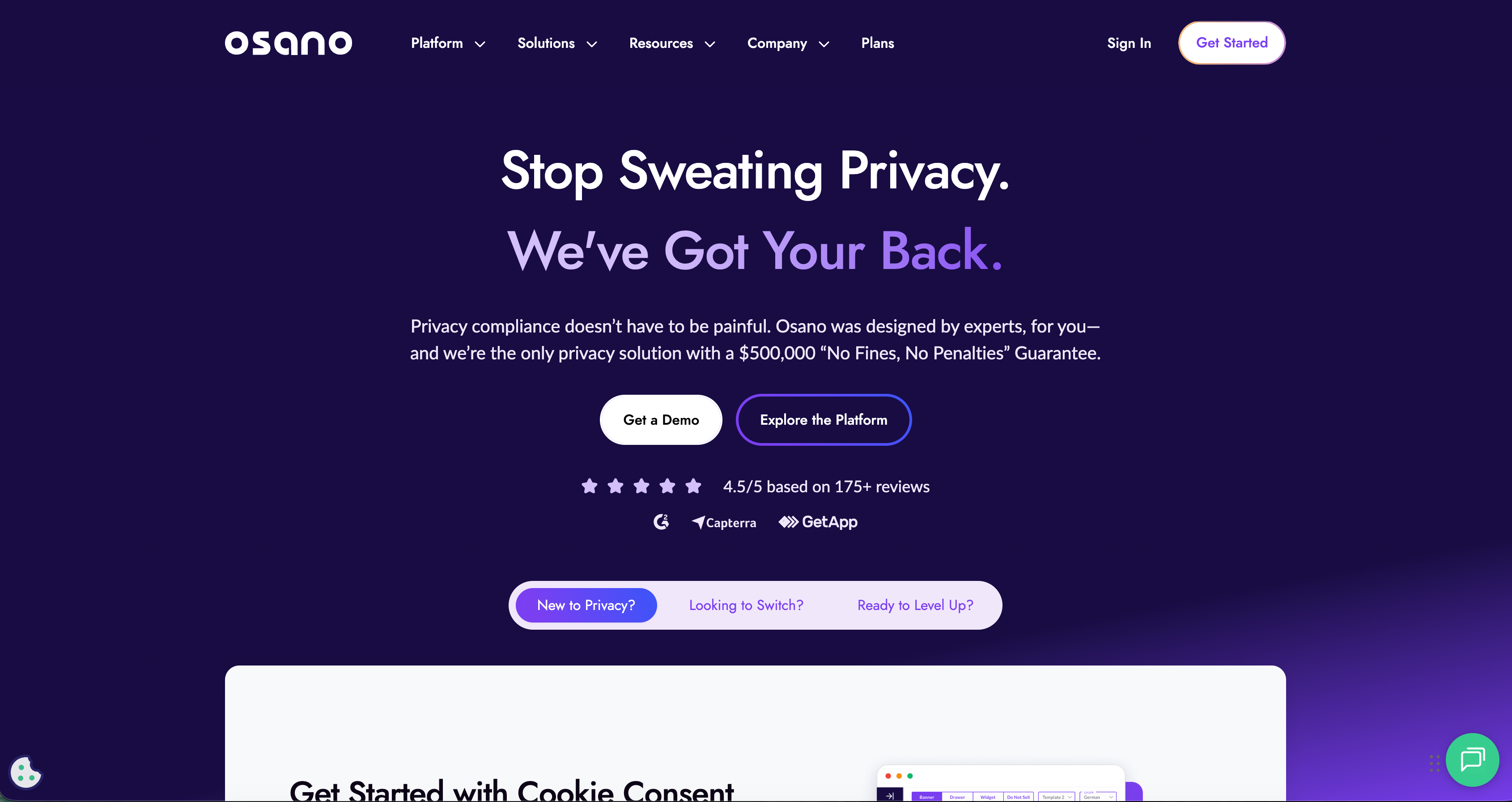
Best for: Companies that want end-to-end coverage of CCPA compliance work across consent, DSARs, data mapping, and vendor risk, without hiring a dedicated privacy team, backed by a capped fines-and-penalties guarantee.
Osano's data privacy management software covers a broad range of CCPA compliance needs, including opt-out requests, Global Privacy Control (GPC) adherance, and automating requests for employee and consumer subject rights.
Key capabilities:
-
Geo-targeted cookie consent: detects California visitors and displays compliant banners in real time
-
Automated, verified DSAR fulfillment with human verification
-
Privacy-centric data mapping across systems
-
Proprietary vendor scoring
-
Audit trails across consent, DSARs, assessments, and vendor monitoring, so you can provide proof of compliance
Osano also backs its platform with a “No Fines, No Penalties” pledge: Osano pays up to $500,000 of penalties incurred while using the platform, per the terms of the pledge. Read the terms at osano.com/pledge.
Pros: Osano is the only privacy vendor with a guarantee. It's also B Corp certified, which serves as a meaningful differentiator for potential buyers having trouble deciding between solutions. Of the privacy solutions in this list, Osano is the best for ongoing compliance, offering continuous monitoring through its Compliance Check feature, and regularly updated documentation and product design for the latest changes in the regulatory and privacy risk landscape.
Notably, Osano has exceptionally responsive, knowledgeable customer support—G2 reviewers repeatedly single this out.
Cons: Banner/UI changes beyond the basics often require CSS or a support ticket rather than self-serve config, and the platform has limitations for larger orgs needing more granular workflows.
OneTrust
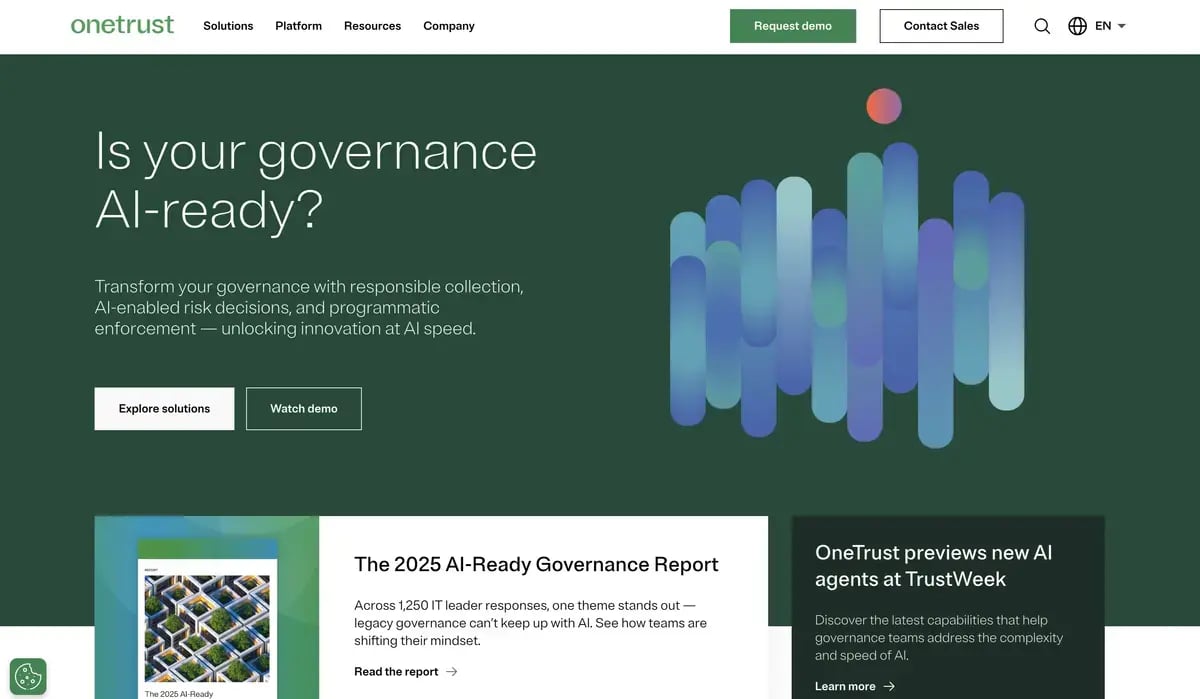
Best for: Enterprise budgets looking for an extensive data privacy platform that uses AI in its automation.
OneTrust has a strong reputation as one of the more widely used tools for data privacy, with a full suite of tools for highly regulated industries. It also offers consulting and training.
Key capabilities:
-
CCPA-specific centralized repository with regulatory guidance and readiness assessments
-
Automated consumer rights workflow engine
-
Built-in “Do Not Sell/Opt Out of Sale” experience builder
-
CCPA-aware data mapping and discovery
-
Integrated breach and incident management with California templates
Pros: Modular pricing lets you start with a single product; implementation consultants are often praised as helpful and responsive.
Cons: OneTrust has a steep learning curve, often requiring outside consultants to implement and use. Pricing may not be friendly for businesses outside of large enterprise. Some users have also reported interface lag. A validated G2 review documented back-to-back price increases of 275% and then 468% within a single year, announced with 21 and 60 days’ notice, respectively. This pattern of short notice and major renewals is common among OneTrust users.
Ongoing customer support is inconsistent and varies sharply by account tier, with mid-market and smaller accounts frequently citing issues.
TrustArc
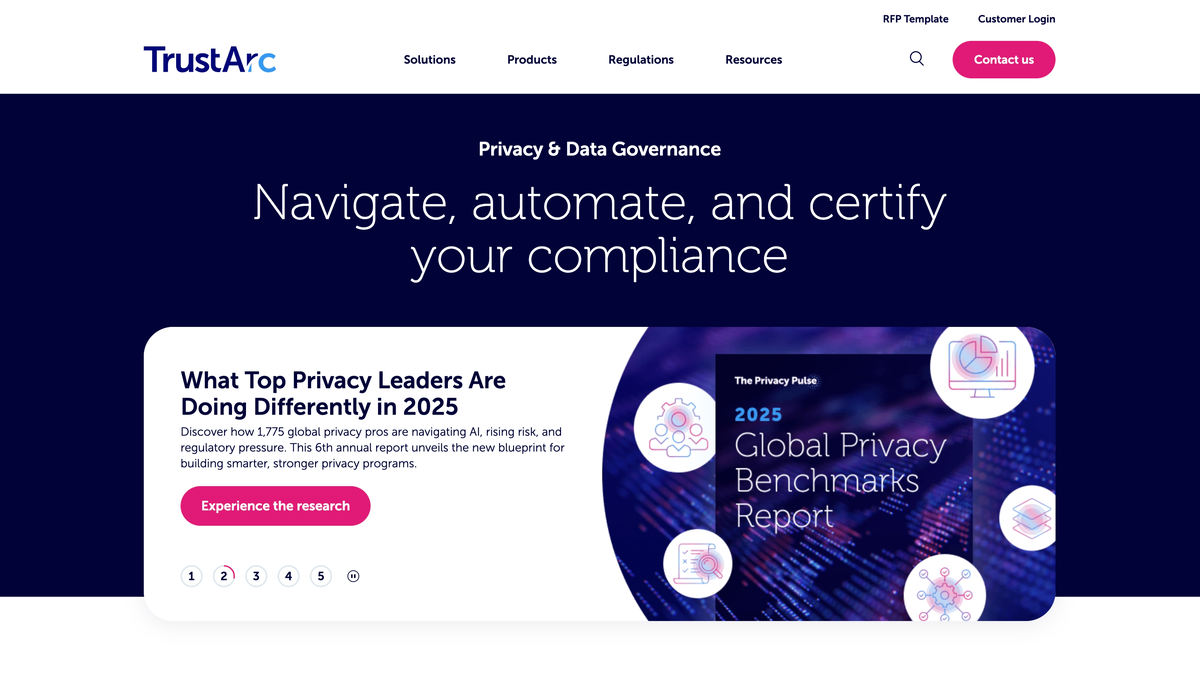 Best for: Mid-market to enterprise privacy and legal teams that want guided CCPA compliance backed by deep regulatory expertise.
TrustArc is an automated privacy solution with a long history as a privacy certification authority. It emphasizes regulatory expertise and practical guidance alongside its software tools.
Key capabilities:
-
Centralized Trust Center for CCPA transparency
-
Auto-law identification for relevant privacy laws
-
Automated cookie consent and preference management
-
API-first integrations with REST APIs
Pros: Google-certified CMP provider; straightforward interface per reviews
Cons: Some users report inconsistent customer support and a steep learning curve to unlock full potential.
Usercentrics
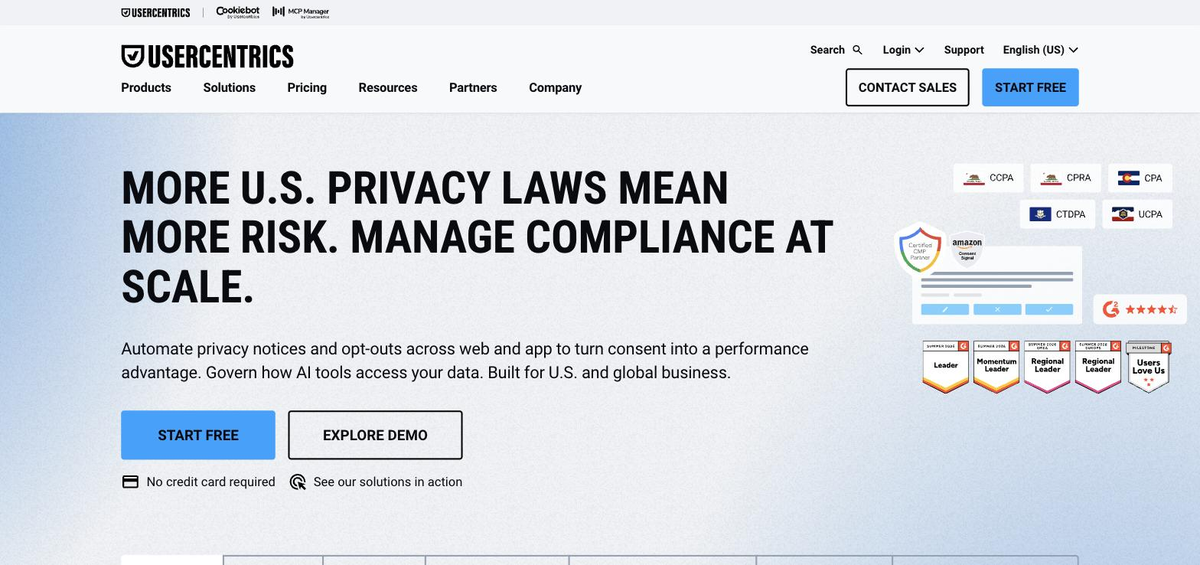
Best for: Digital-first teams that want highly customizable cookie consent and preference management without enterprise-level complexity.
Usercentrics specializes as a CMP built for CCPA, GDPR, and CPRA compliance, with 2,200+ legal templates and strong integration capabilities.
Key capabilities:
-
Data processing service (DPS) scanner for detecting third-party cookies and tracking technologies
-
Library of 2,200+ legal templates
-
Cross-domain and cross-device consent
-
Analytics dashboard with A/B testing
-
Deep customization and brand control
Pros: Usercentrics UI is fully customizable, and the platform offers flexible pricing with a free trial.
Cons: Only provides a rolling 30-day snapshot of analytics. Users can look back up to 12 months at consent data, but its a static download only. Usercentrics' extensive feature set can be challenging for new users, as well.
Securiti
Best for: Enterprises that want CCPA/CPRA compliance folded into a broader data-security and AI-governance program.
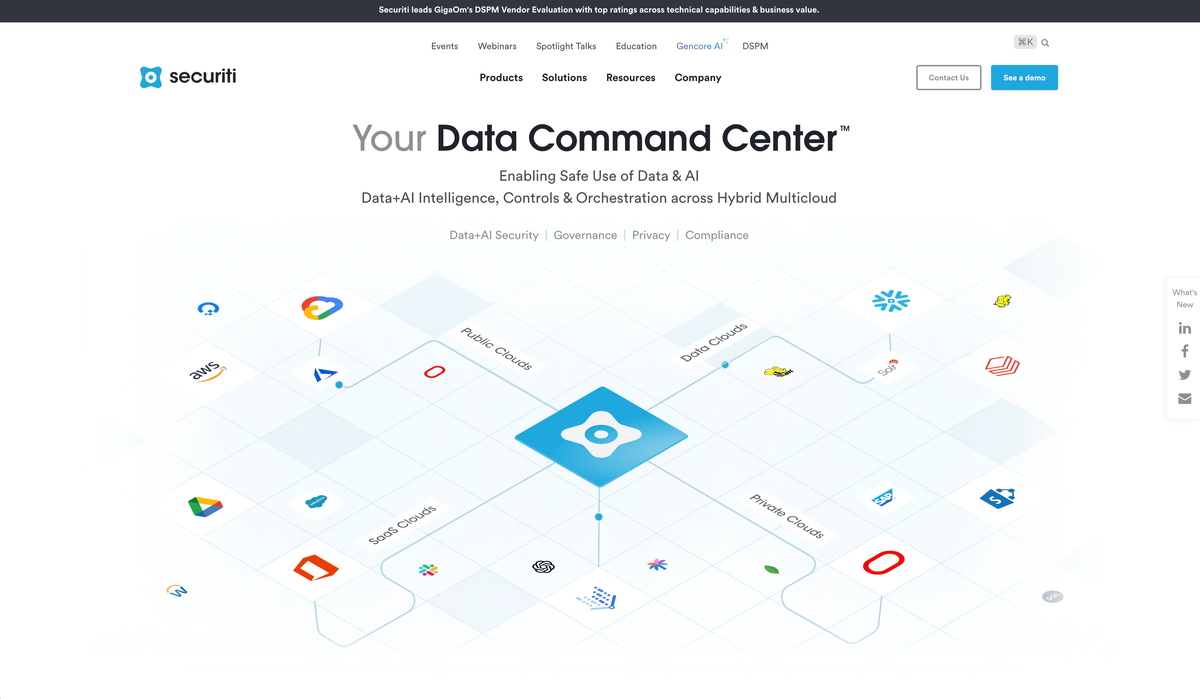
Securiti built its reputation on AI-powered data discovery and classification, then layered CCPA-relevant Do-Not-Sell fulfillment, consent tracking, and rights-request automation on top of that data intelligence.
Key capabilities:
-
Do-Not-Sell/-Share request automation with identity verification
-
Regulatory intelligence (GenAI plus legal-expert-backed content) and a maintained US state-privacy-law resource center
-
Automated PI-to-identity data mapping, surfacing compliance risk by data-subject residency
-
A named Breach Impact Analysis product that automates notifications to affected individuals
Pros: Reviewers most often cite ease of use and excellent, responsive customer support.
Cons: Securiti users report experiencing a steep learning curve. Additionally, multiple reviewers describe a real setup burden due to Securiti's breadth. Often, implementation requires dedicated engineering or compliance staff, and out-of-the-box templates don't always fit non-standard use cases without custom configuration.
A Comparison of the Best CCPA Compliance Tools
|
Platform |
Best for | Standout capabilities | Key trade-offs |
| Osano | Companies that want end-to-end coverage of CCPA compliance work without hiring a dedicated privacy team, backed by a capped pledge | Geo-targeted cookie consent; DSAR automation reviewed by humans; privacy-centric data mapping; proprietary vendor risk scoring; audit trails across consent, DSARs, and vendor monitoring; “No Fines, No Penalties” guarantee (up to $500K, for qualifying paid plans) | Some banner customization can require CSS; not suited for larger enterprises needing advanced customization |
| OneTrust | Enterprises with large budgets and complex global governance needs | CCPA-specific regulatory repository; AI-driven DSAR workflows; Do Not Sell experience builder; CCPA-aware data mapping; California breach response templates | High cost; steep learning curve; may be more than smaller teams need—including one documented case of back-to-back renewal increases of 275% and 468% within a single year |
| TrustArc | Mid-market to enterprise teams wanting guided automation with regulatory expertise | Auto-law identification; centralized public Trust Center; automated cookie consent; API-first connections; Gold-tier Google-certified CMP | Less customizable than enterprise platforms; support quality varies by plan |
| Usercentrics | Digital-first teams focused on consent UX and customization | 2,200+ data processing service (DPS) templates; DPS scanner; cross-domain & cross-device consent; consent analytics with A/B testing; deep UI and branding control | Limited analytics retention; broader compliance workflows require additional tools |
| Securiti | Enterprises folding CCPA/CPRA into a broader AI-governance and data-security program | GenAI-backed regulatory tracking; named Breach Impact Analysis product; automated PI-to-identity data mapping | Steep learning curve; roadmap continuity in question after acquisition |
Explore CCPA Compliance With Osano
Osano brings consent, data mapping, DSARs, and vendor risk together in one platform for CCPA compliance work.
Get a demo to see how Osano can support your compliance program.
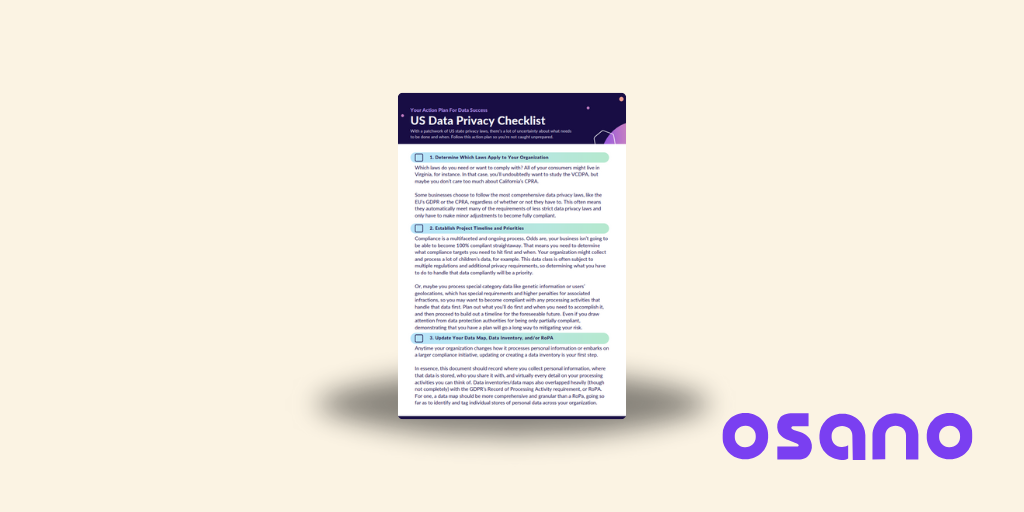
U.S. Data Privacy Checklist
Stay up to date with U.S. data privacy laws and requirements.
Download Your Copy