.svg)


.svg)
.svg)
.svg)
.svg)
.webp?width=1220&height=1090&name=Osano-guarantee-seal%20(1).webp)
When you think of data protection or privacy laws, the GDPR probably comes to mind immediately. It's one of the most influential privacy laws in the world, and getting it wrong can be expensive.
GDPR compliance software helps you operationalize the regulation's ongoing requirements: consent collection, data subject access requests, data mapping, and vendor risk. The best fit depends on whether you need a dedicated privacy platform or broader security compliance automation. This guide compares Osano, DataGrail, TrustArc, Vanta, OneTrust, and Securiti.
How can GDPR compliance software help? A good solution automates much of the ongoing work of adhering to GDPR requirements, though no software makes you compliant on its own.
What Is the GDPR?
The General Data Protection Regulation (GDPR) is an EU law that governs how organizations handle the personal data of people in the EU.
It's also one of the world's best-known and strictest data protection and privacy regulations, designed to give individuals (known as "data subjects" under the law) more control over their information by dictating standards for its collection and use.
The regulation has applied since May 25, 2018. It also reaches beyond the EU: a business anywhere must comply if it offers goods or services to people in the EU or monitors their behavior.
Its rules fall into three main areas:
- Defining legally approved ways to collect, share, and process personal user data
- Requiring organizations to protect personal information with appropriate security measures
- Establishing what EU residents' rights are surrounding the collection and use of their data
What Is GDPR Compliance Software?
GDPR compliance is ongoing work, and for most teams, keeping up with it manually isn't realistic.
GDPR compliance software provides the digital support needed to work toward compliance more accurately and consistently. These tools help you manage personal data, security, and consent in line with GDPR requirements.
Though specific tools vary in functionality, they generally automate various tasks needed to work toward GDPR requirements, such as data mapping, consent management, data subject access request (DSAR) handling, and tracking and documentation.
In short, they give you one place to manage and protect the personal data you hold on people in the EU.
Understanding GDPR: Key Principles and Requirements
Businesses like yours rely on data, so the GDPR's aim isn't to prevent you from using it. Instead, it aims to balance data subjects' privacy with companies' access to the information they need to thrive.
The GDPR introduces a few key concepts to strike that balance.
Data Subject Rights
One of the main aims of the GDPR is to give users more control over their data. So it gives individuals eight data rights:
- Right to be informed: Individuals must be informed about any collection or use of their personal data at the time of collection. If you get their data from someone else, you have to tell them within a reasonable period, and no later than one month.
- Right of access: A data subject can ask for a copy of personal data held by an organization and information on why it's being processed. This is known as a DSAR. You generally have one month to respond."
- Right to rectification: If any data you hold is incorrect or incomplete, individuals have the right to request its correction.
- Right to erasure: This is also known as the "right to be forgotten" and allows subjects to request the deletion of their personal data.
- Right to restrict processing: You must stop processing an individual's data if they request this either verbally or in writing.
- Right to data portability: This right allows data subjects to receive their data in a structured, machine-readable format and have it sent to another organization.
- Right to object: Individuals can object to how their personal information is being used in certain circumstances.
- Rights related to automated decision-making and profiling: Individuals have the right to not be subject to a decision based solely on automated processing that could have a legal or similarly significant effect on them.
7 Principles of GDPR Compliance
In addition to respecting data subject rights, companies must follow seven core principles laid out by the GDPR to remain compliant.
Integrity and Confidentiality
You must employ reliable security and privacy measures to protect any personal data you store and reduce the risk of unauthorized access, loss, or damage.
Lawfulness, Fairness, and Transparency
Any processing of users' data should abide by the law and meet all standards laid out by the GDPR. You must only collect and process personal information if it fits one of these lawful bases: consent, contract, legal obligation, vital interests, public task, or legitimate interests.
Accountability
Beyond implementing the right measures to adhere to GDPR standards, companies must also demonstrate compliance. This involves detailed documentation about data collection, use, and storage.
Purpose Limitation
Collect personal data only for specified, explicit, and legitimate purposes, and don't use it later in ways that conflict with those purposes.
Accuracy
All data you collect and use should be correct and up to date. Inaccurate information should be corrected or deleted promptly.
Data Minimization
Data minimization requires you to collect and use only the personal data that's adequate, relevant, and necessary for your stated purpose.
Storage Limitation
Companies must also limit the period of time they store data, depending on its type and sensitivity. Keep personal data only as long as you need it for its purpose, then delete or anonymize it.
Why Is It Important to Comply with the GDPR?
Noncompliance can get expensive. Organizations that violate the law can be fined up to 4% of their annual global turnover or €20 million, whichever is higher.
Regulators use that power. The Irish Data Protection Commission fined TikTok €530 million in May 2025 over unlawful transfers of European user data to China, the largest GDPR penalty issued that year. The average GDPR fine is about €2.3 million, and Ireland alone accounts for a little over half of cumulative GDPR fine value.
Headline fines don't always stick, either. The €746 million fine (a record at the time) issued to Amazon Europe Core by Luxembourg's CNPD in 2021 was annulled on procedural grounds by the Luxembourg Administrative Court in March 2026. The court confirmed the violations were real. It found that the CNPD hadn't assessed whether Amazon acted intentionally or negligently, and sent the case back to the regulator.
Fines aren't the only cost. A privacy failure can also erode customer trust, and that damage can outlast any penalty.
Key Features of GDPR Compliance Software
Look for these features in any GDPR compliance tool:
Consent Management
GDPR treats consent as one of the lawful bases for processing personal data, and holds it to strict standards. Consent management services should automate this process, managing cookie consent and preferences (cookie consent is required under the EU's ePrivacy rules and held to the GDPR's consent standard), providing granular consent options, letting users withdraw consent quickly, and creating an audit trail to demonstrate lawful processing.
Data Mapping
Data mapping is the process of identifying where personal data is located, how it flows, and who has access to it. Good GDPR compliance software makes it far more manageable by scanning your systems to discover data, often uncovering shadow data, then making a central record and flagging potential compliance issues.
DSAR Automation
For large businesses with many customers and large amounts of data, there can be too many DSARs to handle manually within the one-month deadline. A robust GDPR tool will automate request intake and tracking, retrieve the relevant information, verify the requester's identity, and streamline communication with them.
DPIA Management
Article 35 of the GDPR states that data protection impact assessments (DPIAs) are mandatory where a data processing activity is likely to result in a high risk to individuals' rights and freedoms. A compliance tool should contain guided assessment templates aligned with GDPR requirements.
Data Breach Notification
The GDPR has strict rules about what you should do if a data breach occurs. If a breach poses a risk to people's rights and freedoms, you must notify your supervisory authority without undue delay and, where feasible, within 72 hours of becoming aware of it. If the risk is high, you must also tell the affected individuals. The EU's proposed Digital Omnibus would extend that window to 96 hours and limit it to high-risk breaches, but it hasn't passed yet, so the 72-hour rule still applies. Having a breach notification service within a compliance platform helps streamline this process.
Compliance Reporting
Under the GDPR, demonstrating compliance is just as important as achieving it. Reporting tools make it easier to provide detailed insights and documentation that will hold up under audit.
The Best Software Solutions to Comply with GDPR
These six platforms take different approaches to GDPR, so the right fit depends on what you need most. For a broader view across regulations, see our privacy compliance software buyer's guide.
Osano
Best for: Businesses that want a GDPR platform built for continuous compliance work, not just point-in-time checklists. Compared to enterprise suites like OneTrust and TrustArc, Osano is built to be deployed and run without a dedicated privacy-engineering team or outside consultants and priced for that reality.
Osano covers the core functionality most teams need for ongoing GDPR compliance work: data mapping, consent management, DSAR handling, vendor risk, and assessments. Osano can serve as your required GDPR representative, with a team of local privacy experts and attorneys based in Dublin. Its GDPR solution is designed around the assumption that whoever owns privacy at your company has another job as well.
Key capabilities:
- Geolocation-based consent management for every GDPR jurisdiction, with regulation logic maintained by Osano's privacy attorneys
- DSAR management at scale with automated common request types, covering consumer and employee requests
- Compliance-specific data mapping powered by automation
- Pre-built DPIA and PIA templates aligned to GDPR and tied into data mapping and DSAR workflows
- GDPR vendor management with proprietary Vendor Score
- Renewal increases capped in the contract, so year-two cost is predictable
- “No Fines, No Penalties” Guarantee: Osano pays up to $500,000 of penalties incurred while using the platform, per the terms of the pledge. Read the terms at osano.com/pledge.
As with any tool in this category, Osano operationalizes GDPR requirements and reduces risk. It won't make you compliant with every provision of the regulation on its own; that still takes your privacy and legal judgment.
DataGrail
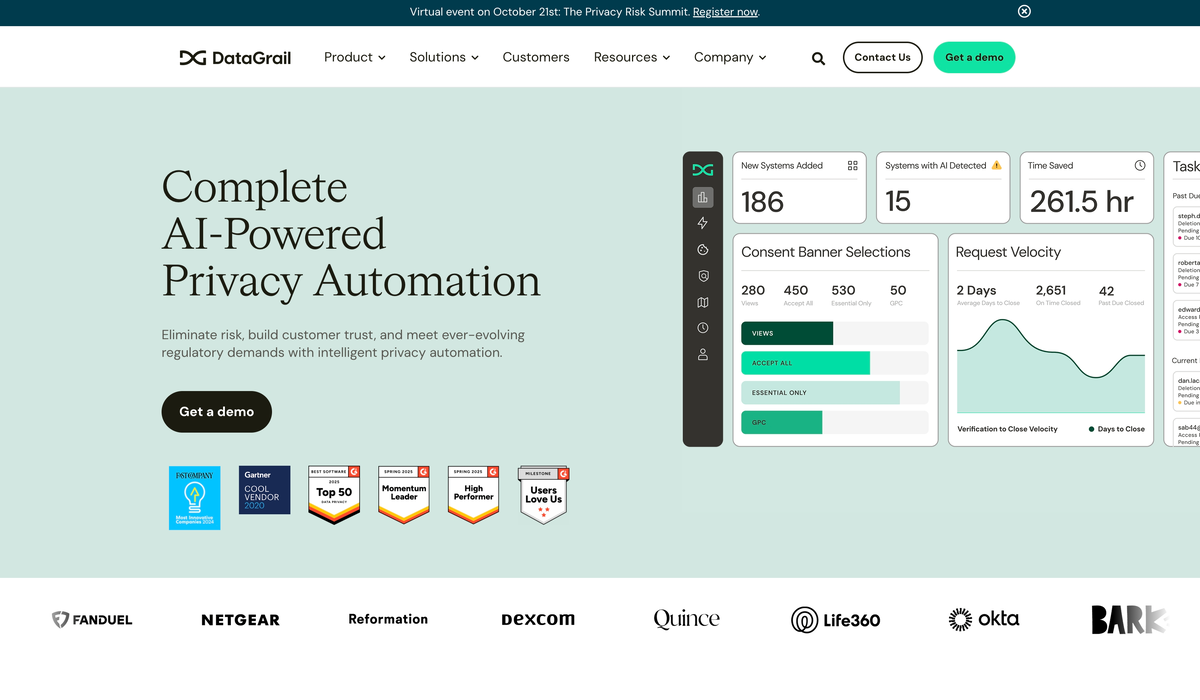
Best for: Businesses looking for an AI-powered solution to prioritize workflow automation for DSARs and real-time privacy risk monitoring.
For businesses struggling to keep up with DSARs, DataGrail is a strong option, offering specialized tools and consent management and more than 2,500 integrations.
Key capabilities:
- Automated Data Subject Request Fulfillment with branded request forms and identity verification
- Unified Data Inventory powered through ML-driven discovery and classification
- Customizable, no-code consent management
- Integration with popular CRM, marketing, and data storage platforms
- PIA, DPIA, and AI risk assessments with auto-populated fields
TrustArc
Best for: Privacy and legal teams that want automated assessment workflows, third-party privacy certifications (the TRUSTe seal, Data Privacy Framework verification, Global CBPR), and deep international data-transfer support, and can absorb a longer, resource-intensive implementation before seeing payoff.
TrustArc is a full-spectrum GDPR compliance platform designed to support complex privacy operations for global companies. It offers end-to-end privacy management and has nearly three decades of experience (it began as TRUSTe in 1997).
Key capabilities:
- Privacy risk assessment to prioritize compliance efforts
- Customizable framework implementation
- Regulatory research database with updates on evolving regulations
- Cookie and tracker management with Google Consent Mode and IAB support
- DSAR automation across 300+ systems
Vanta
Best for: Fast-growing businesses that need broad security-compliance automation (SOC 2, ISO 27001, HIPAA) and want baseline GDPR controls tracking bundled in, rather than organizations whose primary need is dedicated consent or DSAR tooling.
Vanta is primarily a security-compliance automation platform, though its GDPR support goes further than control mapping: its GDPR product includes a personal-data data inventory, records of processing activity (ROPA) management, and DPIAs, aimed at demonstrating GDPR posture. Consumer-facing privacy operations such as consent collection, cookie scanning, and subject rights fulfillment sit outside that scope.
Key capabilities:
- Policy builder and templates
- Inventory management for monitoring assets and tracking sensitive data
- Security awareness training
- Regular updates to compliance controls
OneTrust
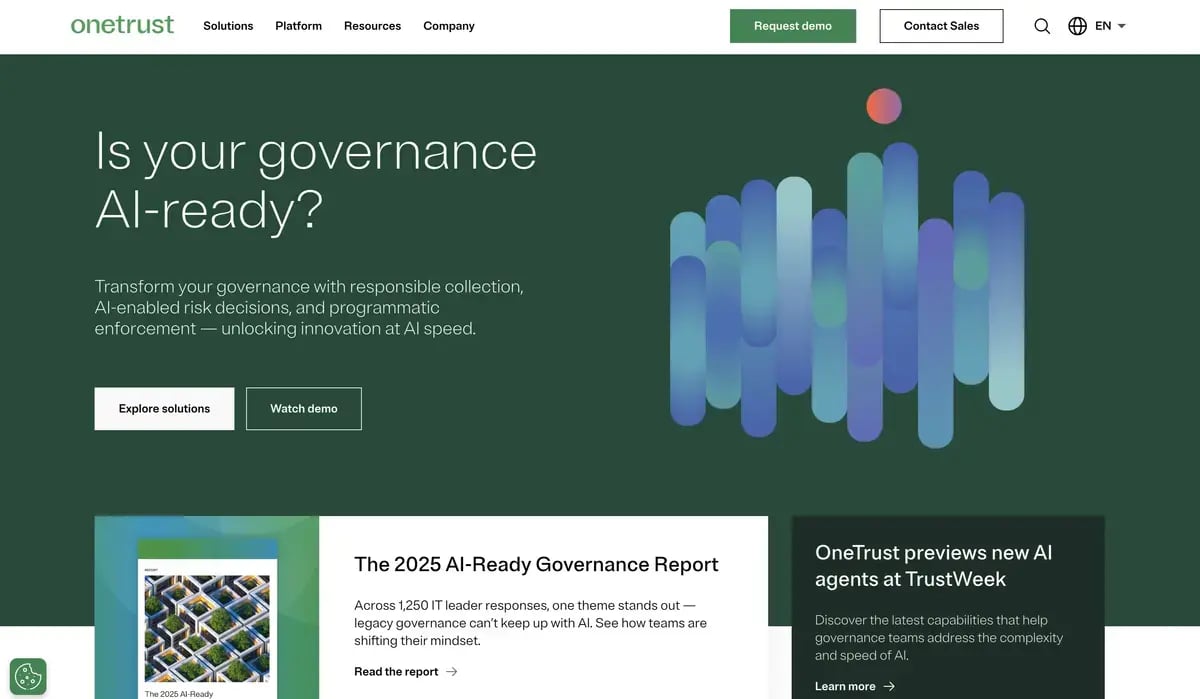
Best for: Large, heavily regulated enterprises with a dedicated privacy, legal, or governance, risk, and compliance (GRC) function that need one platform spanning consent, DSARs, data mapping, assessments, and vendor risk, and the budget and implementation resources (often including outside consultants) to configure it.
OneTrust is the largest and most feature-complete privacy/GRC platform in this category, tracking global regulatory changes and covering nearly every workflow a large compliance team could need. That breadth comes with enterprise-level cost and complexity: G2 reviews repeatedly cite multi-month implementation timelines that often require paid consulting support.
Key capabilities:
- Universal consent and preference management (CMP) across web, mobile, and connected TV (CTV), with real-time sync to CRM/marketing systems
- Automated DSAR intake, identity verification, and cross-team fulfillment workflows with deadline tracking
- Automated and survey-based data mapping with auto-populated ROPA
- Configurable privacy impact Assessments (PIA/DPIA) with risk-based automation rules
- Third-party/vendor risk management via its separate Third-Party Management product line
Securiti
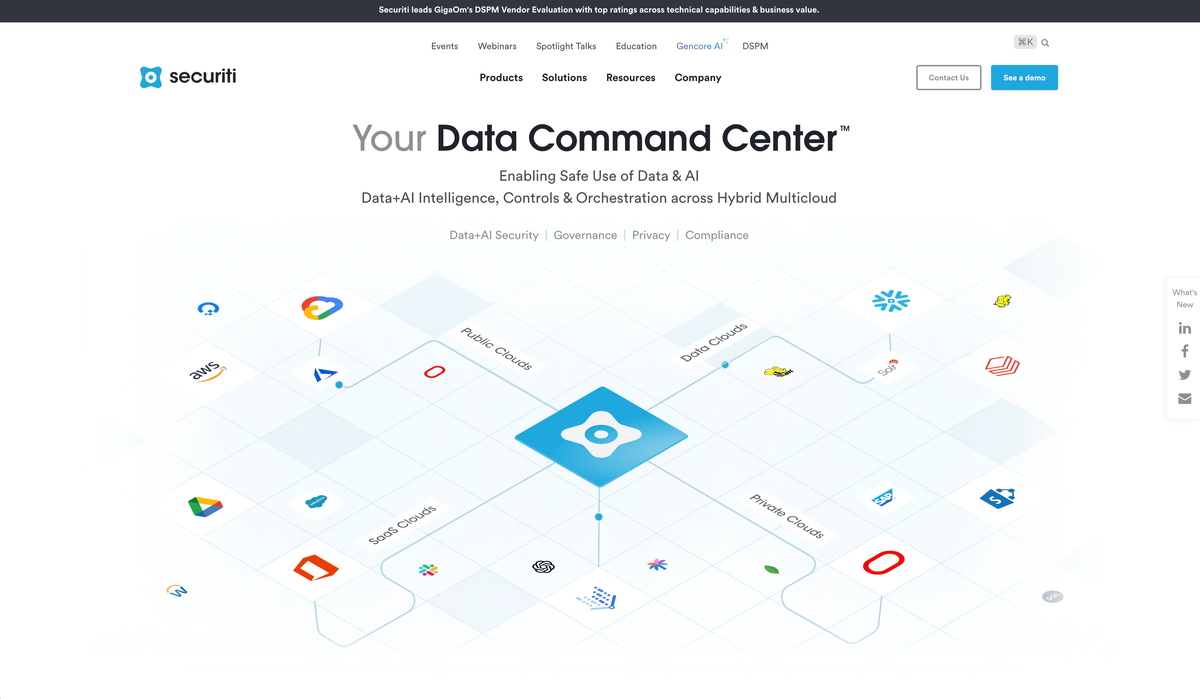
Best for: Enterprises that want GDPR compliance folded into a broader AI governance and data-security program rather than run as a standalone privacy tool.
Securiti built its reputation on AI-powered data discovery and classification across hybrid, multicloud, and SaaS environments, then layered GDPR-relevant consent, DSAR, and assessment workflows on top of that data intelligence. In December 2025, Securiti was acquired by data-resilience vendor Veeam for $1.725 billion, folding Securiti's privacy and AI-governance stack into Veeam's broader platform.
Key capabilities:
- AI-powered data discovery and classification across hybrid multicloud, SaaS, and on-premises systems, feeding GDPR data mapping and ROPA automatically
- Consent management and DSAR/DSR automation with audit-ready documentation
- Privacy assessments (DPIAs) generated from continuously updated data intelligence rather than static questionnaires
- AI-governance tooling (AI discovery, AI risk ratings) aligned to the EU AI Act
Comparing GDPR Compliance Software
| Platform | Best for | Standout capabilities | Key trade-offs |
|---|---|---|---|
| Osano | Teams owning GDPR without a dedicated privacy engineer | Attorney-maintained regulation logic; geolocation consent; DSAR automation; GDPR-aligned DPIA/PIA templates; Vendor Score; capped renewals; $500K guarantee; EU representative service | Banner changes beyond the standard options can require CSS or a support ticket; more opinionated than platforms built for heavy custom workflows |
| DataGrail | SaaS-heavy teams prioritizing DSAR automation | Large pre-built integration network; ML-driven data inventory; no-code consent | Very large or highly regulated organizations may outgrow its scope |
| TrustArc | Privacy and legal teams wanting assessment workflows, third-party certifications, and international data-transfer depth | Auto-law identification; Nymity Research; data inventory and governance; IAB and Consent Mode support | Implementation is time and resource intensive; learning curve before payoff |
| Vanta | Teams whose priority is SOC 2 or ISO 27001, with GDPR controls tracking alongside | Continuous control monitoring; automated evidence collection; data inventory, ROPA, and DPIAs; policy templates; trust center | Security compliance platform; consent collection, cookie scanning, and DSAR fulfillment sit outside its scope |
| OneTrust | Enterprises with a dedicated privacy or GRC function | Deepest coverage across consent, DSARs, RO, assessments, vendor risk; consulting and training | High cost; multi-month implementations often requiring paid consultants; support varies by tier |
| Securiti | Enterprises folding GDPR into a broader AI-governance and data-security program | AI-powered discovery and classification; assessments driven by live data intelligence; EU AI Act tooling | Steep learning curve; now a Veeam business unit post-acquisition, a roadmap-continuity question worth raising |
Where to Start
If your obligations are mainly operational, meaning consent, subject rights, and vendor oversight, start with a dedicated privacy platform. If your immediate pressure is a security audit, a GRC platform is the faster route and you can layer privacy tooling on later. Many organizations end up running one of each. Our CCPA compliance software comparison applies the same lens to US state privacy law.
Want to see how Osano handles ongoing GDPR work? Get a demo and we'll walk through consent, DSARs, data mapping, and vendor risk against your actual program.
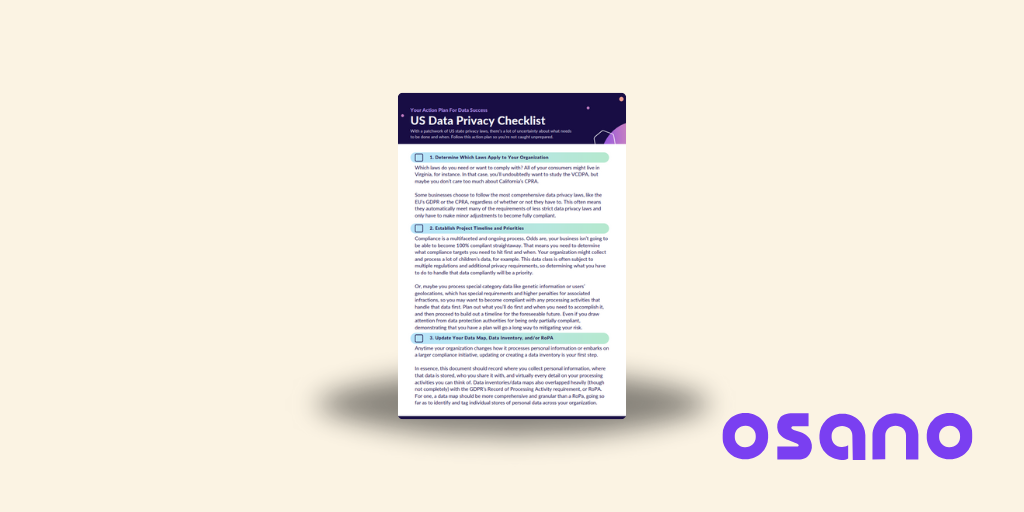
U.S. Data Privacy Checklist
Stay up to date with U.S. data privacy laws and requirements.
Download Your Copy