.svg)


.svg)
.svg)
.svg)
.svg)
.webp?width=1220&height=1090&name=Osano-guarantee-seal%20(1).webp)
You've likely been told your company needs compliance software. Maybe a customer's security questionnaire stalled a deal, or an enforcement notice made the rounds internally, or your board asked what happens when the next privacy law lands.
Compliance software covers two different product categories. Security and GRC platforms like Vanta and Drata automate audit evidence for frameworks such as SOC 2 and ISO 27001. Privacy platforms like Osano and OneTrust run the operational work privacy laws require: consent, data subject requests, data mapping, and vendor risk. Many teams need both.
On the surface, buying compliance software sounds like one purchase. It usually isn't, and picking the wrong half is the most common expensive mistake in this market.
So before you compare vendors, it's worth getting precise about what you're actually shopping for.
The Two Categories Hiding Behind One Term
Ask ten vendors whether they handle GDPR and ten will say yes. They're all telling the truth. They just mean different things.
Security and GRC compliance platforms automate the evidence layer. They connect to your cloud infrastructure, identity provider, and HR systems, then continuously collect proof that your controls are working. When an auditor asks for six months of access reviews, the platform produces them. Vanta and Drata are the best-known examples. Both list GDPR among their supported frameworks, and Vanta also lists ISO 27701 and US Data Privacy. In each case that means control mapping and evidence collection against the standard, not consumer-facing operations like consent collection and subject-rights fulfillment.
Privacy compliance platforms run the operational layer. Someone in California submits a deletion request and it has to be verified, routed, fulfilled, and logged inside a statutory deadline. A visitor in Germany loads your site and trackers have to stay blocked until they consent. A new vendor joins your stack and someone has to assess what data it touches. Osano, OneTrust, and TrustArc work in this layer, alongside other privacy compliance platforms.
Here's the distinction that matters: a GRC platform can prove you have a process for data subject requests. It won't process the request. A privacy platform processes the request but won't produce your SOC 2 evidence.
Vanta is direct about this in its own materials, noting that consent tools focus on collecting and documenting consent while a broader GDPR program also needs data mapping, request management, and assessment workflows, and that you might reasonably run both. That's the right read. These products are adjacent, not interchangeable.
Which Category Do You Need?
Work through this before you book demos.
You probably need a security or GRC platform if: deals are stalling on SOC 2 or ISO 27001, your buyers send security questionnaires, you're preparing for a first audit, or your compliance work is mostly about proving controls to auditors and customers.
You probably need a privacy platform if: you operate a consumer-facing website or app in the EU, UK, California, or any of the growing list of US states with privacy laws; you receive data subject requests; you run marketing tracking that requires consent management; or your exposure is regulatory rather than commercial.
You likely need both if you sell software into enterprise while also collecting personal data from consumers. That's a common position, and it's worth budgeting for deliberately rather than discovering the gap during an incident.
If you landed here because a deal is blocked on SOC 2, the privacy section below won't help you much. Skip ahead to the GRC platforms.
Security and GRC Compliance Platforms
Vanta
Best for: Companies that need to clear SOC 2, ISO 27001, or HIPAA audits quickly, and teams pursuing AI governance or federal work alongside a security program.
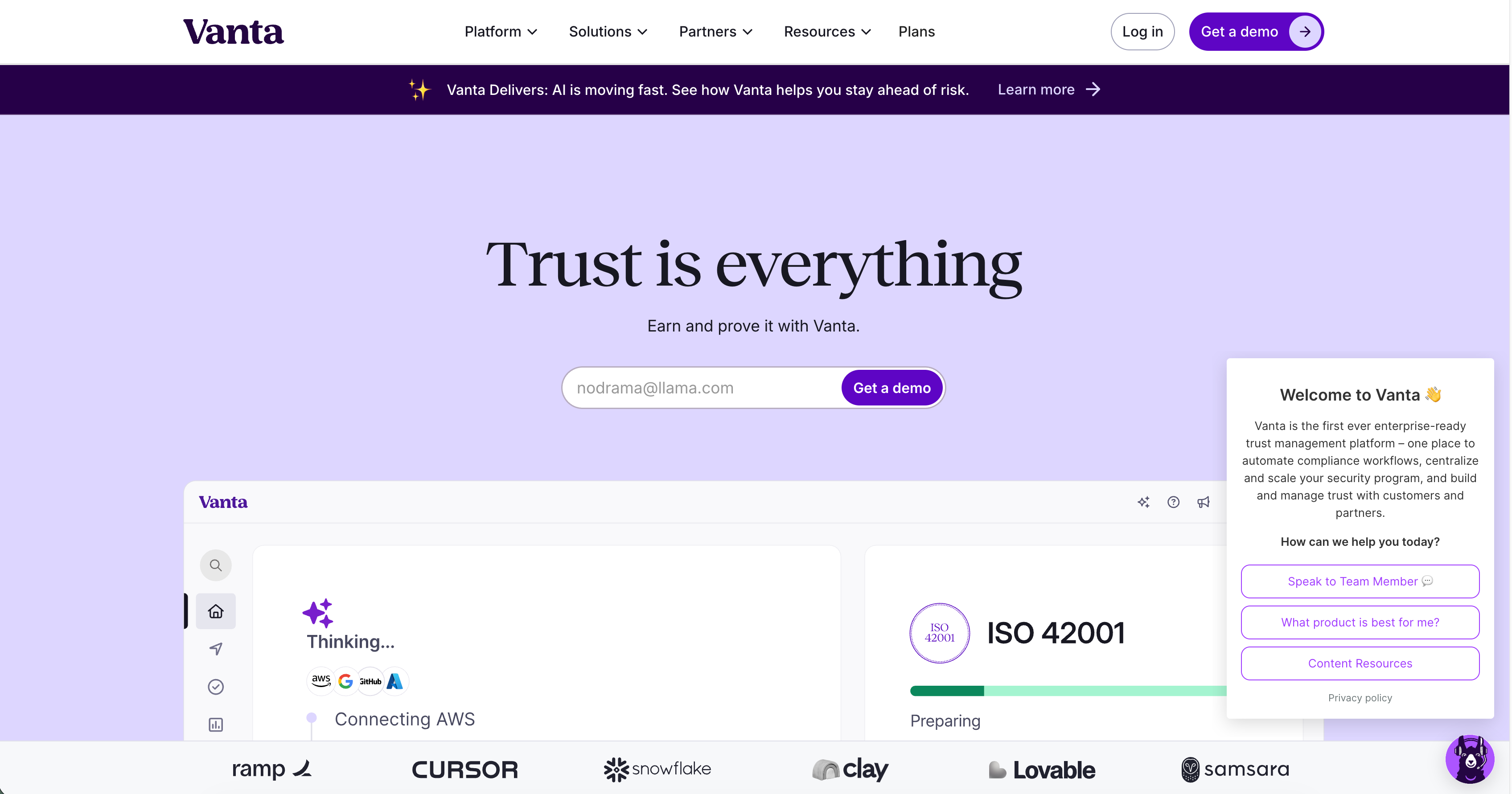
Vanta is one of the most established platforms in this category and publishes the largest framework library among the security-compliance vendors: 35+ frameworks covering SOC 2, ISO 27001, ISO 27701, ISO 42001, HIPAA, HITRUST, GDPR, PCI DSS, NIST CSF 2.0, NIST AI RMF, the EU AI Act, DORA, NIS 2, CMMC 2.0, and FedRAMP, plus custom frameworks. It pulls evidence continuously from cloud services, HR systems, and infrastructure providers across a published 400+ integrations, which turns audit readiness into a standing state rather than a quarterly scramble. Vanta has also moved toward what it calls an agentic trust platform, with AI handling policy drafting, evidence checks, and security questionnaire responses.
Two things stand out. Its ISO 42001 and NIST AI RMF support gives teams shipping AI features a route to demonstrate AI governance alongside an existing security program. And its FedRAMP offering is the most documented among comparable platforms, which matters if you're pursuing federal authorization.
Key capabilities:
- Continuous control monitoring across cloud, identity, and HR systems
- Automated evidence collection across 400+ integrations
- Auditor-approved policy templates with tracked attestations
- Privacy records tooling for GDPR: a personal-data Data Inventory, ROPA management, and DPIAs
- Security questionnaire automation and a customer-facing trust center
- Risk register tied to live control status
- AI governance frameworks including ISO 42001, NIST AI RMF, and the EU AI Act
Where it fits and where it doesn't: Strong on attestation, and the fastest route to a first SOC 2 for most teams. Its privacy support goes further than framework mapping: Vanta's GDPR product includes a live personal-data Data Inventory, ROPA management, and DPIAs tied to that inventory, all aimed at demonstrating GDPR posture. What it doesn't offer is the consumer-facing operational layer: consent collection, cookie scanning, and subject-rights request fulfillment.
Drata
Best for: Security-led teams that want deep continuous monitoring and multi-framework control mapping, especially where engineering owns compliance.
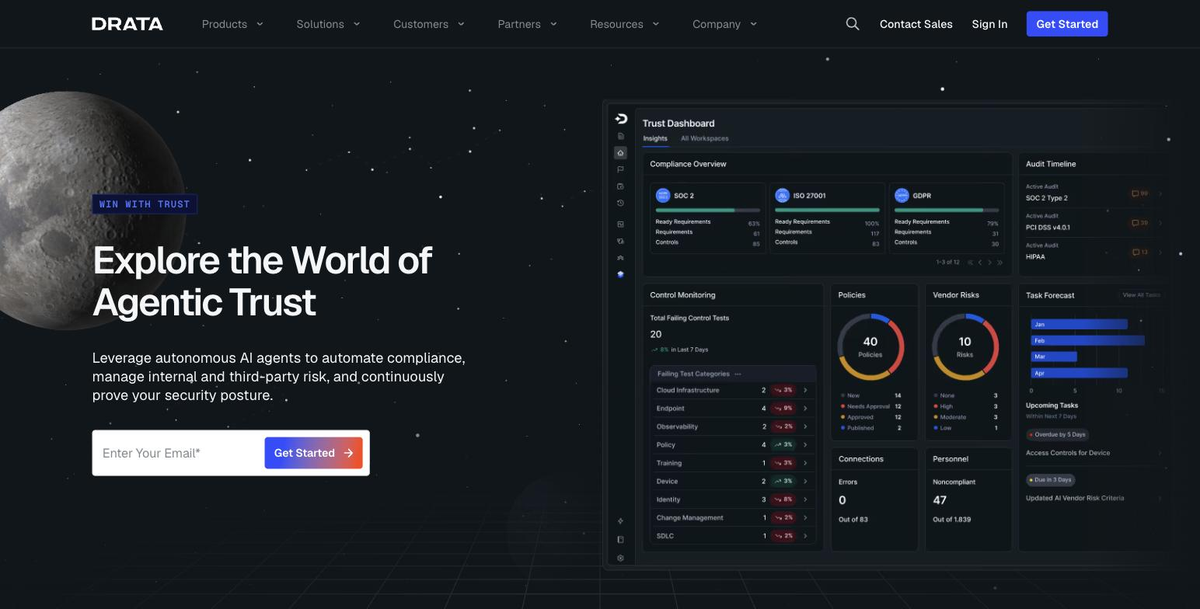
Drata covers similar ground to Vanta with a heavier engineering orientation, and reports 8,500+ customers. It supports 30+ standard frameworks with the option to build custom ones, and cross-framework mapping means a single control can satisfy overlapping requirements across SOC 2, ISO 27001, ISO 42001, GDPR, HIPAA, PCI DSS, DORA, FedRAMP, and CMMC without duplicating work. Control statuses update daily rather than at audit time, so drift surfaces as it happens.
Its risk module links the risk register directly to control status, so a failing control elevates the associated risk automatically, which produces the operational evidence ISO 27001 clause 6.1 asks for. Drata acquired trust-center vendor SafeBase in 2025 and has integrated it into the platform, extending further into customer-facing assurance.
Key capabilities:
- Daily automated control testing with alerting on drift
- Cross-framework control mapping across 30+ frameworks, plus custom frameworks
- Over 300 integrations, or your own via API
- Risk register linked to live control status
- Compliance as code, scanning infrastructure during development
- Audit Hub for auditor collaboration, and SafeBase Trust Center
Where it fits and where it doesn't: A strong choice when compliance lives with your security or engineering team, and the compliance-as-code capability is genuinely differentiated if your controls are infrastructure-heavy. Its GDPR support has the same shape as Vanta's, oriented toward evidence collection rather than running consent and subject rights operations.
Privacy Compliance Platforms
Osano
Best for: Mid-market and enterprise teams, with or without dedicated privacy staff, that want the operational layer run and maintained for them rather than configured from scratch.
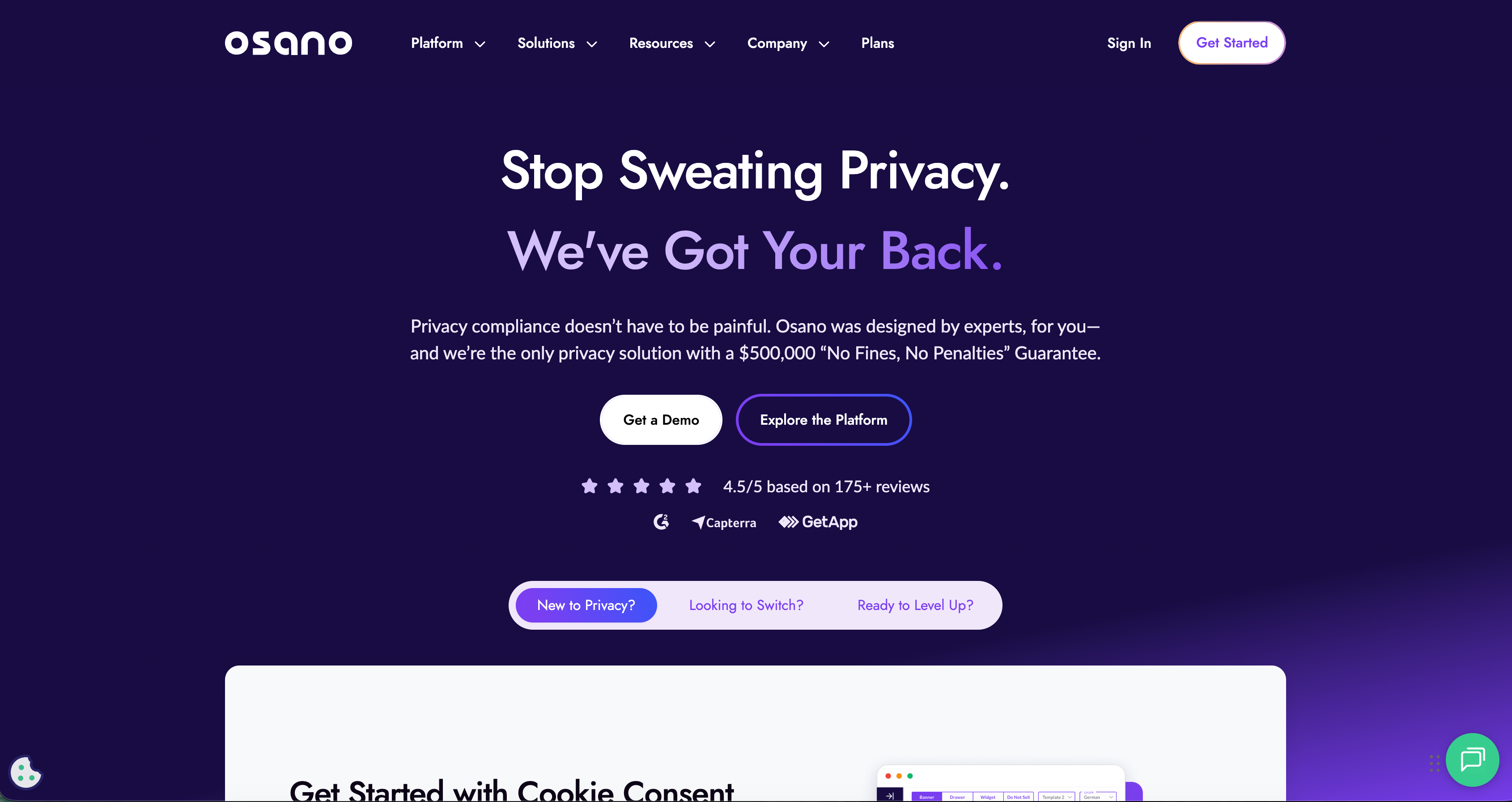
Osano is a privacy compliance specialist. It doesn't produce your SOC 2 evidence, and it isn't trying to. What it does is run the day-to-day privacy work that generalist compliance platforms leave to you: geolocation-aware consent, subject rights requests for consumers and employees, data mapping, and vendor risk assessment.
The design assumption is that most teams carrying privacy don't have a privacy engineering function. Regulations are maintained by Osano's privacy attorneys rather than configured by the customer, templates include guardrails against dark patterns, and consent deploys with one line of JavaScript, which means going live in hours or days rather than a multi-month implementation.
Key capabilities:
- Geolocation-based consent management with regulation logic maintained by Osano's privacy team
- Subject rights request management with automation for common request types, covering both consumer and employee requests
- Compliance-focused data mapping across systems
- Vendor risk management with a proprietary Vendor Score
- Renewal increases capped in the contract, so year-two cost is predictable
- "No Fines, No Penalties" Pledge: Osano pays up to $500,000 of penalties incurred while using the platform, per the terms of the pledge. Read the terms at osano.com/pledge.
Where it fits and where it doesn't: Best suited to teams that want privacy operations handled without dedicating headcount to configuration. Banner changes beyond the standard options can require CSS or a support ticket rather than self-serve configuration, and organizations needing highly granular custom workflows may find the platform more opinionated than they'd like. As with any tool in this category, Osano operationalizes privacy requirements and reduces risk. It won't make you compliant with every provision of laws like the GDPR or CCPA on its own. That still takes your privacy and legal judgment.
Osano is also a certified B Corporation, operating as a public benefit corporation. Its verified B Impact score is 89.8, against a median of 50.9 for businesses that complete the assessment and a certification threshold of 80. That's a governance commitment rather than a product feature, though it's one reason some buyers shortlist it.
OneTrust
Best for: Large, heavily regulated enterprises with a dedicated privacy, legal, or GRC function, and the budget and implementation resources to configure a platform of this scope.
OneTrust is the most feature-complete privacy platform in the category, and it earns that reputation. It tracks global regulatory change and covers nearly every workflow a mature privacy team needs, from consent and preference management through request fulfillment, data mapping, assessments, and vendor risk. It also offers consulting and training alongside the software, which matters for organizations building a privacy program rather than operating one.
Key capabilities:
- Consent and preference management across web, mobile, and CTV
- Request intake, identity verification, and cross-team fulfillment with deadline tracking
- Automated and survey-based data mapping with Article 30 records generation
- Configurable privacy and data protection impact assessments with risk-based automation
- Third-party and vendor risk management
Where it fits and where it doesn't: The breadth is real, and so is the cost of operating it. G2 reviewers consistently describe multi-month implementations that often require paid consulting support, and support quality varies by account tier. Buyers below the enterprise tier also report renewal increases they hadn't planned for, which is worth pinning down in writing before you sign. If you have a privacy team to run it, it's the deepest platform available. If you don't, the configuration burden tends to land on someone who already has another job.
TrustArc
Best for: Mid-market to enterprise privacy and legal teams that want regulatory depth and practical guidance alongside the tooling.
TrustArc has been in this market longer than most, originally as a privacy certification authority, and that history shows in its regulatory content. Auto-law identification flags which privacy laws apply based on your business activities and locations, which is useful when your obligations keep shifting. Nymity Research, its regulatory guidance database, is maintained rather than static.
Key capabilities:
- Auto-law identification based on business activity and geography
- Cookie consent and preference management with Google Consent Mode support
- Data inventory, mapping, and governance with reporting
- Assessment workflows for privacy risk
- Nymity Research regulatory guidance library
Where it fits and where it doesn't: Modular, so you can start with what you need. Implementation takes real time and internal resource, and reviewers note a learning curve before the platform pays off. Some report inconsistent support depending on plan level.
Comparing the Categories
| Platform | Category | Best for | Covers | Doesn't cover |
|---|---|---|---|---|
| Vanta | Security / GRC | Fast first audit; AI governance and FedRAMP paths | 35+ frameworks; 400+ integrations; continuous control monitoring; data inventory, ROPA, and DPIAs; questionnaire automation; trust center | Consent collection, request fulfillment, cookie scanning |
| Drata | Security / GRC | Security-led teams; engineering-owned compliance | 30+ frameworks; 300+ integrations; daily control testing; compliance as code; linked risk register; SafeBase Trust Center | Consent collection, request fulfillment, cookie scanning |
| Osano | Privacy | Mid-market and enterprise teams, with or without dedicated privacy staff, that want the operational layer maintained for them rather than configured and run in-house | Attorney-maintained regulation logic, consent, subject rights, data mapping, vendor risk, capped renewals, $500K pledge | SOC 2 and ISO 27001 evidence automation |
| OneTrust | Privacy | Enterprises with a dedicated privacy function | Consent, requests, data mapping, Article 30 records, assessments, vendor risk at full depth | SOC 2 and ISO 27001 evidence automation |
| TrustArc | Privacy | Teams that want a deep regulatory research library and are staffed to configure and operate a modular platform | Auto-law identification, consent, data inventory, assessments, regulatory research | SOC 2 and ISO 27001 evidence automation |
What to Ask on a Demo
Category confusion is easiest to catch with direct questions:
- Which specific articles or sections of the regulation does this cover, and which does it document?
- If a consumer submits a deletion request today, walk me through what your platform does with it.
- Who maintains the regulatory logic, us or you? What happens when a law changes?
- What does year two cost, and is the increase capped in the contract?
- What's a realistic implementation timeline with our team size, and does it require outside help?
That last pair is worth pressing on. Unexpected renewal costs and implementation burden are the two most common complaints across every vendor in both categories, and both are answerable in writing before you sign.
Frequently Asked Questions
Is compliance software the same as GRC software?
Not quite. GRC software covers governance, risk, and compliance for security frameworks, typically SOC 2, ISO 27001, HIPAA, and PCI DSS. Privacy compliance software covers the operational requirements of data protection laws like the GDPR and CCPA. Both get called compliance software.
Can one platform handle both privacy and security compliance?
Some vendors offer modules in both areas, but depth varies considerably. Most organizations with meaningful obligations on both sides run a platform in each category rather than compromising on one.
Do I need privacy compliance software if I already use Vanta or Drata?
If you collect personal data from consumers, likely yes. Both support GDPR, and Vanta's GDPR product goes as far as a personal-data inventory, ROPA management, and DPIAs. Neither runs consent collection, cookie scanning, or subject-rights request fulfillment, so those operational requirements still need dedicated tooling. Check whether they apply to you before assuming your GRC platform covers them.
Does compliance software make my company compliant?
No. Software operationalizes requirements, reduces manual effort, and produces records that hold up under audit. Interpreting how a law applies to your business remains a judgment call for your privacy and legal teams, and for outside counsel where the stakes warrant it.
Where to Start
If you're blocked on a security audit, start with the GRC platforms. If your exposure is regulatory and consumer-facing, start with the privacy platforms. If both apply, sequence by whichever risk is closer.
On the privacy side, Osano covers consent, subject rights, data mapping, and vendor risk, whether privacy sits with a dedicated team or with someone who carries it alongside another job.
Get a demo to see how it would fit your program.
U.S. Data Privacy Checklist
Stay up to date with U.S. data privacy laws and requirements.
Download Your Copy