.svg)


.svg)
.svg)
.svg)
.svg)
.webp?width=1220&height=1090&name=Osano-guarantee-seal%20(1).webp)
We can all agree that data is necessary. Businesses need it for their operations, and almost every analyst, marketer, financial advisor, doctor, or any other data-driven professional will insist that more is better.
However, data collected from consumers is regulated.
As a result, most businesses rely on data privacy management software to stay compliant.
What to Know Before You Choose Your Data Privacy Management Software
Data privacy solutions won’t solve all your compliance problems and make your privacy risks vanish. But the right solution for your organization will help you reduce risk, ensure compliance, implement your data privacy strategy effectively, and keep your investors, boss, and customers happy.
Before you can find the right solution, you may want to understand a few factors that will inform how privacy works at your organization. You don’t need to know everything there is about the following factors, but they’re important to be aware of and consider once you start evaluating solutions:
Applicable Data Privacy Laws: The data protection regulations and guidelines that apply to your organization, depending on the sector and areas in which it operates.
Emerging Privacy Developments: Evolving best practices and platform changes that aren’t law yet, but might become standard expectations.
Data Mapping and Inventory: The type of information collected, how it’s stored, how it flows through processes, and who has access to it.
Third-Party and Vendor Relationships: How external parties with whom you share information process it on your behalf.
Internal Policies: Policies and ongoing training for your internal teams on how they should handle customer data.
Technology Integration Needs: How the various technological tools you use fit together.
Data Privacy Management: Key Concepts to Understand
The factors listed above will guide the solutions evaluation process at your organization, but you’ll also want an understanding of these fundamental privacy principles.
Data Minimization
The concept of data minimization is a key component to privacy by design. Data minimization means collecting only the information that you truly need for a given purpose–and not one bit more.
The less you store, the fewer data privacy risks you face and the lower your risk of a data breach. You’ll have less to manage and less to worry about exposing should your organization suffer a breach.
If you pare down your data requirements to the bare bones, you might discover that you don’t really need all that personally identifiable information (PII) or sensitive information.
Data minimization, if done correctly, makes you look at your processes to identify what information you need, why you need it, and how long you need it for. This informs your data collection, retention, and governance policies.
Consent Management
Once you’ve decided what information your business needs from consumers, you need their permission to process it. Consent is the most common legal basis for collecting consumers’ personal information, and it’s all about giving individuals the knowledge and power to make an informed decision about whether and how you use their data.
Consumers need to be informed about the data you’re collecting from them and what you’ll use it for, including whether you’ll share it with third parties. They should also be told how long you’ll retain it and what rights they have over their data.
Under most circumstances, you must let consumers opt in before you collect their data or give them the opportunity to opt out of data collection. Certain jurisdictions require permission to be explicitly provided before you can collect data, while others state that it is implied until the user decides to withdraw it. The former is called opt-in consent, and the latter is opt-out consent. Effective consent management means offering clear choices, avoiding pre-ticked boxes or vague language, and making it easy for people to withdraw consent later.
This consent must also be documented. If your business can’t prove when and how consent was given, you could be exposed to regulatory risk.
Managing consent effectively and compliantly across all of the different jurisdictions with data privacy laws is a big reason why companies rely on data privacy management software. Otherwise, they’d have to track dozens of laws, changing guidance, and maintain a homegrown consent management solution. Outsourcing this work to data privacy management software providers frees up time and lowers risk.
Data Security
People often confuse privacy with security. Security is a key part of maintaining privacy, implemented through data loss prevention measures. Strong data privacy isn’t possible without strong data security.
This principle requires you to put measures in place to prevent data breaches, unauthorized access, misuse, or accidental exposure of personal and sensitive data.
For example, you may use tools like encryption, access controls, multi-factor authentication, and breach monitoring. You must also ensure employees only have access to the data they need to do their jobs—no more, no less.
Regulators expect organizations to apply appropriate technical and organizational measures. Essentially, this means determining the right level of protection for your data. Publicly available information doesn’t need as much security, whereas PII and sensitive data demand the highest level of protection you can provide.
Transparency and Accountability
Privacy is about building trust, and trust requires openness. You must be clear with your users about how you’ll use their collected data, and this should be communicated in your privacy policy.
You must also be prepared to honor data subject access requests (DSARs), such as when a customer asks to access, correct, or delete their data.
Accountability goes a step further. It’s not enough to say you comply; you have to show it. This might involve keeping records of processing activities, publishing privacy notices, or conducting regular impact assessments to check that your practices match your policies. Transparency tells people what you’re doing; accountability proves that you’re actually doing it.
Data Governance
Strong data governance ensures that data remains accurate, usable, and well-managed throughout its entire lifecycle. Doing this well means your organization has identified responsible parties for various data management duties (e.g., overseeing the DSAR workflow, managing consent on the website, assessing vendors) and defined how data should be classified, retained, and eventually disposed of.
Without data governance, privacy efforts can be inconsistent, with some departments adhering to organizational policies while others follow their own set of policies or even mishandle data. With established policies, everyone has a clear set of rules to follow.
Data governance ties privacy into the broader picture of governance, risk, and compliance (GRC) and gives leaders confidence that data processes are being handled responsibly at every level of the business.
Comparing the Best Data Privacy Management Software
So, now you have a certain understanding of data privacy principles and the factors that might affect them at your business. Next, you just need the right privacy tool to implement and automate it. Let’s take a look at what your options are:
Osano
Best For: Privacy Compliance Across Organizations of All Sizes
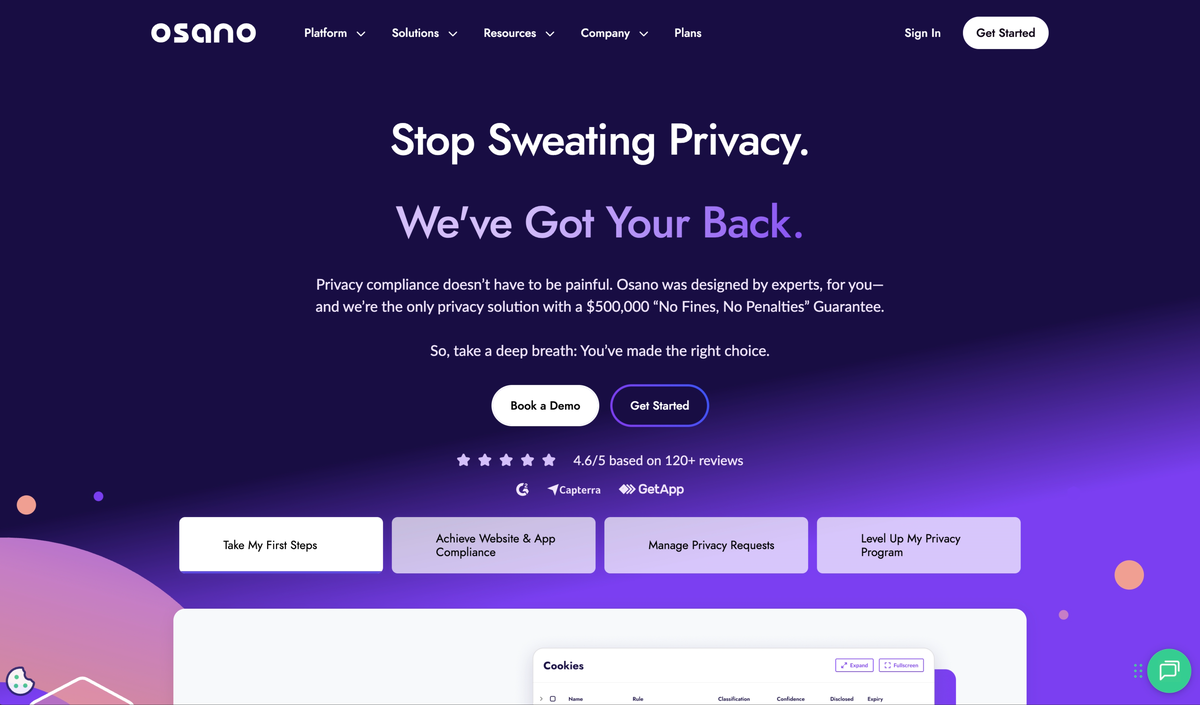
If you’re looking for a balanced solution for organizations that are just starting to build a privacy program or are looking to expand an existing program, Osano makes data privacy management accessible without sacrificing compliance depth. This intuitive platform offers everything you need for privacy management, including:
- Cookie consent management
- Consent and preference management
- Data mapping
- Subject rights management
- Vendor risk management
Osano also provides value-add services other privacy management software solutions lack. This includes its Audit Defense service, where Osano experts will guide you through the response process should your organization receive a notice from a regulator, and on-demand privacy consultations, where you can run aspects of your privacy program past a privacy pro at Osano.
Ease of use and ease of compliance are Osano’s standout qualities. Its consent management, for example, can be stood up with a single line of JavaScript, ensuring you comply with cookie consent regulations faster, and it even comes with pre-built integrations for an easier setup. Unlike larger, more complex solutions, Osano’s products all work together seamlessly for a cohesive user experience. The best part is, it offers transparent pricing—you can customize your package and pay only for what you need.
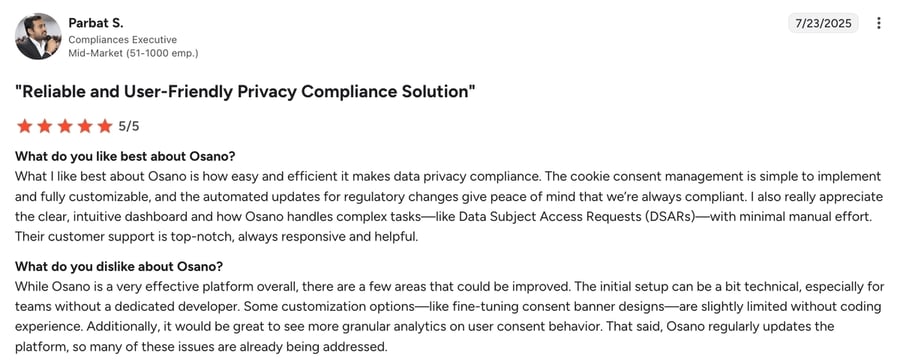
Osano also scales effortlessly, making it just as perfect for a team of one as it is for large global companies. Speaking of international businesses, it enables cookie consent in line with privacy regulations like the GDPR and the CCPA, supporting compliance with over 95 regulations, over 50 countries, and in more than 42 languages.
It even gives customers a “No Fines, No Penalties,” Guarantee–Osano promises to pay up to $500,000 of any penalties that arise as a result of using its platform. This is an example of a broader consumer-first attitude; Osano was the first privacy vendor to also get certified as a B-Corp, and customers regularly report its support is best in class.
OneTrust
Best For: Large to Enterprise Businesses with Complex Privacy Compliance Needs
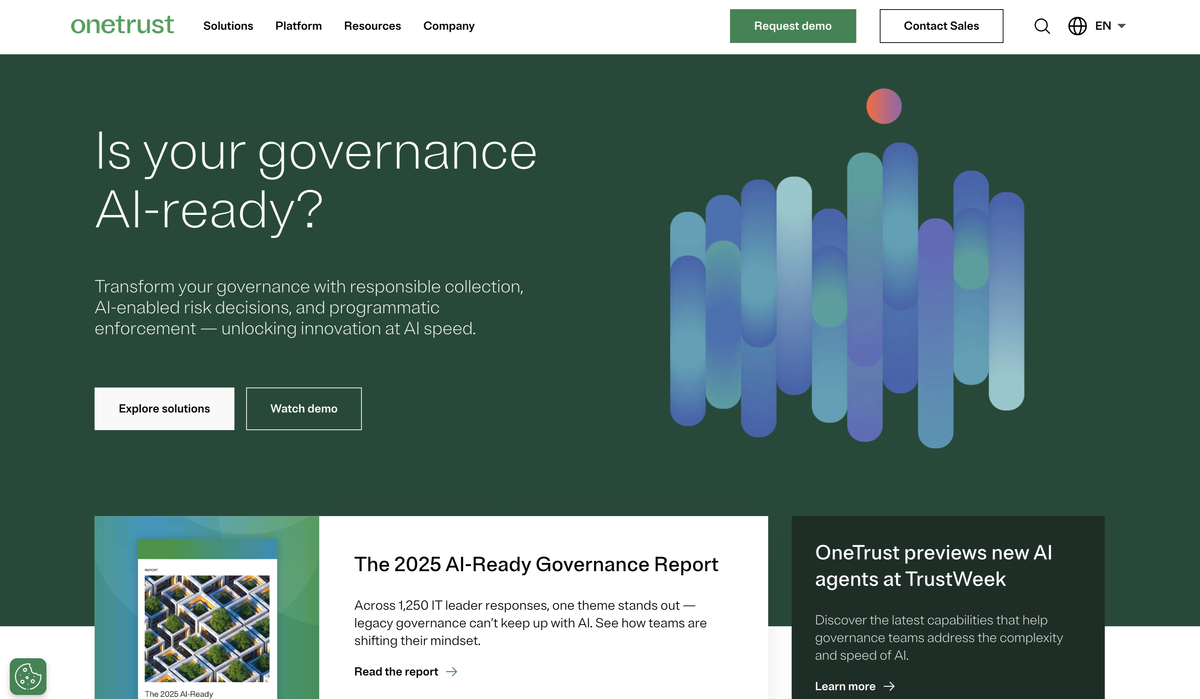
This is likely the name you’ve heard most often in conversations about data privacy management software. OneTrust offers a comprehensive, modular platform for data privacy, security, and governance.
It helps large enterprise maintain data privacy with features like:
- Data mapping and inventory
- Consent and preference management
- DSAR and rights fulfillment workflows
- Privacy impact assessment tools
- Third-party risk management
If you’re a large, global organization with complex compliance needs, this is a great choice. It even integrates easily with other popular business solutions.
However, if you’re not a massive operation with the budget and technical resources required to fully implement and maintain it? OneTrust might be a bit too expensive and complicated for you. Poor-fit OneTrust customers often bemoan the lack of support and erratic pricing structure with high renewal costs. Furthermore, the flexibility and wide scope of OneTrust can mean that businesses without privacy and privacy tech experts on staff can customize themselves out of compliance or set up the software in an incomplete and non-compliant fashion.
Large enterprises can weather these swings in prices and have the resources to bring in OneTrust consultant firms to help implement and maintain the software, but for everyone else, it’s not ideal.
TrustArc
Best For: Enterprises That Want Regulatory Credibility with Tried-and-Tested Software
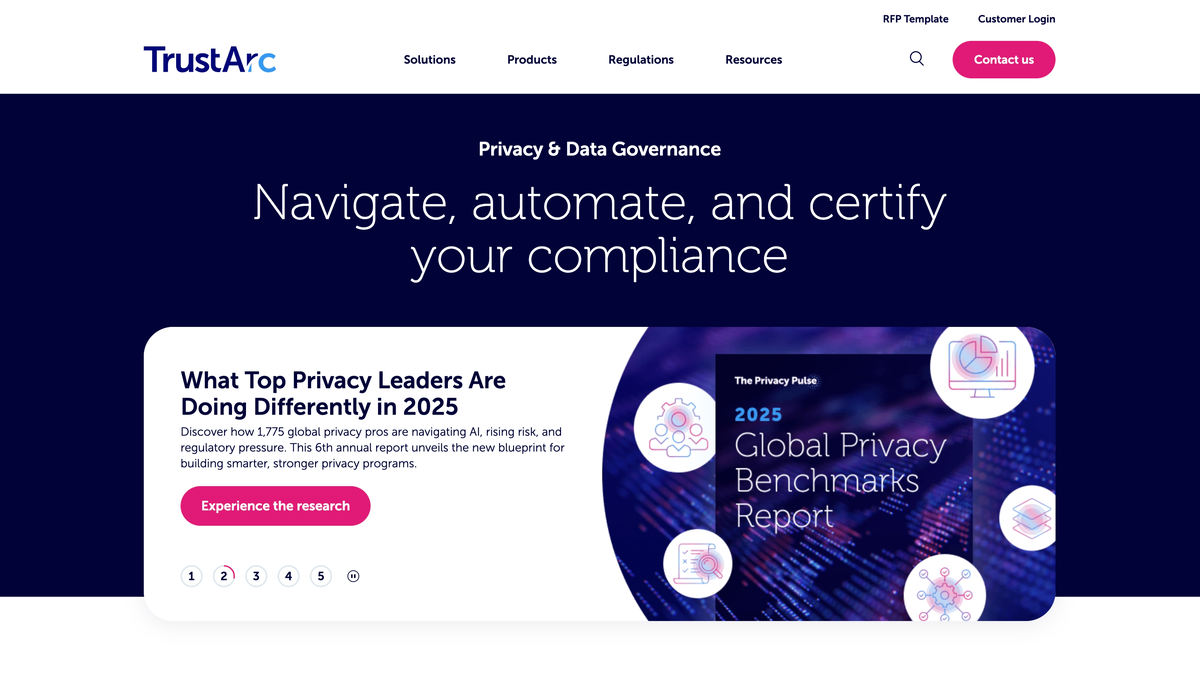
If you’re looking for a reliable product that has stood the test of time, TrustArc is your privacy management solution. It’s been in the market for decades and has built a reputation for strong regulatory compliance.
Since it’s been operating for so long, adapting to evolving regulatory requirements is already a core part of its repertoire. Its features include:
- Global regulatory coverage
- Automated privacy assessments
- DSAR fulfillment workflows
- Cookie and consent management
- Privacy program benchmarking
However, it’s not perfect. Some people find its pricing a bit too high. Others consider its interface less intuitive than other modern options. Often, TrustArc customers need additional support to make basic changes to their configuration that other solutions let you make in-app. It also lacks some quality-of-life features, offering fewer options for DSAR identity verification, no live previews for consent banners, and the like.
BigID
Best For: Enterprises That Need Better Visibility in Complex Data Environments
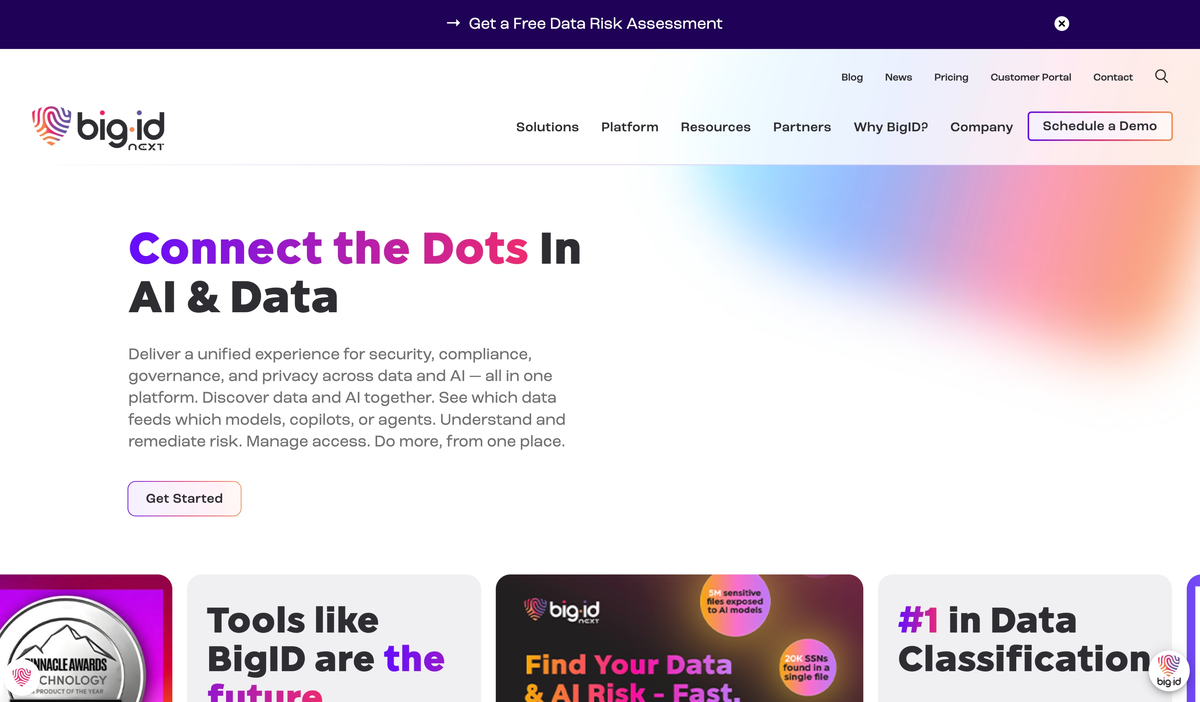
To implement a strong privacy framework, you must first know where your personal data resides. It needs to be mapped and classified. For large enterprises with complex IT infrastructure, monitoring data flow and storage can be difficult.
If you’re nodding your head, BigID might be a good fit for you. It is a data discovery tool that also helps classify sensitive information across systems, providing a strong technical foundation.
Its mapping and discovery features work equally well for business assets stored on-premises, in the cloud, or in hybrid environments. The platform offers:
- Automated data discovery and classification across structured and unstructured systems
- Sensitive data classification
- DSAR automation
- Policy enforcement
- Integrations with major data warehouses and cloud services
However, its greatest strength is also its weakness. It's excellent if you need to manage data discovery and governance, but, as a result, it doesn’t focus quite as much on end-to-end data privacy compliance.
DataGrail
Best For: Subject Rights Requests for Mid-Sized Businesses
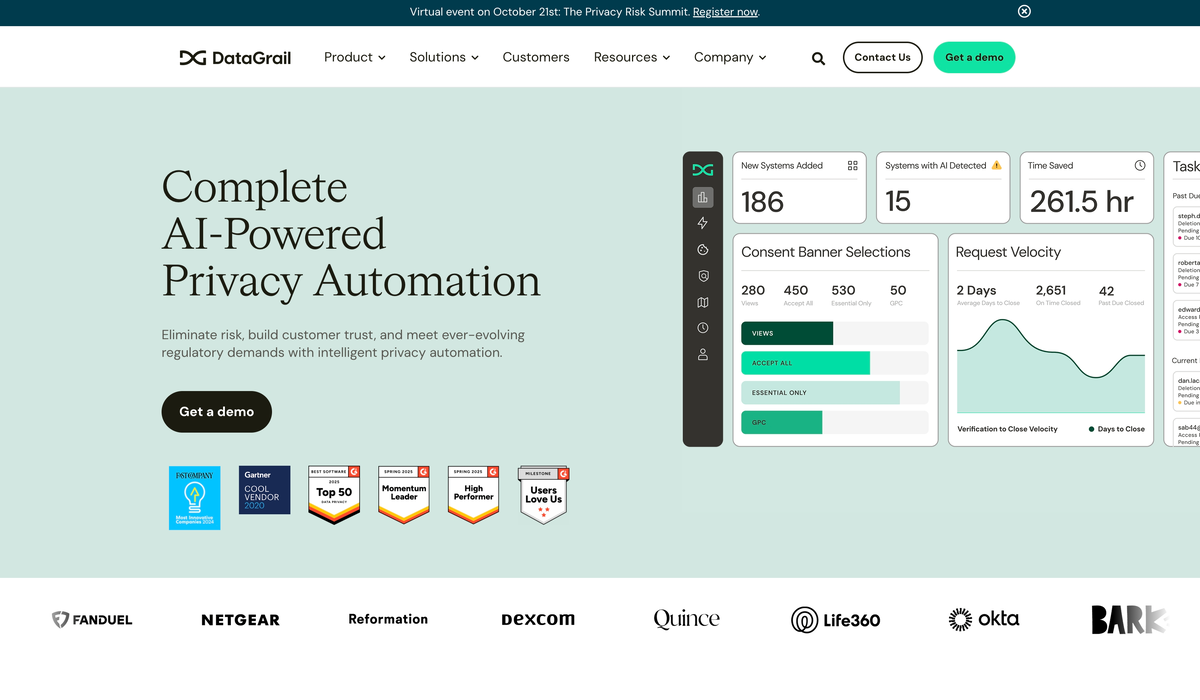
Like BigID, DataGrail has a narrow focus. It helps businesses automate data subject rights management and maintain transparency with customers. It might not be as comprehensive as some of the other solutions in this list. However, it is simple, straightforward, and effective at what it does.
If your organization handles a high volume of DSARs, this is the perfect tool—efficient and easy to use. It offers:
- Automated DSAR workflows
- Identity verification for data requests
- Consent preference management
- Real-time data discovery across connected systems
While DataGrail offers consent management in addition to its DSAR offerings, this feature has some surprising shortcomings for data privacy management software, such as not being a Google-certified CMP Partner.
Again, this means DataGrail might not be suitable for those who need more than just DSARs. But if you’re a small- or medium-sized business looking for an affordable solution to streamline data subject requests, this will do the job. Learn more about DataGrail alternatives here.
Securiti
Best For: A Single Solution for Multiple Aspects of Data Governance
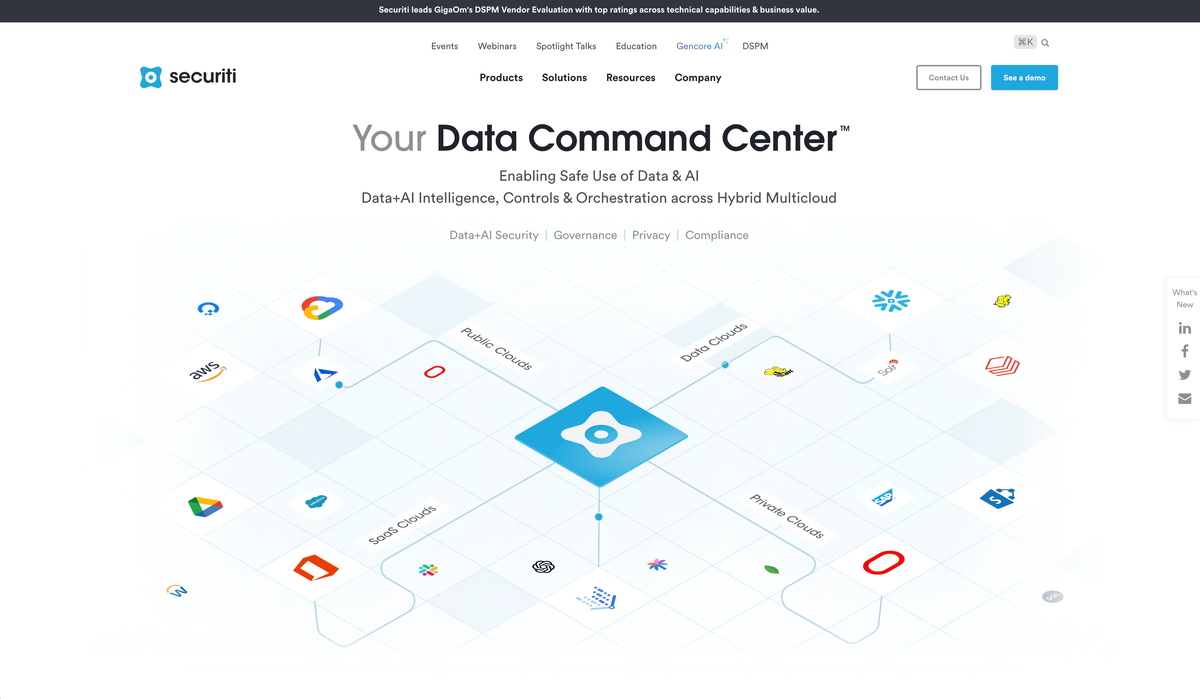
This “PrivacyOps” platform unifies privacy, security, governance, and compliance into one solution. Traditionally, these functions were handled separately, but by removing these silos, Securiti helps organizations reduce gaps in their processes. As such, it helps to align privacy and security more effectively.
Unlike BigID and DataGrail, which focus on one aspect of privacy and excel at it, Securiti offers an all-in-one approach to privacy compliance. Its key features include:
- DSAR and consent automation
- Data mapping and classification
- Vendor and third-party risk management
- AI-driven risk assessments
- Unified governance dashboards
However, it’s still a relatively new player. Although it is growing in popularity, the partner ecosystem is relatively smaller, and it has fewer case studies than long-established vendors like OneTrust or TrustArc.
Enzuzo
Best For: Startups and Small Businesses Looking for Affordability and Ease of Use
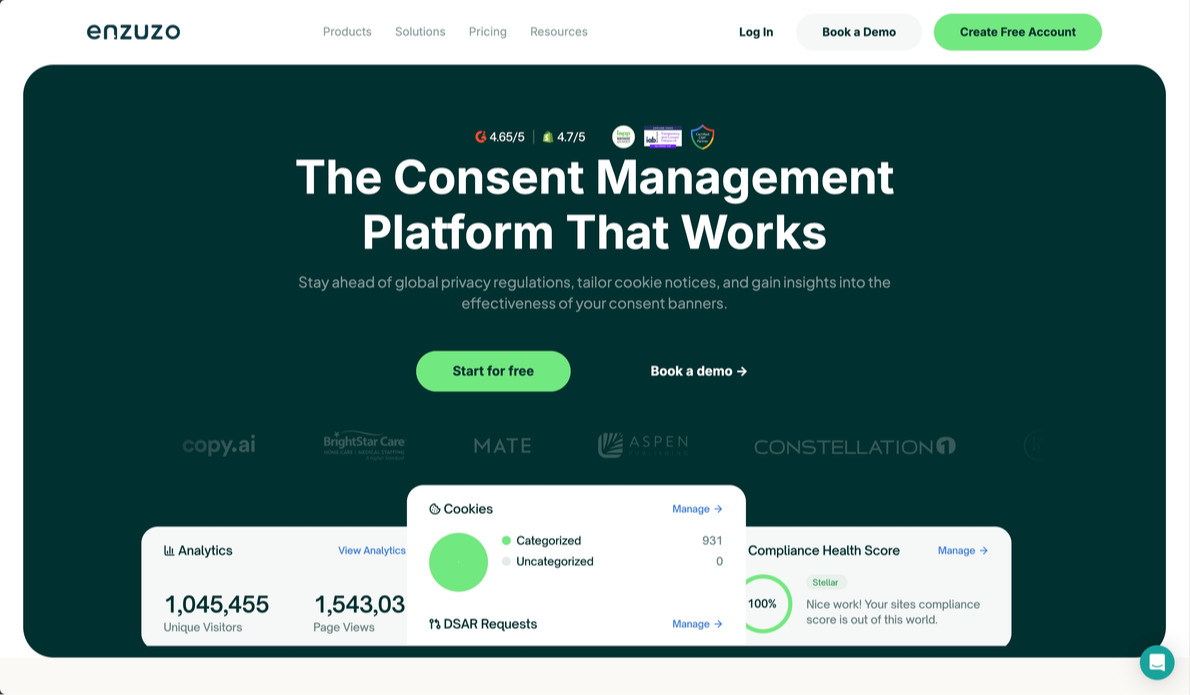
This is an emerging privacy platform that prioritizes simplicity and affordability. While not as feature-rich as the big players, Enzuzo is an attractive option for small businesses and startups beginning their privacy journey.
It is fairly affordable, easy to use, and quick to deploy, offering features like:
- Website privacy and cookie policy generation
- Consent and preference management
- DSAR fulfillment
- Basic vendor management
Of course, what makes it perfect for smaller businesses is exactly why it’s not suitable for larger organizations. It doesn’t have as many features and has limited analytics and governance capabilities.
Data Privacy Management Software Comparison
|
Feature / Platform |
Osano |
OneTrust |
TrustArc |
BigID |
Securiti |
DataGrail |
Enzuzo |
|
Consent & Preference Management |
Easy, global coverage |
Comprehensive |
Yes |
Limited |
Yes |
Yes |
Basic |
|
DSAR Automation |
Streamlined |
Advanced |
Yes |
Yes |
Yes |
Strong focus |
Basic |
|
Data Mapping & Discovery |
Robust for most organizations |
Advanced |
Yes |
Strongest feature |
Yes |
Limited |
Limited |
|
Vendor Risk Management |
Real-time monitoring and alerts |
Extensive (via third-party software integration) |
Basic |
Limited |
Yes |
Limited |
Limited |
|
Ease of Use |
Very easy |
Complex for smaller teams |
Moderate learning curve |
Technical focus |
Fairly intuitive |
Simple |
Very easy |
|
Pricing |
Affordable, transparent, scalable |
Enterprise-level (high) |
Higher range |
Enterprise-level (high) |
Mid to high |
Mid-range |
Affordable |
|
Best For |
Orgs of all sizes seeking balance & ease |
Large, global enterprises |
Enterprises with strict needs |
Enterprises with complex data environments |
Orgs wanting privacy, security & governance |
Mid-sized companies (DSARs) |
Startups & small businesses |
Ready to take the next step in the evaluation process? Find out how Osano can help your organization and book a demo today.
Building the Business Case for Privacy
Know you need a privacy solution, but need to secure buy-in first? Check out our guide on how you can build the business case for data privacy software.
Download Your Copy