.svg)


.svg)
.svg)
.svg)
.svg)
.webp?width=1220&height=1090&name=Osano-guarantee-seal%20(1).webp)
OneTrust is a data privacy, security, and governance platform. It’s a broad tool that helps organizations comply with privacy regulations and build customer trust.
So, why would you need to look at OneTrust competitors?
Since OneTrust has been in the market for a long time, customers often default to it. By doing so, they miss out on other options that suit them better or are, in fact, better.
The thing is, while some might need the full suite of services, sometimes, what you need is just a specialist data privacy solution. And, if a product offers privacy, security, and governance, is it the best in the market for all three? Or, does it just offer a good spread across different areas of data privacy and compliance?
Yes, it offers a range of services, but is it as privacy-focused or streamlined as you want?
Is it really the best choice for your business?
Comparing OneTrust alternatives will allow you to make an informed choice. It will help your business identify a product that better matches your company’s needs, budget, resources, and scale.
Of course, to do that, you’ll need to know what you want from your data privacy management solution.
What Features to Look For in a OneTrust Alternative
The features you’d look for in your OneTrust alternative would depend on what your business needs.
If you’re a small-to-medium enterprise (SME), your priority might be affordability. You might want something that’s easy for non-technical users to use.
Or even looking for features that will make it possible for smaller privacy teams (we see you, team of one) to handle the growing volume of work in privacy compliance.
Based on what you do, you might just require essential compliance features, like cookie consent or automation, to streamline your processes.
On the other hand, as a larger enterprise or one in a regulated field, you might prioritize third-party risk management, AI governance, or heavy customizations for your data management needs.
Of course, certain features are essential for comprehensive privacy risk management.
Let’s take a look at them.
Essential Features for a OneTrust Alternative
Compliance Coverage
If you’re a business that uses and stores customer data, you must protect it according to appropriate legal and regulatory requirements.
However, these laws change as technologies evolve and needs change. It can be helpful to have a data privacy management solution that can help you keep up with these changes.
You’d want a privacy management solution that gives you comprehensive coverage for various data protection regulations, such as GDPR, CPRA, and LGPD.
The platform should adapt to regulatory changes and guide you on maintaining compliance across jurisdictions.
Why It Matters: A solution that covers a wide range of privacy laws is critical to reducing the risk of non-compliance, avoiding costly fines, and losing customer trust.
Consent Management
Customer data and preferences cannot be saved without them agreeing explicitly. Not getting their approval before you collect their personal information can lead to fines.
Managing user consent for data collection is a core function of any data privacy tool. Look for a solution that offers flexible and customizable consent banners.
It should also be very easy to use and integrate with your website or app to capture, store, and track consent in compliance with local and international regulations.
Solutions like Osano make it easier for businesses to comply with privacy laws.
Why It Matters: Users want their privacy, and you should be able to prove that you have the required data privacy policies to build trust with them. Effective consent management helps your business comply with laws and it communicates to your customers that they have control over their personal information.
Privacy Impact Assessments and Risk Analysis
In addition to getting user consent before collecting data, you must also make sure that the data is gathered, stored, used, and maintained responsibly.
As you adopt newer technologies or change business operations, you should also evaluate your privacy and data practices.
As part of proactive privacy management, many businesses conduct privacy impact assessments (PIAs) and risk analyses to evaluate how they collect and process personal data.
Advanced tools should facilitate these assessments, with templates and automated risk analysis features to streamline the process.
Why It Matters: PIAs and risk assessments help identify potential privacy issues before they become problems, enabling businesses to implement safeguards and reduce the risk of regulatory penalties or reputational damage.
Data Mapping
It’s quite difficult to keep your data protected if you don’t know where it resides. Data mapping tracks where personal data is stored and how it flows through your systems. It keeps you in control of sensitive data.
Your privacy management solution should automate data discovery, classification, and visualization. That will make it easier for you to manage risk, handle subject rights requests, and meet compliance obligations.
Why It Matters: Understanding where personal data resides helps minimize risk even when your data environment is complex. It also allows you to respond efficiently to data subject access requests (DSARs).
Data Subject Rights Management
Customers have the right to know what personal information a business has saved and if it is correct. They also have the right to revoke the consent to store and use their data.
Privacy regulations require that your business respond to individuals' requests to access, rectify, or delete their personal data in accordance with data privacy laws.
To give timely and compliant responses, your solution should automate and simplify DSAR processing. Automation reduces the amount of manual labor for your employees. It also improves the accuracy of responses and speeds the turn-around time for an individual’s request.
Why It Matters: Managing DSARs can be resource-intensive, especially if your business works with large data sets. Automating this process can help you meet regulatory compliance while reducing administrative burden.
Scalability and Flexibility
Any business, no matter how small, expects to grow. The problem is that as you grow, you also see a corresponding increase in the data volumes that your business handles.
At the same time, you must also be able to quickly adapt to any new data privacy regulations.
Therefore, your alternative to OneTrust should be able to accommodate business growth and changing privacy needs.
The solution should offer flexibility enough to meet evolving data protection requirements and integrate seamlessly with existing systems.
Why It Matters: Your privacy management needs will likely grow as your business expands. A scalable solution gives you long-term viability and reduces the need for future platform changes.
In addition to these essential features, you may also want certain advanced features, such as:
Customizability and Workflow Automation
Every organization has unique privacy management workflows that may include repetitive tasks, such as processing consent updates or DSARs.
These tasks are time-consuming, and using people to do them might not be the best use of your company’s resources, especially when considering the efficiency of a data privacy management platform.
Advanced solutions should offer customization options that allow your business to automate such tasks and tailor workflows to your specific operational requirements.
Why It Matters: Automating privacy processes reduces manual work, while customization allows you to fine-tune the solution to fit your specific needs. Together, they enhance accuracy and efficiency while freeing up resources for higher-value tasks.
API and Integration Capabilities
For seamless data privacy management across your organization's tech stack, it’s important to choose a solution with robust API and integration capabilities.
This allows the platform to connect with your existing systems—such as CRM, cloud storage, or marketing platforms—so that data privacy is maintained across all touchpoints.
Why It Matters: Integrating privacy management into your broader infrastructure makes it simpler to manage data across multiple platforms. It helps you maintain compliance at all times, even as your data flows across different systems.
Top OneTrust Competitors
Now that you know the essential and advanced features to look for in a data privacy management solution, let’s take a look at some of the most popular alternatives to OneTrust.
Osano vs. OneTrust
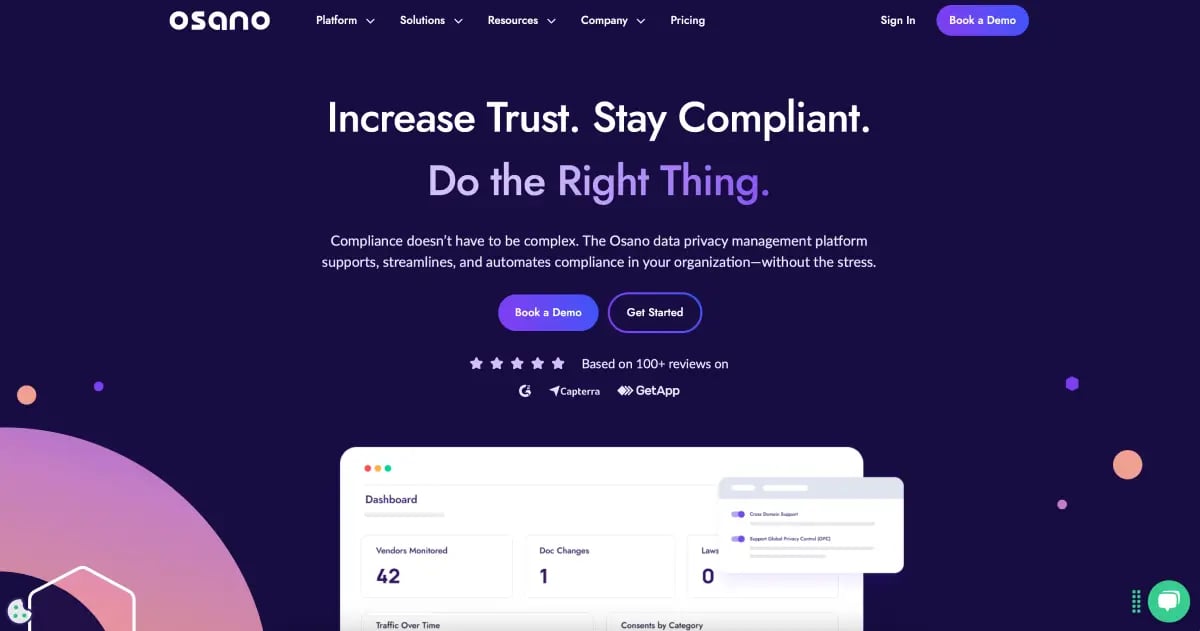
Osano is a more focused alternative to OneTrust. It's built with small and midsize teams in mind, and it covers the privacy essentials without the complexity or cost that often comes with a platform like OneTrust.
Osano is affordable, easy to use, and built around customer support. You get cookie consent management, data subject rights processing, automated data mapping, and vendor risk assessments in one streamlined product, without the extra modules and add-ons that come with a full OneTrust deployment.
OneTrust's site scans run on a schedule, and only once every month at most. Osano's script checks for new cookies and trackers every time a real visitor loads your page, so you find out what's actually running on your site before a regulator or a customer does.
Osano is also easier to get running. Deployment takes a single line of code, and a single-domain cookie banner can go live in days. That matters if you don't have a large, dedicated privacy team to manage a longer rollout.
Osano customers get a named contact instead of a ticket queue. On G2, Osano scores 4.5 out of 5 across 172 reviews, just ahead of OneTrust Privacy Automation's 4.3 across 154 reviews, with ease of use and support cited most often.
Osano also backs its compliance tools with a $500,000 No Fines, No Penalties guarantee, something OneTrust doesn't offer.
SMEs that want a simpler, more cost-effective solution without sacrificing core privacy management features will find Osano the perfect fit as a data privacy platform.
Still unsure about choosing Osano? Read how Osano compares with other providers such as DataGrail.

Ketch vs. OneTrust
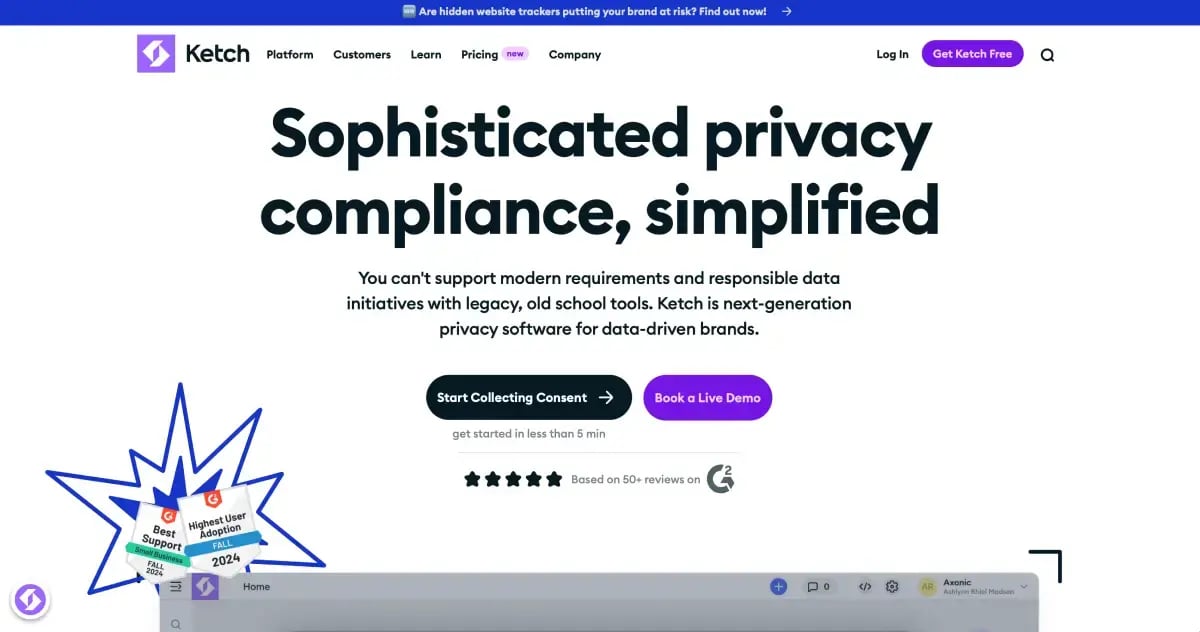
Ketch is a strong alternative to OneTrust for businesses that need an efficient, scalable solution for managing data privacy. It automates privacy compliance across various jurisdictions and helps businesses incorporate privacy in their operations with minimal manual effort, fulfilling compliance requirements effectively.
The product offers features like automated consent management and policy enforcement. It’s a flexible platform with strong support for data mapping and subject rights management, much like OneTrust, making it one of the top alternatives for data privacy compliance.
Its interface is much simpler than that of OneTrust, which is helpful if your IT is smaller or doesn’t have highly specialized technical expertise.
Its pricing is affordable compared to OneTrust's pricing structure, which is more suited to larger enterprises with bigger budgets.
Ketch might be good for you if you need automated compliance with a focus on scalability but without the full suite of complex features that OneTrust offers.
BigID vs. OneTrust
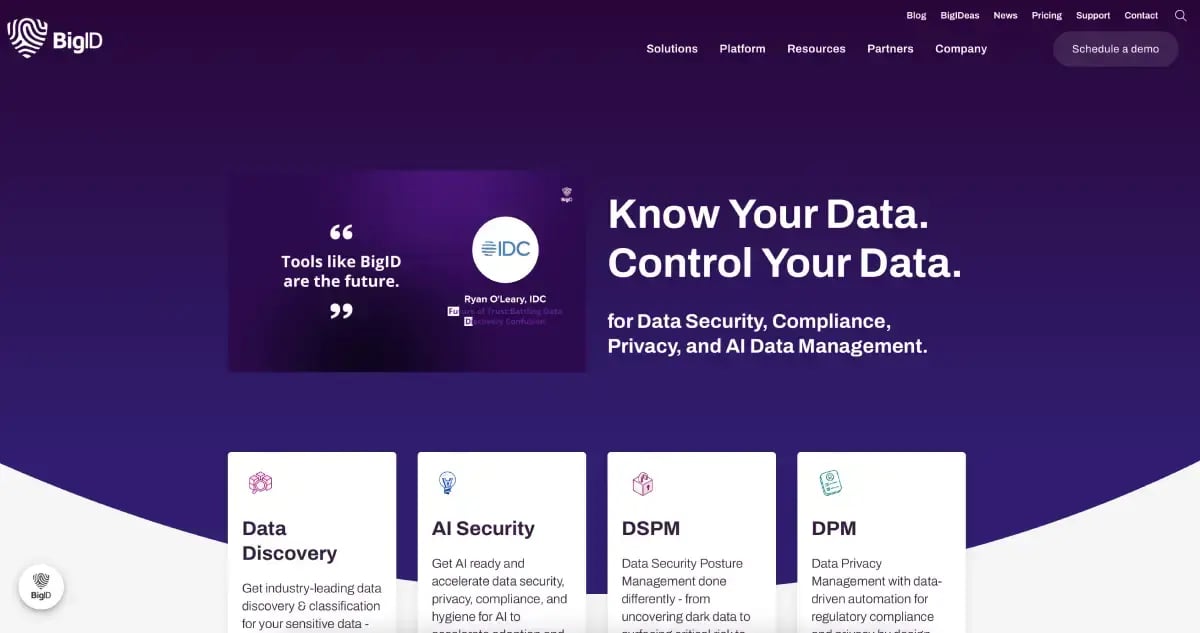
BigID is known for its cutting-edge approach to data discovery and privacy governance, making it a leader in privacy management software. Unlike OneTrust, which is a more general platform, this data governance platform uses machine learning to map, classify, and manage data across complex environments, making it especially appealing to organizations with advanced needs.
This platform excels in data discovery and privacy governance, using AI-driven technology to find and classify personal data across structured and unstructured data sources.
Businesses with vast amounts of data and complex data landscapes might find its machine-learning-powered tools ideal.
Its pricing is in line with its enterprise focus, which makes it more suitable for larger companies that need advanced governance tools.
OneTrust provides a broader set of compliance features but may not offer the depth in data governance that BigID does. If you need deep data discovery and classification across a vast business, this might be better for you than OneTrust.
CookiePro vs. OneTrust
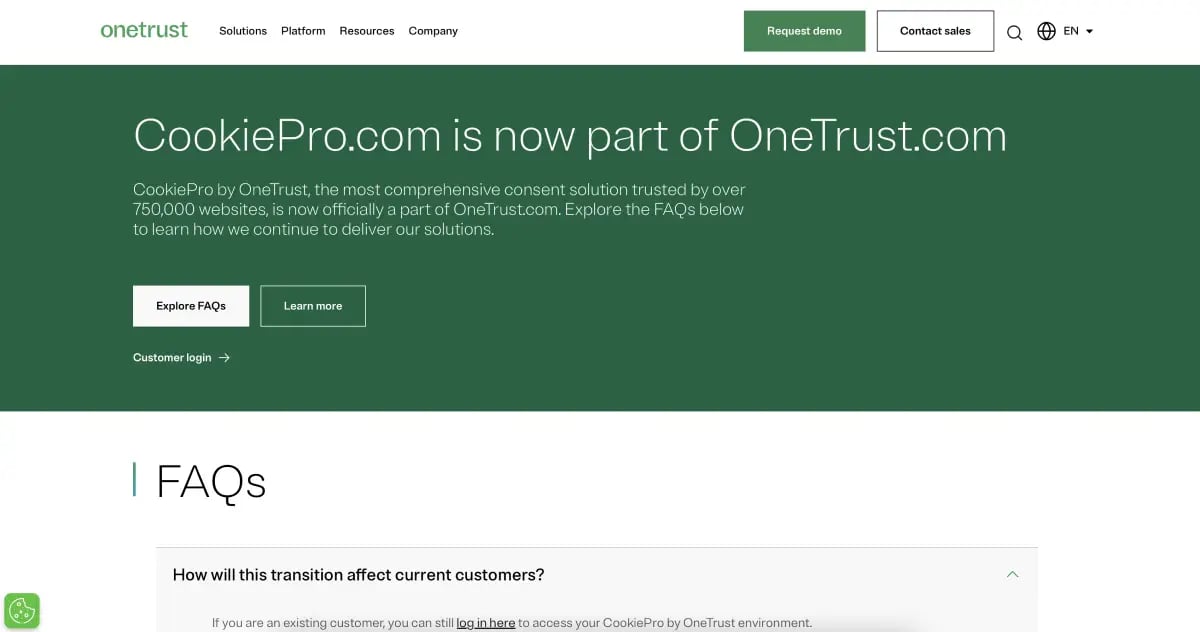
CookiePro is a OneTrust product explicitly designed to manage cookie consent. If your priority is web compliance, especially regarding cookies and tracking, it provides a streamlined, easy-to-implement solution.
Since its focus is on cookie consent and compliance, it’s simpler and more focused than the full OneTrust product suite. It provides tools to create customizable banners and manage user preferences in line with global regulations.
As a more niche tool, it’s more cost-effective than OneTrust's full suite, which has more features than necessary for businesses focused solely on consent management.
It’s ideal if you only need a specialized consent solution rather than a broader privacy platform.
DataGrail vs. OneTrust
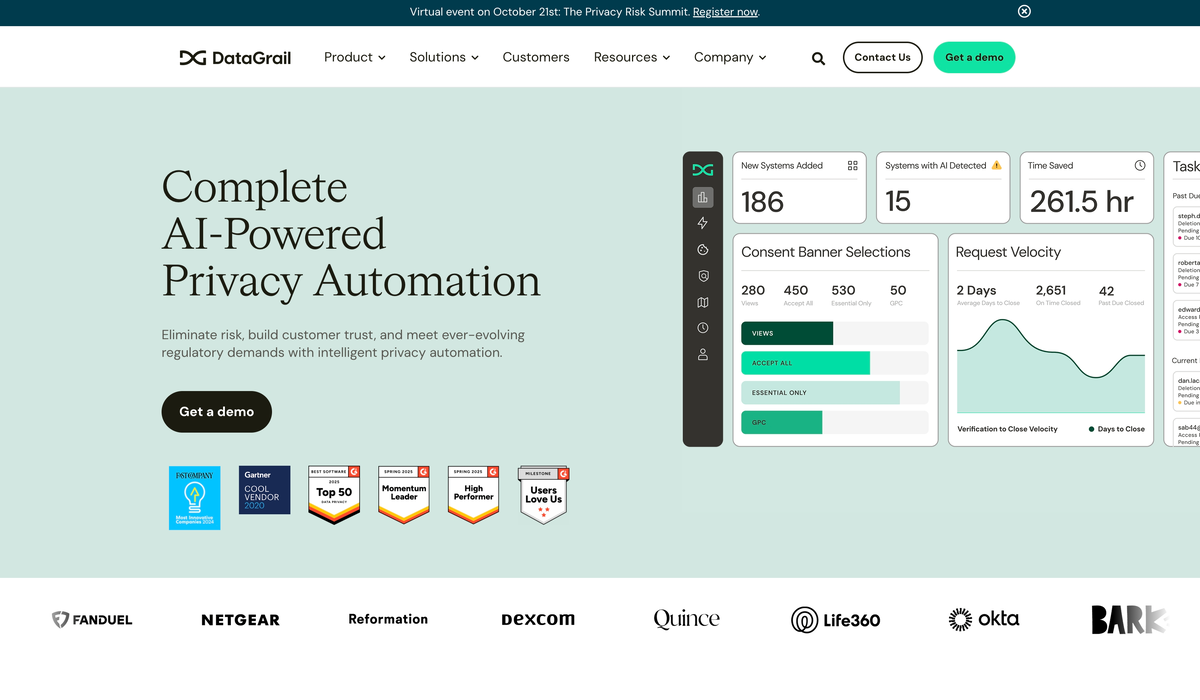
DataGrail is a data privacy platform built around integrations. Rather than asking you to migrate into one system, it connects directly to the tools you already use for data mapping, consent, and subject rights requests.
This integration-first design is DataGrail's main differentiator from OneTrust. Data mapping updates as your stack changes, instead of relying on the periodic manual mapping many OneTrust deployments require.
DataGrail is often positioned around the breadth of its integrations, which makes it a stronger fit for teams with a lot of existing point solutions to connect rather than teams starting from scratch.
If your privacy program depends heavily on connecting to tools you already run, DataGrail's integration depth may be a better match than OneTrust's broader, more manual platform.
Cookiebot vs. OneTrust
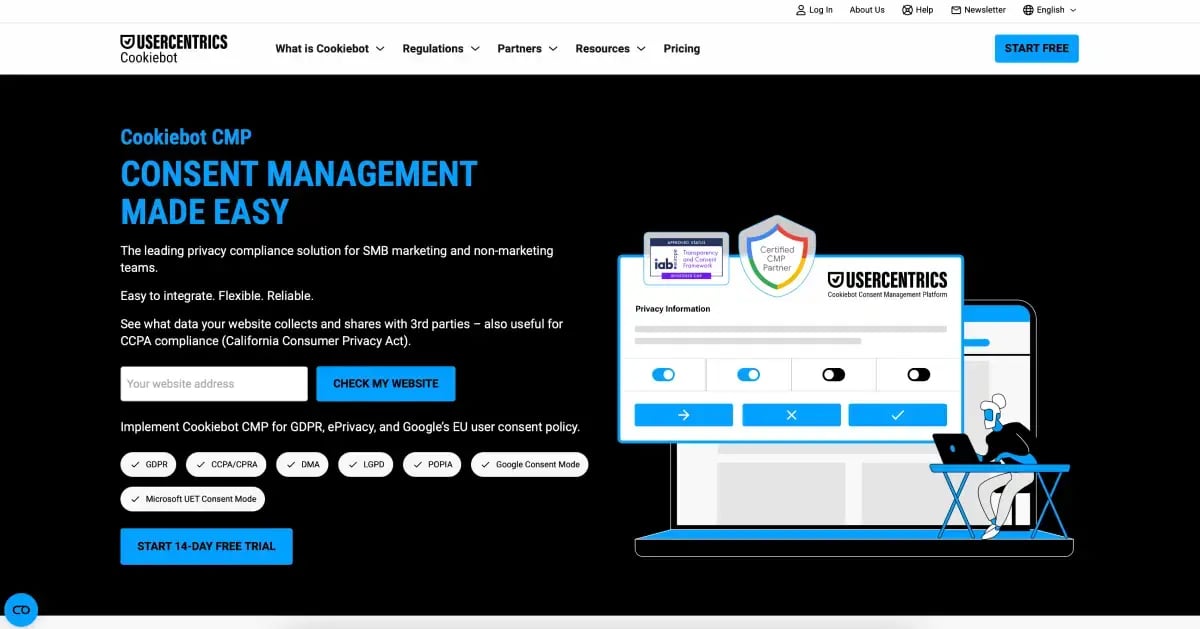
Cookiebot, like CookiePro, is focused on consent management. It's simple and easy to integrate with websites, making it suitable for smaller businesses or organizations that need an easy-to-deploy consent management tool, where OneTrust's broader platform may be overkill.
It is a straightforward solution for consent management, with user-friendly tools to manage cookies in compliance with global laws. Since it’s easy to integrate, you need minimal technical expertise.
Its simplicity also means its cost is lower, so if you don’t need the full capabilities of OneTrust’s more extensive (and expensive) platform, this is the tool for you.
TrustArc vs. OneTrust
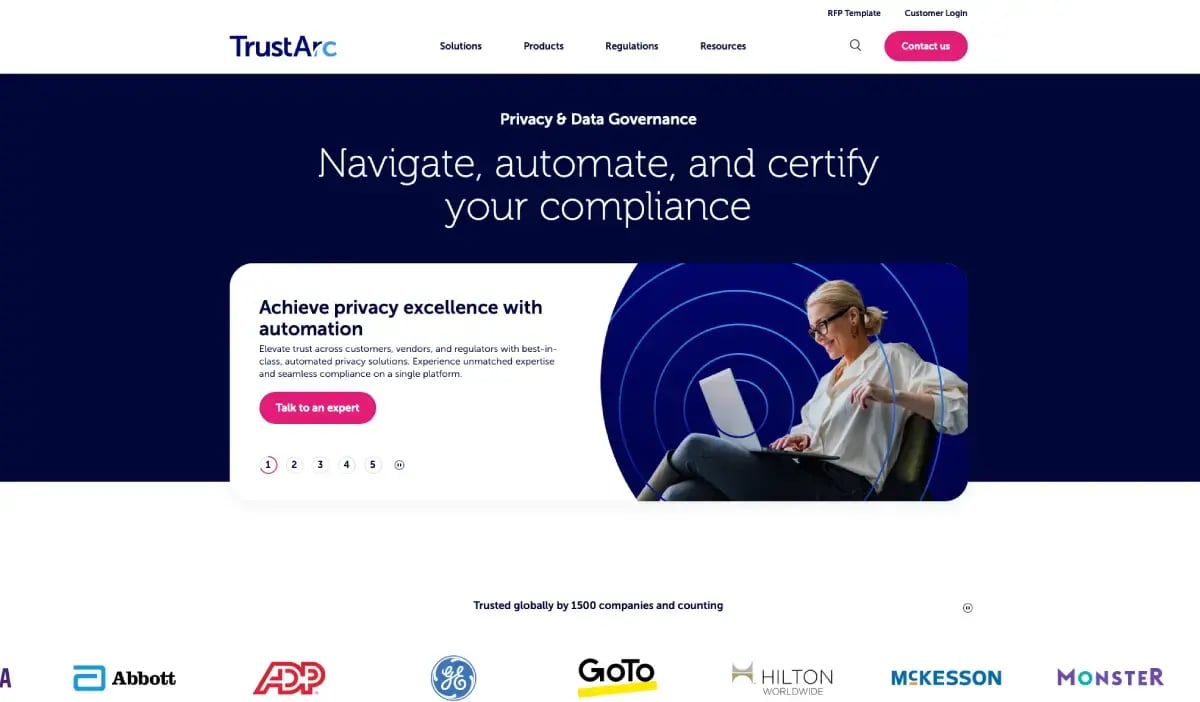
TrustArc is often considered one of OneTrust’s closest competitors. Both platforms offer comprehensive privacy solutions, but TrustArc is particularly well-regarded for its depth in serving complex enterprise needs.
It helps large, sprawling businesses manage data privacy and focuses strongly on data governance, risk assessments, and third-party vendor management.
Although highly customizable, TrustArc is often considered more suitable for larger multinational businesses, with additional emphasis on large-scale implementations and industry-specific compliance needs.
TrustArc’s pricing is comparable to OneTrust since it’s aimed at large businesses that require a full-featured privacy management solution.
Large enterprises that need a fully configurable, enterprise-grade privacy management system will find TrustArc to be a strong alternative to OneTrust.
Termly vs. OneTrust
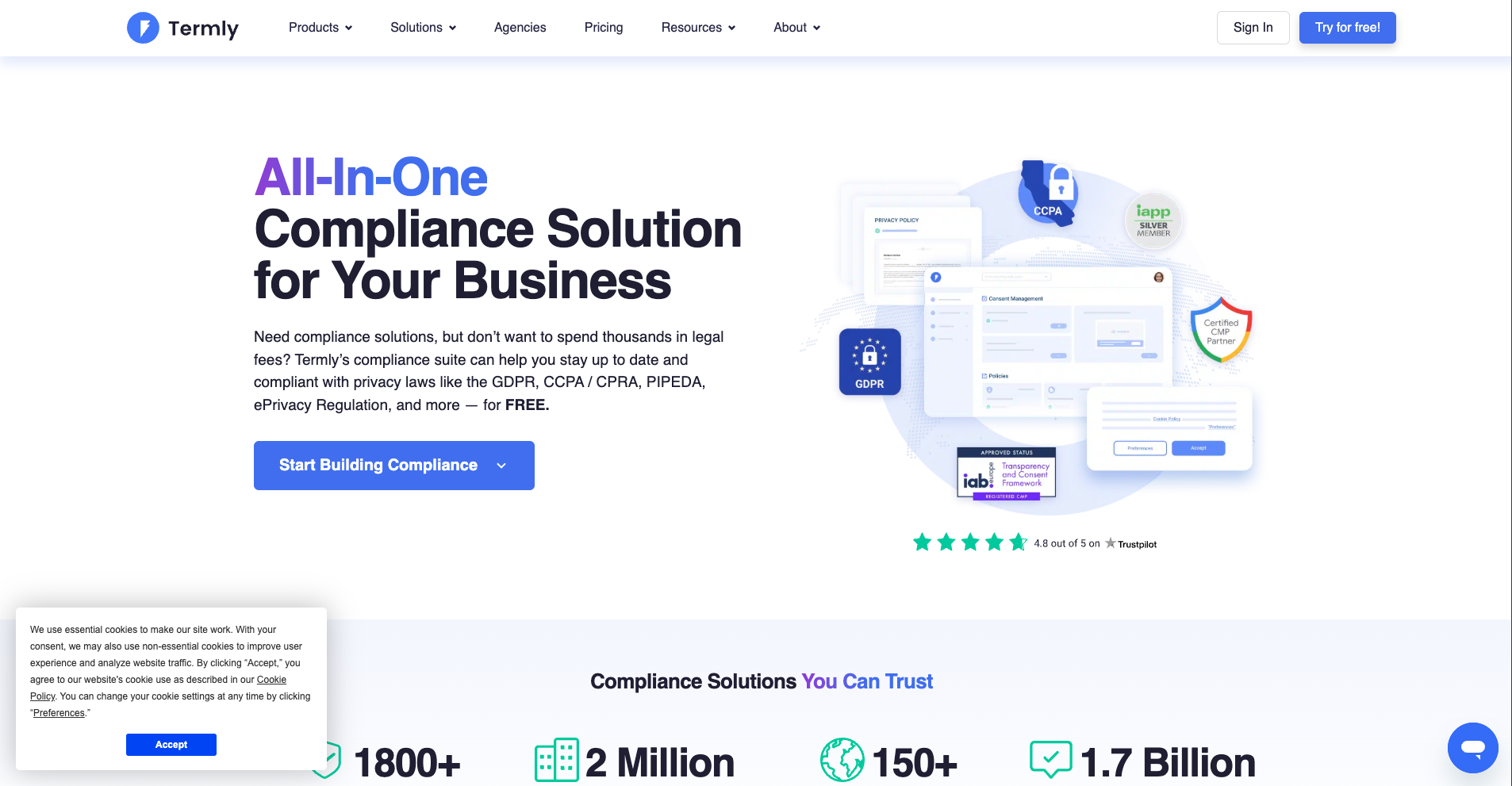
Termly offers policy generation and cookie consent management aimed at small businesses and solo site owners, at a lower price point than OneTrust's enterprise-oriented plans.
It includes templates for privacy policies, terms of service, and cookie banners, along with basic consent tracking, covering the essentials many small sites need without a lengthy setup process.
Because it's built for simpler use cases, Termly takes more manual work to keep current as regulations change across jurisdictions, compared to platforms built around continuous monitoring.
Termly is a reasonable starting point if you're a small business that needs basic policy and cookie consent coverage and doesn't yet need the depth OneTrust offers.
Didomi vs. OneTrust
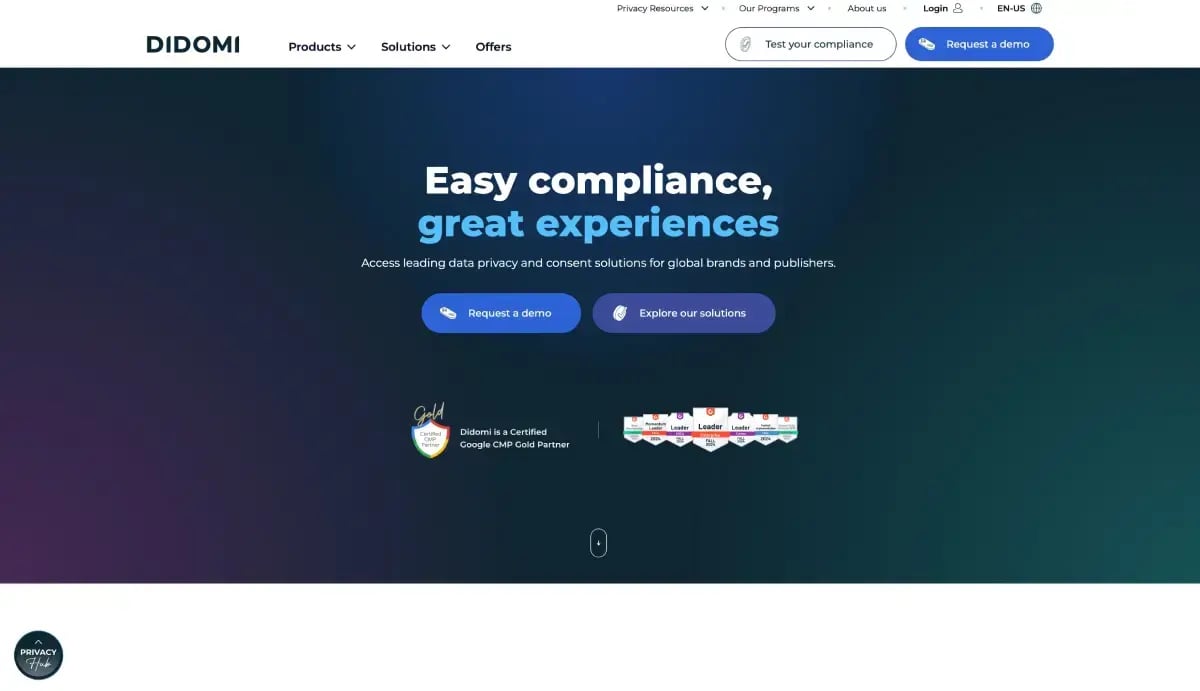
Didomi specializes in consent management and customer experience personalization. It manages user consent and preferences across different platforms.
The tool has a simple and intuitive interface. It’s quick to deploy, and helps you manage consent across your digital properties.
It builds trust with customers by offering them personalized privacy options.
OneTrust, while more detailed, may not offer the same focus on user preferences and experience personalization.
Didomi is also lower priced than OneTrust, so if you’re mainly interested in consent and preference management, it’s a better option for you.
Why Choose Osano as Your OneTrust Alternative?
The main reason why you’d choose Osano over OneTrust is its focus.
OneTrust offers a broad range of data privacy, governance, and protection services.
On the other hand, Osano specializes in data privacy. If your priority is managing privacy compliance without the help of an army of consultants and a computer science degree, this is the tool for you.
Osano’s platform makes managing consent, data subject rights, privacy risk, and privacy regulations easy. It's especially ideal for SMEs seeking affordable and easy-to-use solutions for managing privacy compliance.
As a B-Corp and public benefit corporation, Osano provides cutting-edge privacy tools, helping businesses align with regulations, build trust, and become the next wave of trusted brands by upholding privacy as a cornerstone of integrity and transparency.
Because OneTrust doesn't have this specific focus, OneTrust customers can be surprised to find out they're not in compliance; OneTrust provides the tooling, but they don't invest a lot in supporting their customers' compliance. OneTrust customers need to take on the burden of configuring and managing their tooling to stay in compliance.
Whether you've got a OneTrust implementation running, another privacy vendor's solution, or no data privacy management solution in place, you can test your compliance with our free Compliance Check tool.
Scan your website for privacy issues here.
FAQ
What's the best OneTrust alternative for a small team?
It depends on how much of OneTrust's platform you actually use. If you mainly need cookie consent and data subject request handling without a dedicated privacy team or a small privacy team, Osano is built for that. If you need broader governance, risk, and third-party management, TrustArc or BigID are closer matches to OneTrust's scope.
Is OneTrust worth it for a small business?
OneTrust's own G2 reviewers cite a steep learning curve and complex setup as common drawbacks, and the platform is generally built for organizations with a dedicated privacy function. Smaller teams often look at more focused, easier-to-deploy tools instead.
What do OneTrust alternatives typically cost?
Pricing varies by vendor and by how many modules you need, and most platforms in this space require talking to sales for a quote. Cookie-consent-only tools tend to cost the least; full privacy platforms cost more.
How is Osano different from OneTrust?
Osano focuses specifically on privacy compliance: consent management, subject rights requests, assessments, and data mapping. OneTrust covers privacy plus broader governance, risk, and compliance work. If you don't need the GRC layer, Osano is the more focused tool.
See Osano in Action
Ready to move on from OneTrust? You're not alone. Book a demo with our team to see how Osano can help simplify your privacy program.
Book a Demo